CCSS.
The Standard
Rewrite simple rational expressions in different forms; write a(x /b(x) in the form q(x) + r(x)/b(x), where a(x), b(x), q(x), and r(x) are polynomials with the degree of r(x) less than the degree of b(x), using inspection, long division, or, for the more complicated examples, a computer algebra system.
Common Core State Standards for Mathematics
Teacher's field guide
What This Standard Means
What Students Need to Do
- Students divide one polynomial by another using inspection, long division, or a computer algebra system for harder examples. They express the result as a polynomial plus a remainder fraction and keep any excluded input values.
What Mastery Looks Like
- A student arranges terms by descending powers, inserts zero placeholders, and completes each subtraction accurately. They check that the divisor times the quotient, plus the remainder, equals the original numerator.
Common Misconceptions
- Students may divide numerator terms by separate parts of the denominator or cancel terms across addition. They may omit zero placeholders, lose a sign during subtraction, or stop before the remainder has lower degree. They may also forget values that make the original denominator zero remain excluded.
How to Assess It
- Give this exit ticket: Rewrite (2x² + 5x + 1)/(x + 2), state any excluded value, and verify the result by multiplication.
Lesson moves
Ways to Teach It
Use algebra tiles to arrange x² + 3x + 2 into a rectangle with width x + 1, then name the quotient.
Ask students to explain why a remainder with degree equal to the divisor means the division is not finished.
Run a card sort matching rational expressions, quotient and remainder forms, and multiplication checks.
Model a rectangular garden with polynomial area and width, then interpret the quotient as length and the remainder as leftover area.
Free download
Printable HSA-APR.D.6 Worksheet
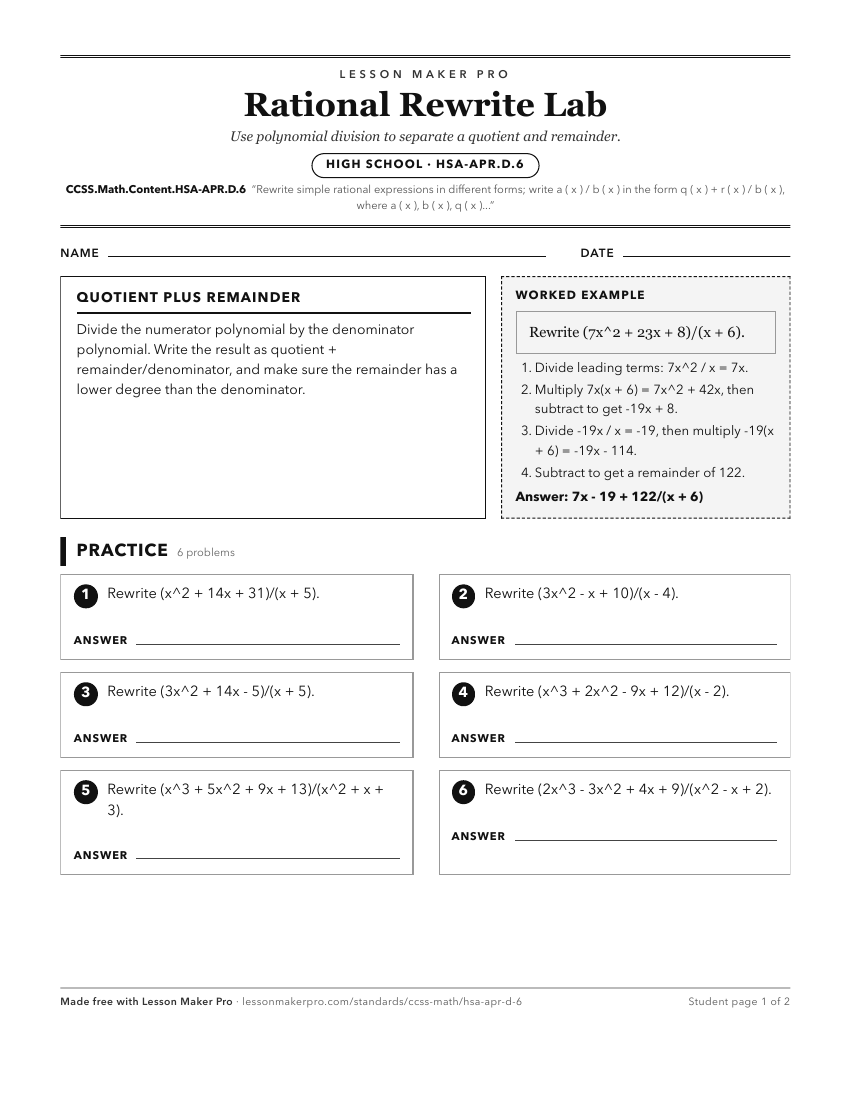
A ready-to-print activity worksheet aligned to CCSS.Math.Content.HSA-APR.D.6, with an answer key for the teacher on its own page. No account needed.
PDF, US Letter, prints cleanly in black and white.
Download the worksheetLearning progression
Where This Standard Sits
Before This Standard
If students are struggling here, check these first.
- CCSS.Math.Content.HSA-APR.A.1
Polynomial division rewrites rational expressions by multiplying and subtracting polynomials while tracking degrees and remainders.
- CCSS.Math.Content.HSA-SSE.A.2
Recognizing expression structure helps students choose division or inspection to rewrite a rational expression as a polynomial plus a remainder fraction.
- CCSS.Math.Content.7.NS.A.2d
Number long division gives the quotient and remainder structure used when rewriting polynomial rational expressions by polynomial division.
What This Unlocks
Mastery here sets students up for these next.
- CCSS.Math.Content.HSA-APR.D.7
Rewriting improper rational expressions with polynomial division supports simplifying operation results and seeing rational expressions behave like fractions.
- CCSS.Math.Content.HSF-IF.C.7d
Rewriting rational expressions by division helps identify quotient end behavior and slant asymptotes when graphing rational functions.
Keep exploring
Related Standards
- CCSS.Math.Content.HSA-APR.D
Rewrite rational expressions
- CCSS.Math.Content.7.EE.B.4a
Solve word problems leading to equations of the form px + q = r and p(x + q) = r, where p, q, and r are specific rational numbers. Solve equations of these form...
- CCSS.Math.Content.HSN-RN.A.2
Rewrite expressions involving radicals and rational exponents using the properties of exponents.
Turn this exact standard into a lesson
Grade, subject, topic, and the complete standard are prefilled. Create one free, no account needed.
Also for this standard:Make a WorksheetMake a QuizMake a Sub Lesson