CCSS.
The Standard
(+) Represent complex numbers on the complex plane in rectangular and polar form (including real and imaginary numbers), and explain why the rectangular and polar forms of a given complex number represent the same number.
Common Core State Standards for Mathematics · The Complex Number System
Teacher's field guide
What This Standard Means
What Students Need to Do
- Students plot a complex number a+bi at (a,b) on the complex plane. They find modulus r and argument θ, then write r(cos θ+i sin θ). They explain the forms match because a=r cos θ and b=r sin θ.
What Mastery Looks Like
- Given either form or a graph, students produce the other form accurately and place the point in the correct quadrant. They handle numbers on either axis and state an appropriate angle. They verify equivalence by comparing real and imaginary components.
Common Misconceptions
- Students may treat a+bi as (b,a), use tan⁻¹(b/a) without correcting the quadrant, or confuse modulus with modulus squared. They may think pure real or imaginary numbers lack polar forms, or assign a fixed argument to zero.
How to Assess It
- Exit ticket: Plot z=-√3+i, find its modulus and an argument from 0° to 360°, then write its polar form. Show two equations that verify your answer.
Lesson moves
Ways to Teach It
Give students graph paper, rulers, protractors, and complex-number cards. They plot each point, then measure and label its modulus and argument.
Ask, “Why do 1+i and √2(cos 45°+i sin 45°) name the same point?” Students write a two-step explanation.
Run a card sort matching rectangular forms, polar forms, and complex-plane graphs, including points on all four quadrants and both axes.
Use an AC-circuit phasor with amplitude 10 and phase 30°. Students draw it and find its rectangular components.
Free download
Printable HSN-CN.B.4 Worksheet
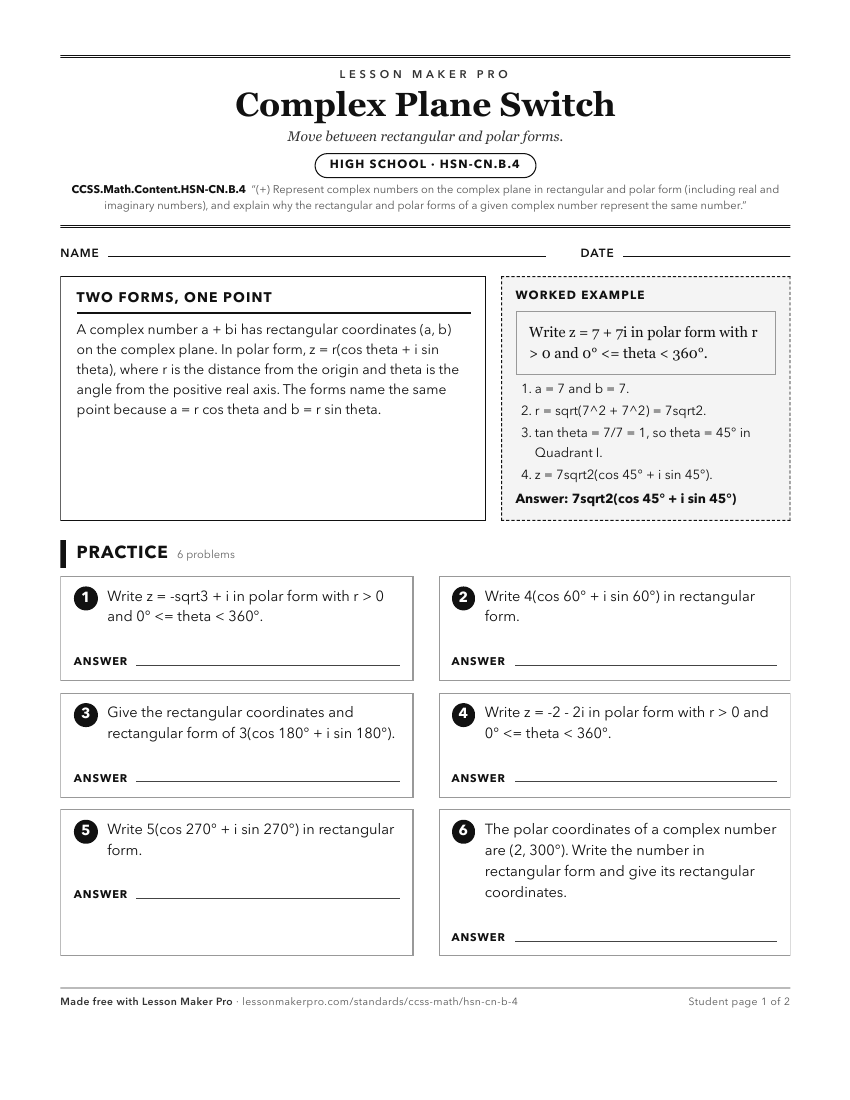
A ready-to-print activity worksheet aligned to CCSS.Math.Content.HSN-CN.B.4, with an answer key for the teacher on its own page. No account needed.
PDF, US Letter, prints cleanly in black and white.
Download the worksheetLearning progression
Where This Standard Sits
Before This Standard
If students are struggling here, check these first.
- CCSS.Math.Content.HSN-CN.A.1
Students must know complex numbers as a + bi before plotting rectangular coordinates or relating them to polar form.
- CCSS.Math.Content.HSG-SRT.C.6
Right-triangle trigonometric ratios support seeing polar form’s radius and angle as rectangular real and imaginary components.
- CCSS.Math.Content.HSF-TF.A.2
Unit circle angles and coordinates support converting a complex number between polar form and rectangular real and imaginary parts.
What This Unlocks
Mastery here sets students up for these next.
- CCSS.Math.Content.HSN-CN.B.6
Plotting complex numbers as plane points supports interpreting differences as vectors for distance and averages as midpoint coordinates.
- CCSS.Math.Content.HSN-CN.B.5
Geometric operations require placing complex numbers on the plane, with polar form supporting multiplication as rotation and scaling.
Keep exploring
Related Standards
- CCSS.Math.Content.HSN-CN.C.8
(+) Extend polynomial identities to the complex numbers.
- CCSS.Math.Content.HSN-CN.A.3
(+) Find the conjugate of a complex number; use conjugates to find moduli and quotients of complex numbers.
- CCSS.Math.Content.HSN-CN.B
Represent complex numbers and their operations on the complex plane.
Turn this exact standard into a lesson
Grade, subject, topic, and the complete standard are prefilled. Create one free, no account needed.
Also for this standard:Make a WorksheetMake a QuizMake a Sub Lesson