CCSS.
The Standard
Use the relation i² = -1 and the commutative, associative, and distributive properties to add, subtract, and multiply complex numbers.
Common Core State Standards for Mathematics · The Complex Number System
Teacher's field guide
What This Standard Means
What Students Need to Do
- Students add, subtract, and multiply numbers written as a+bi. They use distribution, combine like terms, and replace i² with -1.
What Mastery Looks Like
- A student correctly simplifies sums, differences, and products into a+bi form. They distribute accurately, combine like terms, and replace every i² with -1.
Common Misconceptions
- Students may combine real and imaginary terms as if they were like terms. They often miss subtraction signs or forget that i² equals -1 when multiplying.
How to Assess It
- Exit ticket: Simplify (3+2i)+(5-7i), (4+i)-(2-3i), and (2+3i)(1-4i). Write each answer in a+bi form.
Lesson moves
Ways to Teach It
Use red cards for real terms and blue cards for imaginary terms, then physically group terms while simplifying sums and differences.
Ask students to explain why (2+3i)(2-3i) has no imaginary part and predict whether that always happens with conjugates.
Run a four-corner relay where teams simplify operation cards and move only after another student verifies each i² replacement.
Model series AC circuit impedance by adding (4+3i) ohms and (2-5i) ohms, then interpret the real and imaginary components.
Free download
Printable HSN-CN.A.2 Worksheet
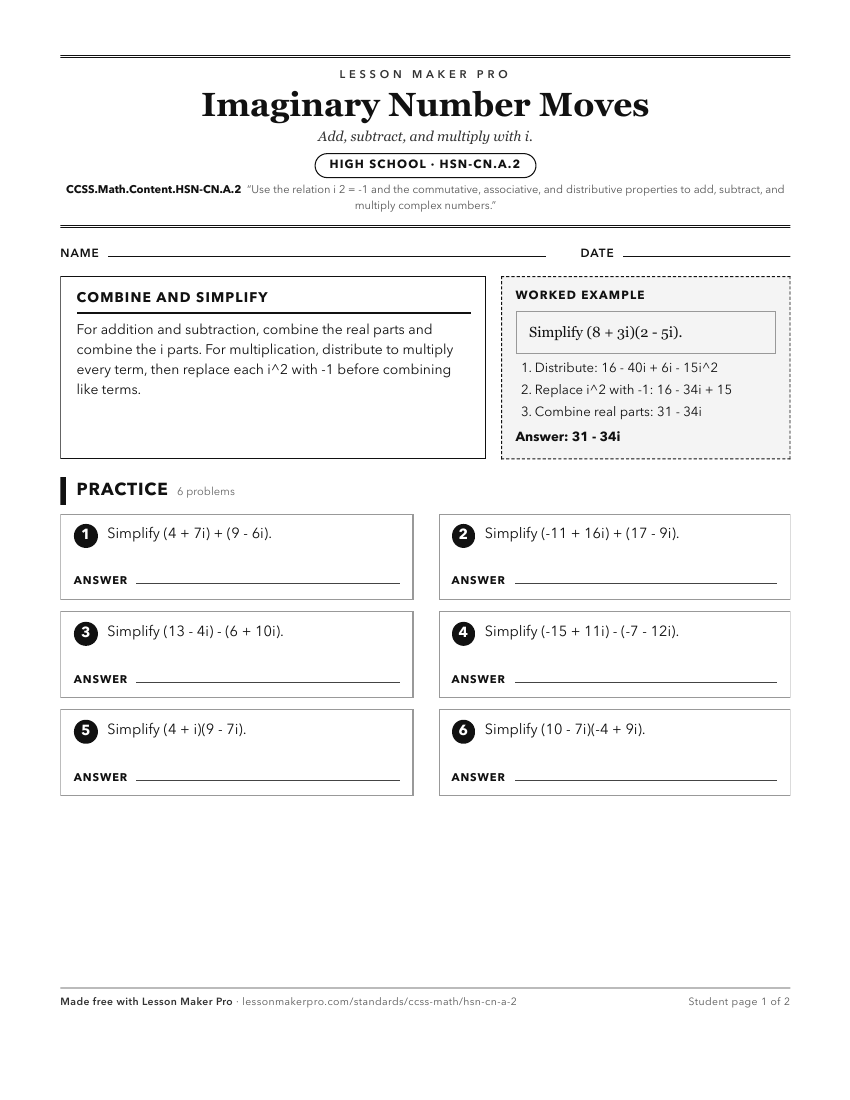
A ready-to-print activity worksheet aligned to CCSS.Math.Content.HSN-CN.A.2, with an answer key for the teacher on its own page. No account needed.
PDF, US Letter, prints cleanly in black and white.
Download the worksheetLearning progression
Where This Standard Sits
Before This Standard
If students are struggling here, check these first.
- CCSS.Math.Content.7.EE.A.1
Combining and expanding linear expressions prepares students to distribute and collect real and imaginary parts in complex-number arithmetic.
- CCSS.Math.Content.HSN-CN.A.1
Adding, subtracting, and multiplying complex numbers requires knowing the form a+bi and replacing i² with -1.
- CCSS.Math.Content.HSA-APR.A.1
Polynomial operations practice carries over to distributing products and combining like terms when simplifying expressions with i² = -1.
What This Unlocks
Mastery here sets students up for these next.
- CCSS.Math.Content.HSN-CN.A.3
Using conjugates for quotients requires multiplying complex expressions and simplifying with i² = -1.
- CCSS.Math.Content.HSN-CN.C.8
Students need complex multiplication and i² = -1 to expand and verify identities with complex factors like x² + 1.
- CCSS.Math.Content.HSN-CN.B.5
Algebraic complex addition, subtraction, and multiplication carry into plotting those operations and checking computations on the complex plane.
Keep exploring
Related Standards
Turn this exact standard into a lesson
Grade, subject, topic, and the complete standard are prefilled. Create one free, no account needed.
Also for this standard:Make a WorksheetMake a QuizMake a Sub Lesson