CCSS.
The Standard
Know there is a complex number i such that i² = -1, and every complex number has the form a + bi with a and b real.
Common Core State Standards for Mathematics · The Complex Number System
Teacher's field guide
What This Standard Means
What Students Need to Do
- Students use i to rewrite square roots of negative numbers. They express numbers with separate real and imaginary components and identify each component.
What Mastery Looks Like
- A student can rewrite √(-9) as 3i and explain why its square is -9. They can identify 4 as the real part and -2 as the imaginary part of 4 - 2i.
Common Misconceptions
- Students may think i equals -1 rather than a number whose square is -1. They may call bi the imaginary part instead of naming its real coefficient, b.
How to Assess It
- Exit ticket: Rewrite √(-25) using i, then identify the real and imaginary parts of 7 - 5i.
Lesson moves
Ways to Teach It
Give students cards showing negative square roots, complex forms, and component labels, then have them build matching sets.
Ask students to explain why no real number can square to -1 and how i addresses that problem.
Play a sorting game where students place number cards under real, pure imaginary, or complex headings.
Show an impedance label of 6 + 3i ohms, then have students identify the resistance and reactance values.
Free download
Printable HSN-CN.A.1 Worksheet
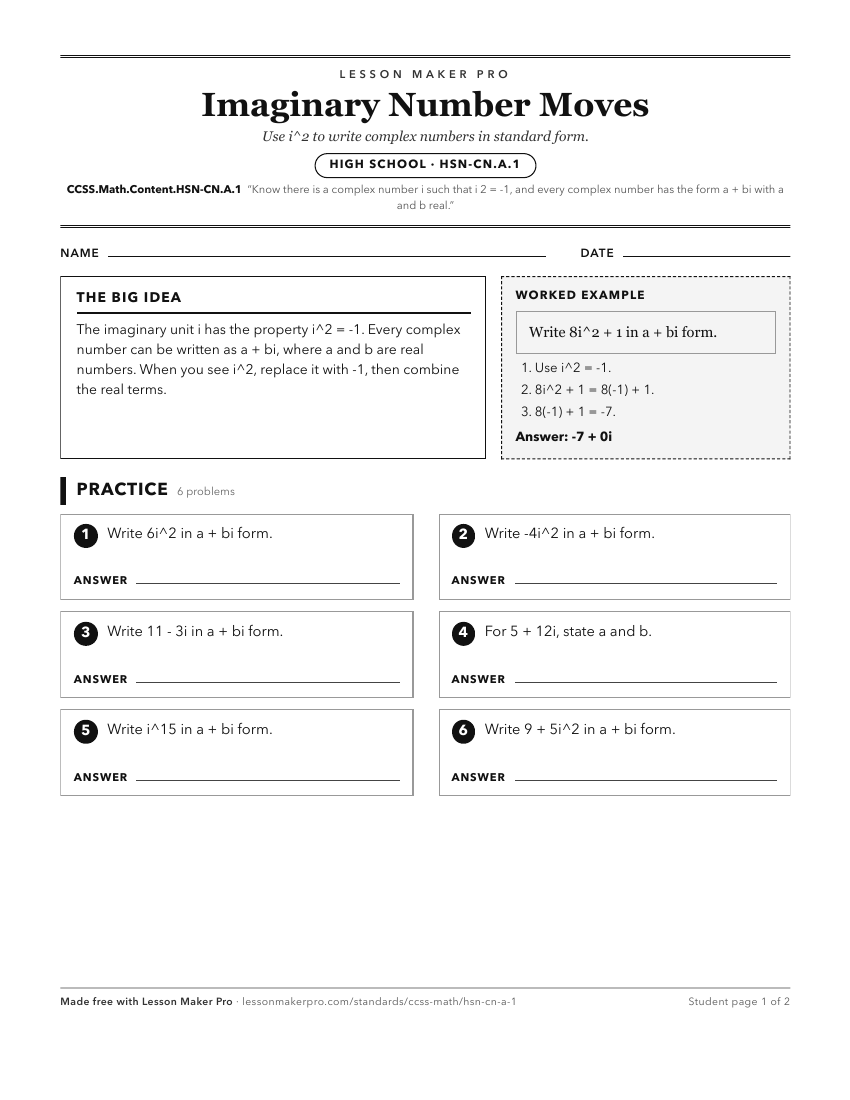
A ready-to-print activity worksheet aligned to CCSS.Math.Content.HSN-CN.A.1, with an answer key for the teacher on its own page. No account needed.
PDF, US Letter, prints cleanly in black and white.
Download the worksheetLearning progression
Where This Standard Sits
Before This Standard
If students are struggling here, check these first.
- CCSS.Math.Content.8.NS.A.1
Understanding rational and irrational real numbers supports interpreting the real parts a and b in complex numbers.
- CCSS.Math.Content.8.EE.A.2
Solving x² = p with root notation supports understanding i as the new number whose square is negative.
- CCSS.Math.Content.HSA-SSE.A.1a
Interpreting terms and coefficients helps students parse a + bi as real part plus coefficient times the new unit i.
What This Unlocks
Mastery here sets students up for these next.
- CCSS.Math.Content.HSA-REI.B.4b
Knowing i² = -1 and a + bi notation lets students express quadratic formula results with negative discriminants.
- CCSS.Math.Content.HSN-CN.A.3
Conjugates, moduli, and quotients all require writing complex numbers as a + bi and using i² = -1.
- CCSS.Math.Content.HSN-CN.B.4
Students must know complex numbers as a + bi before plotting rectangular coordinates or relating them to polar form.
- CCSS.Math.Content.HSN-CN.C.7
Solving quadratics with nonreal roots requires using i and writing answers in a + bi form.
- CCSS.Math.Content.HSN-CN.A.2
Adding, subtracting, and multiplying complex numbers requires knowing the form a+bi and replacing i² with -1.
- CCSS.Math.Content.HSN-CN.C.8
Using identities with complex factors requires knowing i² = -1 and writing numbers in a + bi form.
Keep exploring
Related Standards
Turn this exact standard into a lesson
Grade, subject, topic, and the complete standard are prefilled. Create one free, no account needed.
Also for this standard:Make a WorksheetMake a QuizMake a Sub Lesson