CCSS.
The Standard
(+) Know and apply the Binomial Theorem for the expansion of (x + y)n in powers of x and y for a positive integer n, where x and y are any numbers, with coefficients determined for example by Pascal's Triangle.
Common Core State Standards for Mathematics
Teacher's field guide
What This Standard Means
What Students Need to Do
- Students expand powers of binomials by using Pascal's Triangle or the binomial coefficient formula. They track coefficients, signs, and descending and ascending exponents in each term.
What Mastery Looks Like
- Given an expression such as (2x - 3)^5, students write every term correctly without repeated multiplication. They can find a requested term or coefficient and explain its source in Pascal's Triangle.
Common Misconceptions
- Students may write x^n + y^n, distribute the exponent, or omit middle terms. They often choose the wrong Pascal row or forget that negative terms create alternating signs. They may also fail to make the exponents in each term add to n.
How to Assess It
- Exit ticket: Expand (2x - y)^4. Write the Pascal row used, and verify that each term's exponents total 4.
Lesson moves
Ways to Teach It
Arrange coefficient cards from one Pascal row, then pair them with power cards to build the expansion of (x + y)^5.
Ask students to explain why the x exponent falls while the y exponent rises across an expansion.
Run a matching game with binomial powers, Pascal rows, and completed expansions, including examples with subtraction and coefficients.
List all outcomes for four coin tosses, group them by number of heads, and connect the group sizes to Pascal's Triangle.
Free download
Printable HSA-APR.C.5 Worksheet
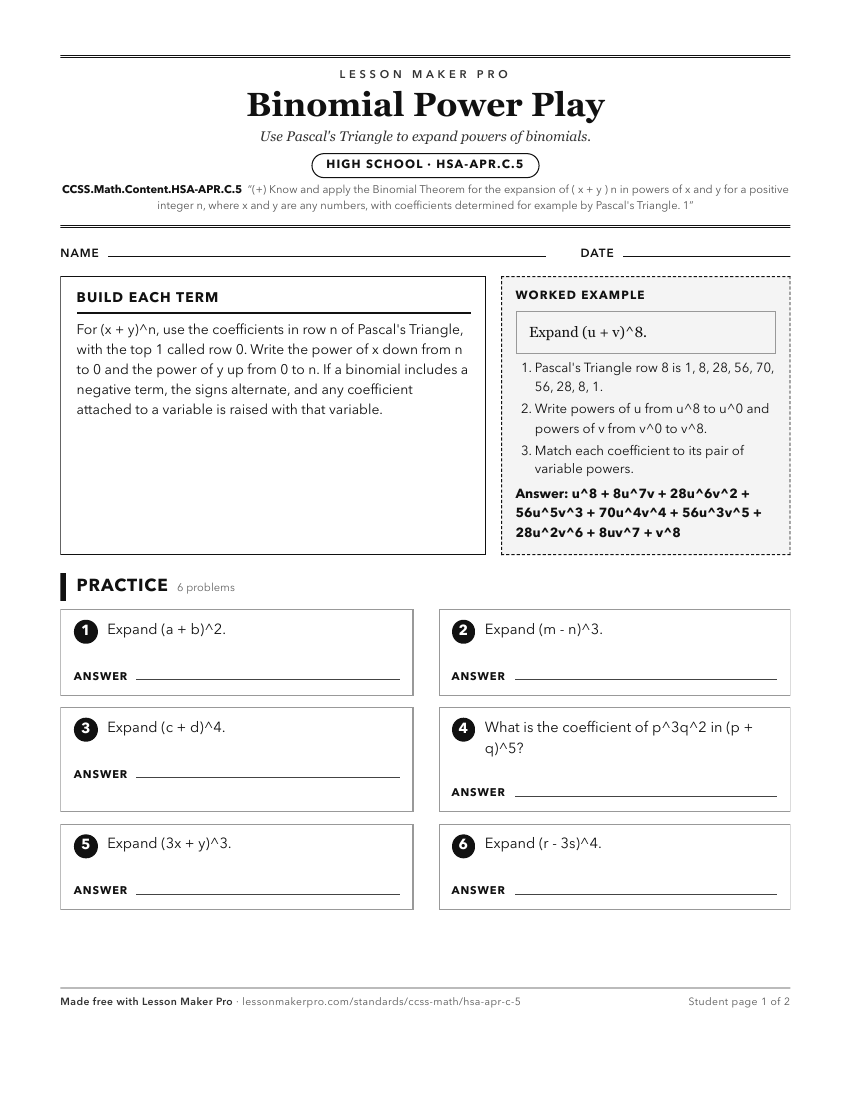
A ready-to-print activity worksheet aligned to CCSS.Math.Content.HSA-APR.C.5, with an answer key for the teacher on its own page. No account needed.
PDF, US Letter, prints cleanly in black and white.
Download the worksheetLearning progression
Where This Standard Sits
Before This Standard
If students are struggling here, check these first.
- CCSS.Math.Content.HSA-SSE.A.1a
Recognizing terms and coefficients helps students read binomial expansions and connect Pascal’s Triangle numbers to each term.
- CCSS.Math.Content.HSA-APR.A.1
Multiplying binomials and combining like terms underlie why powers expand into polynomial terms with Pascal's Triangle coefficients.
- CCSS.Math.Content.8.EE.A.1
Exponent rules support reading and simplifying the powers in binomial expansions, though coefficients and patterns are the main new work.
Keep exploring
Related Standards
- CCSS.Math.Content.HSN-CN.C.8
(+) Extend polynomial identities to the complex numbers.
- CCSS.Math.Content.HSA-APR.C.4
Prove polynomial identities and use them to describe numerical relationships.
- CCSS.Math.Content.HSN-CN.C.9
(+) Know the Fundamental Theorem of Algebra; show that it is true for quadratic polynomials.
- CCSS.Math.Content.HSS-CP.B.9
(+) Use permutations and combinations to compute probabilities of compound events and solve problems.
Turn this exact standard into a lesson
Grade, subject, topic, and the complete standard are prefilled. Create one free, no account needed.
Also for this standard:Make a WorksheetMake a QuizMake a Sub Lesson