CCSS.
The Standard
Know and apply the Remainder Theorem: For a polynomial p(x) and a number a, the remainder on division by x - a is p(a), so p(a) = 0 if and only if (x - a) is a factor of p(x).
Common Core State Standards for Mathematics
Teacher's field guide
What This Standard Means
What Students Need to Do
- Students evaluate a polynomial at a given number and use the result to predict division by a related linear binomial. They decide whether the binomial divides evenly or leaves a remainder.
What Mastery Looks Like
- A student can correctly match x - 5 with 5 and x + 5 with -5. The student evaluates accurately, states the remainder, and justifies whether the binomial is a factor.
Common Misconceptions
- Students often use the wrong sign, matching x + 3 with 3 instead of -3. They may identify a binomial as a factor even when substitution gives a nonzero value. Substitution and synthetic division errors can also hide correct reasoning.
How to Assess It
- Exit ticket: For p(x) = x^3 - 4x + 1, find the remainder when dividing by x - 2 and decide whether x - 2 is a factor. Show substitution, not long division.
Lesson moves
Ways to Teach It
Give pairs polynomial cards and linear-divisor cards; students substitute the matching value, then sort divisors into factors and nonfactors.
Have students explain in writing why x + 3 requires evaluating p(-3), then compare their sign reasoning with a partner.
Run a factor hunt: teams test four candidate divisors for one polynomial, earning a point for each correct calculation and justification.
Use h(t) = -5t^2 + 20t for a launched ball; students find ground times and match each time to a factor.
Free download
Printable HSA-APR.B.2 Worksheet
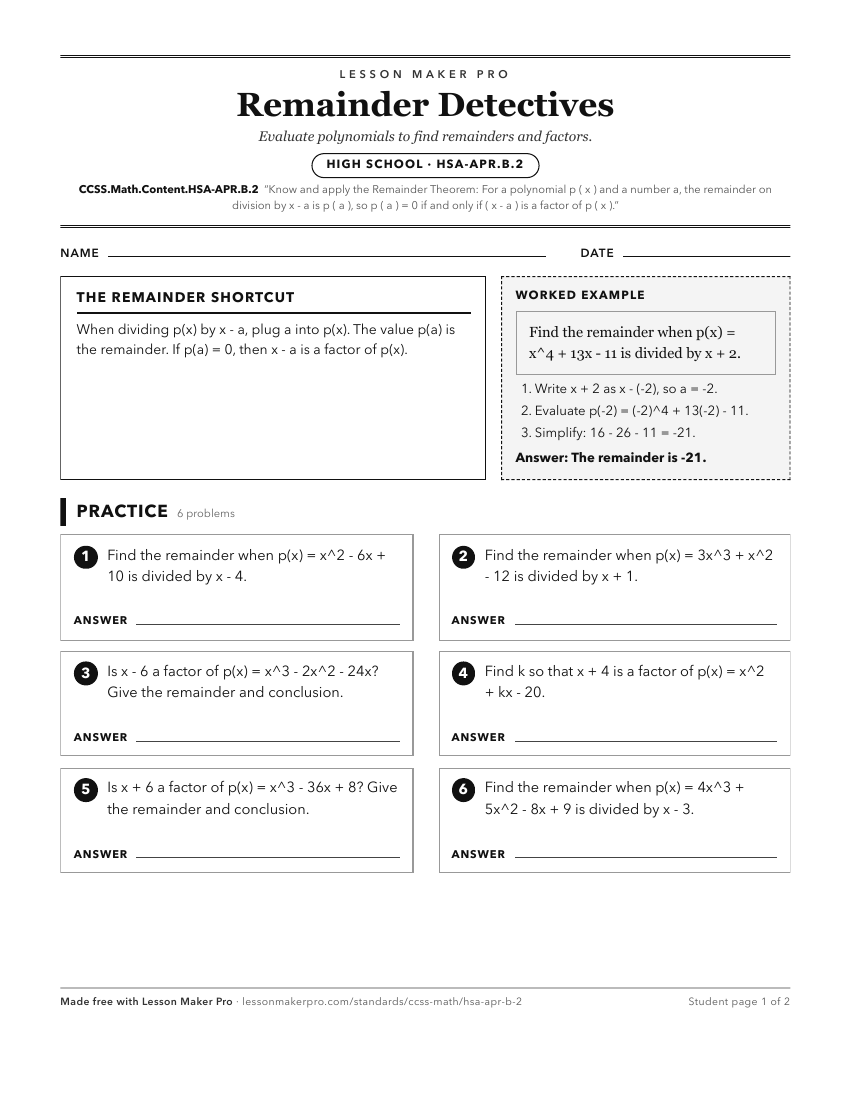
A ready-to-print activity worksheet aligned to CCSS.Math.Content.HSA-APR.B.2, with an answer key for the teacher on its own page. No account needed.
PDF, US Letter, prints cleanly in black and white.
Download the worksheetLearning progression
Where This Standard Sits
Before This Standard
If students are struggling here, check these first.
- CCSS.Math.Content.HSA-APR.A.1
Polynomial multiplication and subtraction support checking factors and carrying out the division steps used in the Remainder Theorem.
- CCSS.Math.Content.HSA-SSE.A.2
Seeing polynomial structure and rewriting expressions supports recognizing factors like x minus a when using the Remainder Theorem.
- CCSS.Math.Content.HSF-IF.A.2
Understanding p(a) as a function value supports evaluating polynomials and recognizing when that value makes x - a a factor.
What This Unlocks
Mastery here sets students up for these next.
Keep exploring
Related Standards
- CCSS.Math.Content.HSA-REI.B.4a
Use the method of completing the square to transform any quadratic equation in x into an equation of the form (x - p)² = q that has the same solutions. Derive t...
- CCSS.Math.Content.HSA-APR.B
Understand the relationship between zeros and factors of polynomials
- CCSS.Math.Content.7.NS.A.2b
Understand that integers can be divided, provided that the divisor is not zero, and every quotient of integers (with non-zero divisor) is a rational number. If ...
- CCSS.Math.Content.HSA-APR.D.6
Rewrite simple rational expressions in different forms; write a(x /b(x) in the form q(x) + r(x)/b(x), where a(x), b(x), q(x), and r(x) are polynomials with the ...
Turn this exact standard into a lesson
Grade, subject, topic, and the complete standard are prefilled. Create one free, no account needed.
Also for this standard:Make a WorksheetMake a QuizMake a Sub Lesson