CCSS.
The Standard
Understand that integers can be divided, provided that the divisor is not zero, and every quotient of integers (with non-zero divisor) is a rational number. If p and q are integers, then -(p/q) = (-p)/q = p/(-q). Interpret quotients of rational numbers by describing real-world contexts.
Common Core State Standards for Mathematics
Teacher's field guide
What This Standard Means
What Students Need to Do
- Students divide signed integers and rational numbers, as long as the divisor is not zero. They recognize every integer quotient as rational and move a negative sign among equivalent fraction forms. They also describe what signed quotients mean in real situations.
What Mastery Looks Like
- Students correctly divide positive and negative rational numbers when the divisor is not zero. They place a single negative sign in any equivalent position and explain a quotient using quantities, units, and context.
Common Misconceptions
- Students may think division by zero gives zero or is allowed. They may treat a negative sign in front of a fraction differently from one in the numerator or denominator. Some also forget that two negative signs produce a positive quotient.
How to Assess It
- Exit ticket: Evaluate −24 ÷ 6, rewrite the answer as a fraction with the negative sign in two equivalent positions, and describe a matching situation.
Lesson moves
Ways to Teach It
Give pairs integer cards and fraction strips to build and compare three equivalent forms of a negative quotient.
Ask students to explain why −3/4, (−3)/4, and 3/(−4) are equal, but (−3)/(−4) is not.
Play quotient match: students pair division expressions, signed fraction forms, and values, then justify each match to a partner.
Use a bank balance changing by equal daily amounts, and have students interpret negative quotients as losses or withdrawals per day.
Free download
Printable 7.NS.A.2b Worksheet
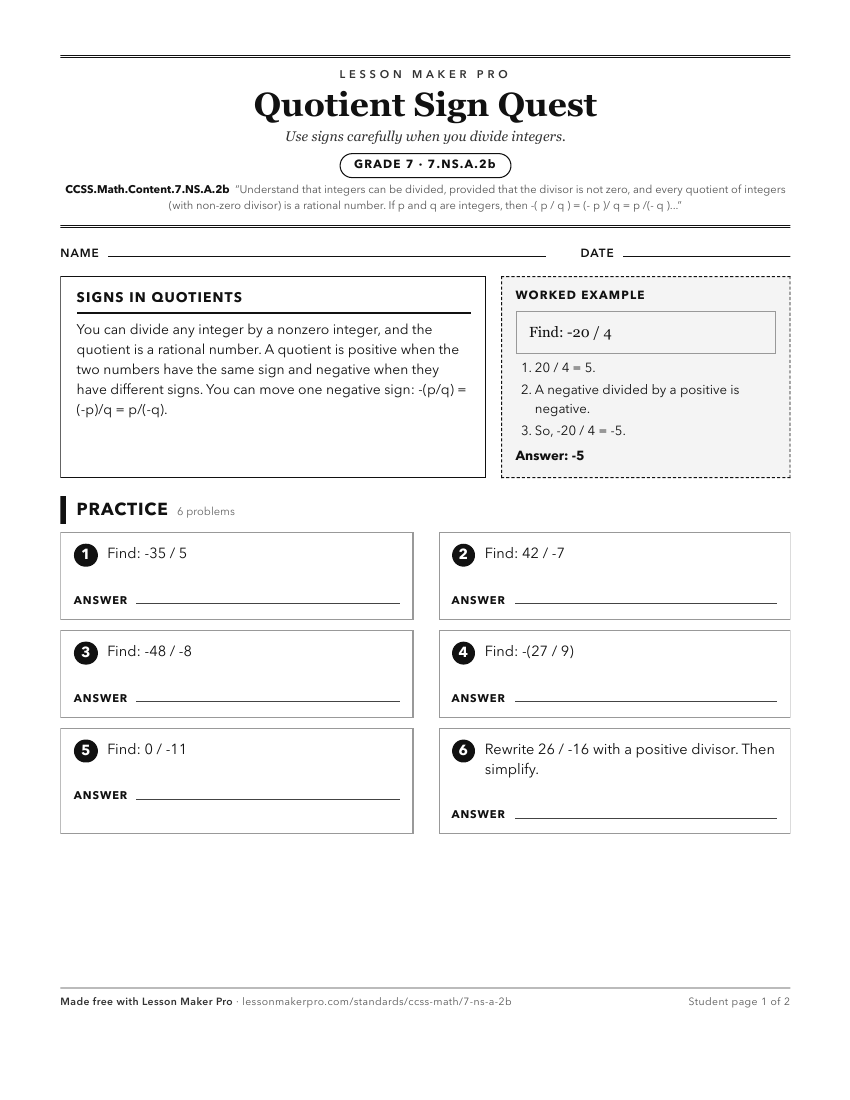
A ready-to-print activity worksheet aligned to CCSS.Math.Content.7.NS.A.2b, with an answer key for the teacher on its own page. No account needed.
PDF, US Letter, prints cleanly in black and white.
Download the worksheetLearning progression
Where This Standard Sits
Before This Standard
If students are struggling here, check these first.
- CCSS.Math.Content.7.NS.A.2a
Signed multiplication rules and inverse relationships support why integer quotients have consistent signs and remain rational numbers.
- CCSS.Math.Content.6.NS.A.1
Dividing fractions supports seeing integer quotients as rational numbers and interpreting non-whole quotients in contexts.
- CCSS.Math.Content.6.NS.C.5
Representing positive and negative quantities supports making sense of signed quotients and their meanings in real-world division contexts.
What This Unlocks
Mastery here sets students up for these next.
- CCSS.Math.Content.8.NS.A.1
Knowing rational numbers as integer quotients supports identifying irrationals and expressing repeating decimals as fractions.
- CCSS.Math.Content.HSN-RN.B.3
Explaining rational closure requires using rational numbers as integer quotients with nonzero denominators, exactly the representation introduced here.
Keep exploring
Related Standards
- CCSS.Math.Content.7.NS.A.1c
Understand subtraction of rational numbers as adding the additive inverse, p - q = p + (-q). Show that the distance between two rational numbers on the number l...
- CCSS.Math.Content.7.NS.A.1b
Understand p + q as the number located a distance |q| from p, in the positive or negative direction depending on whether q is positive or negative. Show that a ...
- CCSS.Math.Content.7.NS.A.2d
Convert a rational number to a decimal using long division; know that the decimal form of a rational number terminates in 0s or eventually repeats.
Turn this exact standard into a lesson
Grade, subject, topic, and the complete standard are prefilled. Create one free, no account needed.
Also for this standard:Make a WorksheetMake a QuizMake a Sub Lesson