CCSS.
The Standard
Explain why the sum or product of two rational numbers is rational; that the sum of a rational number and an irrational number is irrational; and that the product of a nonzero rational number and an irrational number is irrational.
Common Core State Standards for Mathematics · The Real Number System
Teacher's field guide
What This Standard Means
What Students Need to Do
- Students determine whether a result must be rational or irrational when adding or multiplying numbers from each group. They use fraction forms and contradiction, while treating multiplication by zero separately.
What Mastery Looks Like
- Given numbers or variables, a student predicts the result type without using a calculator. The student gives a valid argument and identifies zero as the exception in multiplication.
Common Misconceptions
- Students may call every nonterminating decimal irrational, even when it repeats. They may forget that zero times an irrational number is rational. Some rely on examples instead of a general argument.
How to Assess It
- Exit ticket: Classify 2/3 + 5/8, 4 + √3, -2√5, and 0√7. Justify each answer without decimal approximations.
Lesson moves
Ways to Teach It
Give pairs of rational and irrational number cards; students build sums and products, sort results, and explain each placement.
Ask students to write a rebuttal to the claim that multiplying an irrational number by any rational number always gives an irrational result.
Play Proof Match: teams pair result cards with fraction-form or contradiction arguments, earning a point only when both match.
Use a square tile with diagonal √2 meters, then analyze total length after adding 3 meters or scaling by 1/2.
Free download
Printable HSN-RN.B.3 Worksheet
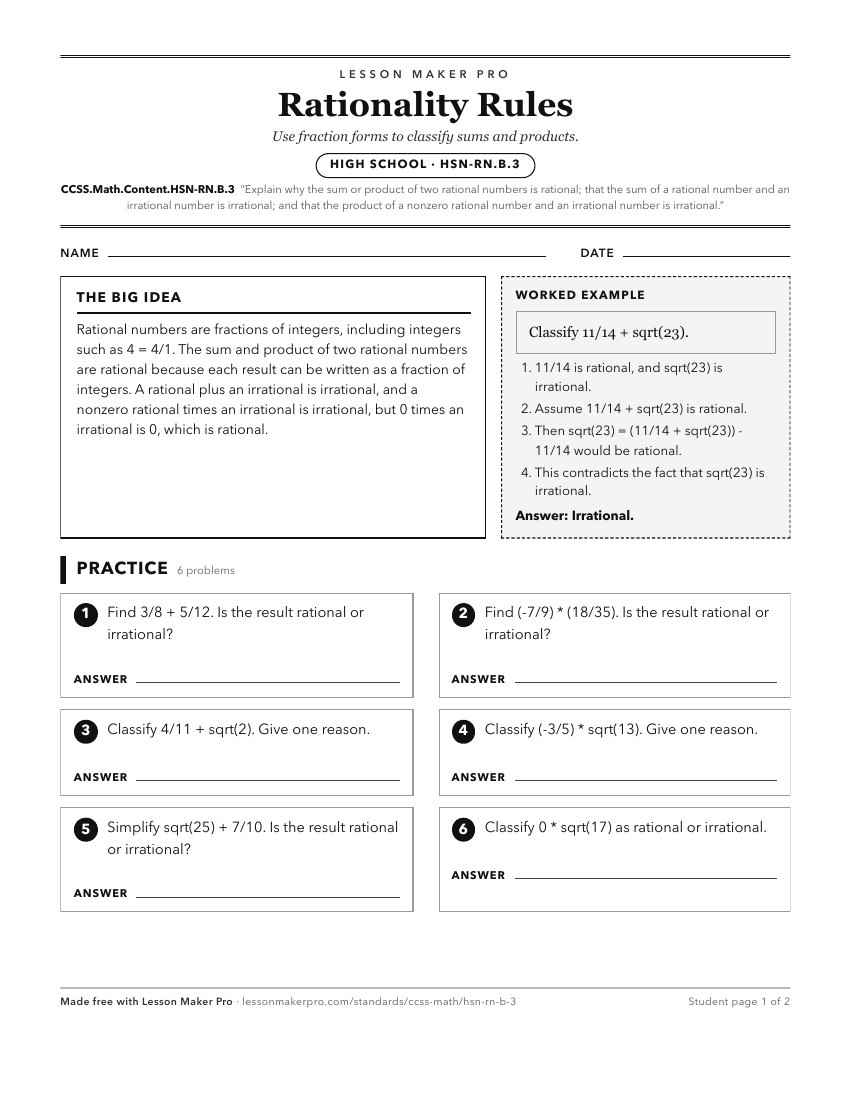
A ready-to-print activity worksheet aligned to CCSS.Math.Content.HSN-RN.B.3, with an answer key for the teacher on its own page. No account needed.
PDF, US Letter, prints cleanly in black and white.
Download the worksheetLearning progression
Where This Standard Sits
Before This Standard
If students are struggling here, check these first.
- CCSS.Math.Content.8.NS.A.1
Knowing irrational means not rational and recognizing rational forms supports explaining why operations stay rational or create irrational results.
- CCSS.Math.Content.7.NS.A.2b
Explaining rational closure requires using rational numbers as integer quotients with nonzero denominators, exactly the representation introduced here.
- CCSS.Math.Content.7.NS.A.1d
Using operation properties with rational sums supports later closure arguments about rational sums, though irrational cases require new proof ideas.
Keep exploring
Related Standards
- CCSS.Math.Content.HSN-RN.B
Use properties of rational and irrational numbers.
- CCSS.Math.Content.HSA-APR.D.7
(+) Understand that rational expressions form a system analogous to the rational numbers, closed under addition, subtraction, multiplication, and division by a ...
- CCSS.Math.Content.7.NS.A.2a
Understand that multiplication is extended from fractions to rational numbers by requiring that operations continue to satisfy the properties of operations, par...
Turn this exact standard into a lesson
Grade, subject, topic, and the complete standard are prefilled. Create one free, no account needed.
Also for this standard:Make a WorksheetMake a QuizMake a Sub Lesson