CCSS.
Standard Cluster
Use properties of rational and irrational numbers.
Common Core State Standards for Mathematics
Cluster contents
Standards in This Cluster
CCSS.Math.Content.HSN-RN.B is a cluster heading. These are the individual standards under it.
Teacher's field guide
What This Cluster Means
What Students Need to Do
- Students determine whether sums and products involving rational and irrational numbers are rational or irrational. They explain which results are guaranteed and use counterexamples when no single result is guaranteed.
What Mastery Looks Like
- Students correctly predict when a sum or product must be rational or irrational. They support each claim with number properties, algebra, or a counterexample.
Common Misconceptions
- Students may think combining two irrational numbers always gives an irrational result. They may also label every nonterminating decimal irrational, forgetting that repeating decimals are rational.
How to Assess It
- Use an exit ticket: classify and justify the results of 3 + √2, √2 + (−√2), 5√3, and √3 × √3.
Lesson moves
Ways to Teach It
Give pairs of rational and irrational number cards, then have students combine, calculate, classify, and explain each result.
Ask students to explain why rational plus irrational must be irrational, then find two irrational numbers with a rational sum.
Play a claim challenge where teams prove a statement about sums or products, or defeat it with a counterexample.
Compare exact and decimal forms of a square's diagonal length, then classify each measurement and explain why rounding changes its number type.
Free download
Printable HSN-RN.B Worksheet
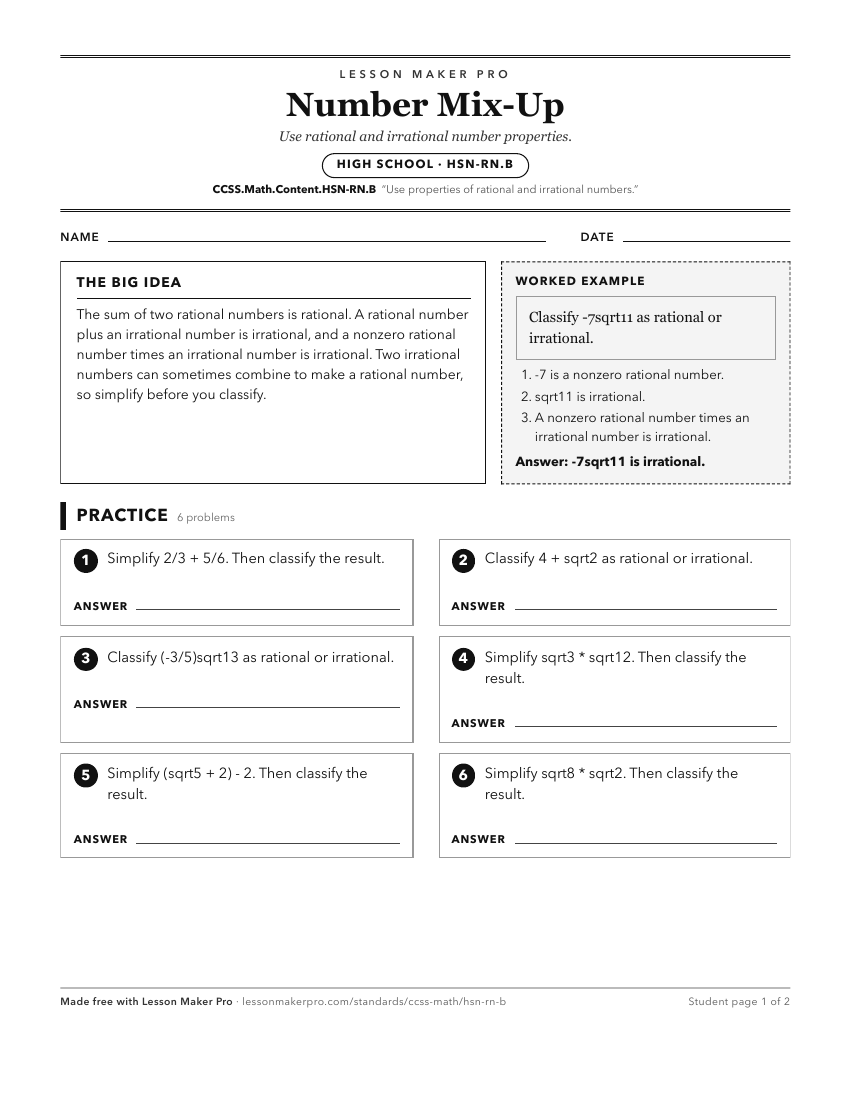
A ready-to-print activity worksheet aligned to CCSS.Math.Content.HSN-RN.B, with an answer key for the teacher on its own page. No account needed.
PDF, US Letter, prints cleanly in black and white.
Download the worksheetKeep exploring
Related Standards
- CCSS.Math.Content.8.NS.A
Know that there are numbers that are not rational, and approximate them by rational numbers.
- CCSS.Math.Content.6.NS.C.7
Understand ordering and absolute value of rational numbers.
- CCSS.Math.Content.HSN-RN.A
Extend the properties of exponents to rational exponents.
- CCSS.Math.Content.6.NS.C
Apply and extend previous understandings of numbers to the system of rational numbers.
Turn this cluster into a lesson
Grade, subject, topic, and the complete cluster are prefilled. Create one free, no account needed.
Also for this cluster:Make a WorksheetMake a QuizMake a Sub Lesson