CCSS.
The Standard
Understand ordering and absolute value of rational numbers.
Common Core State Standards for Mathematics · The Number System
Teacher's field guide
What This Standard Means
What Students Need to Do
- Students place positive and negative integers, fractions, and decimals on a number line and compare them with inequality symbols. They interpret absolute value as distance from zero and use comparisons in contexts such as temperature, elevation, and debt.
What Mastery Looks Like
- Students correctly plot and order positive and negative integers, fractions, and decimals. They use <, >, and = accurately, and explain absolute value as distance from zero in mathematical and real situations.
Common Misconceptions
- Students may think the number with the larger digits is always greater, so they rank −8 above −3. They may treat absolute value as making every number positive without connecting it to distance from zero. They may also confuse a number’s order with the order of its absolute value.
How to Assess It
- Exit ticket: Plot −2.5, 1.5, and −0.5 on a number line, order them, then state each absolute value and explain one comparison.
Lesson moves
Ways to Teach It
Make a floor number line with tape, then have students place fraction, decimal, and integer cards and justify their positions.
Ask students to explain in writing why −3 < −1 but |−3| > |−1|.
Play a card game where pairs draw rational numbers, compare them, then earn a point by stating both absolute values correctly.
Give students a table of city temperatures and ask them to order the cities and find each temperature’s distance from zero.
Free download
Printable 6.NS.C.7 Worksheet
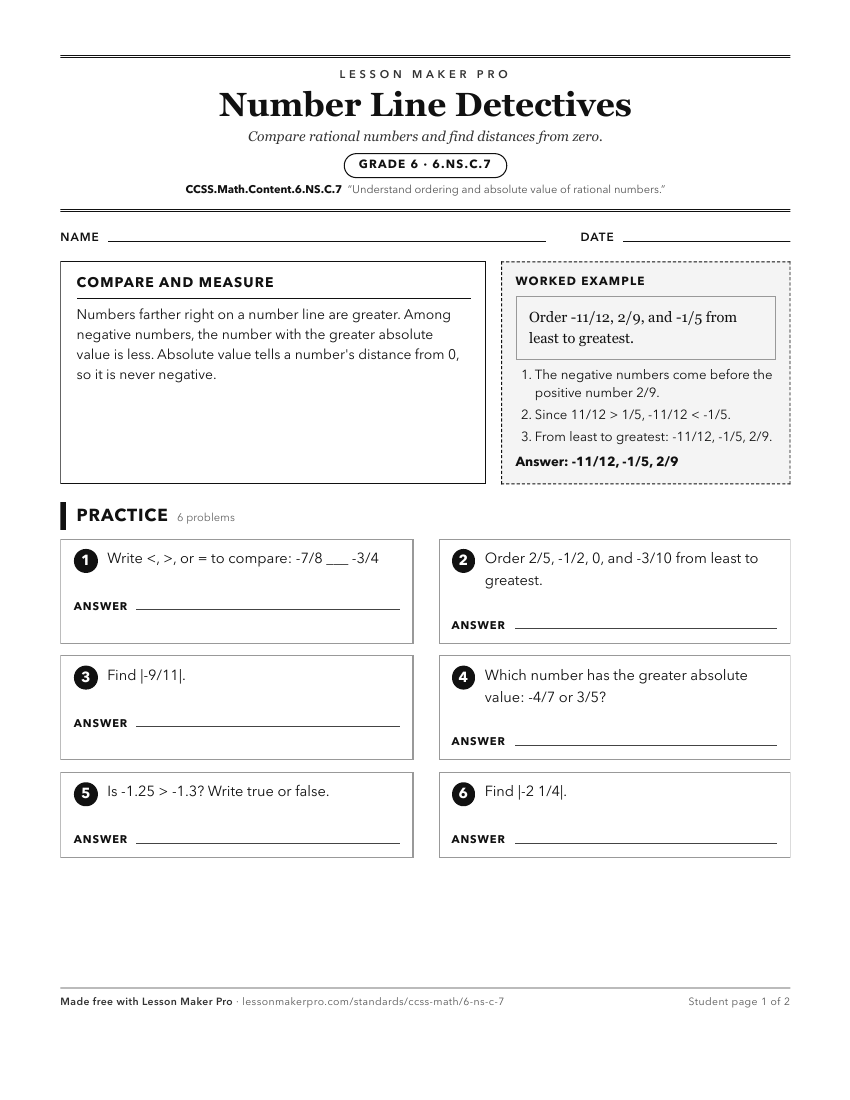
A ready-to-print activity worksheet aligned to CCSS.Math.Content.6.NS.C.7, with an answer key for the teacher on its own page. No account needed.
PDF, US Letter, prints cleanly in black and white.
Download the worksheetLearning progression
Where This Standard Sits
See the whole path on the The Number System progression map.
Before This Standard
If students are struggling here, check these first.
- CCSS.Math.Content.6.NS.C.5
Interpreting positives, negatives, and zero in contexts supports comparing signed numbers and understanding distance from zero.
- CCSS.Math.Content.6.NS.C.6
Ordering and absolute value use rational numbers’ locations on the number line, especially distance and direction from zero.
- CCSS.Math.Content.4.NF.A.2
Comparing fractions with symbols and benchmarks supports ordering positive rational numbers before extending comparisons to negatives and absolute value.
What This Unlocks
Mastery here sets students up for these next.
Keep exploring
Related Standards
- CCSS.Math.Content.6.NS.C.7c
Understand the absolute value of a rational number as its distance from 0 on the number line; interpret absolute value as magnitude for a positive or negative q...
- CCSS.Math.Content.HSN-RN.B
Use properties of rational and irrational numbers.
- CCSS.Math.Content.6.NS.C
Apply and extend previous understandings of numbers to the system of rational numbers.
- CCSS.Math.Content.6.NS.C.7b
Write, interpret, and explain statements of order for rational numbers in real-world contexts.
Turn this exact standard into a lesson
Grade, subject, topic, and the complete standard are prefilled. Create one free, no account needed.
Also for this standard:Make a WorksheetMake a QuizMake a Sub Lesson