CCSS.
The Standard
Know that numbers that are not rational are called irrational. Understand informally that every number has a decimal expansion; for rational numbers show that the decimal expansion repeats eventually, and convert a decimal expansion which repeats eventually into a rational number.
Common Core State Standards for Mathematics · The Number System
Teacher's field guide
What This Standard Means
What Students Need to Do
- Students use decimal expansions to distinguish rational numbers from irrational numbers. They recognize terminating and eventually repeating decimals as rational. They convert an eventually repeating decimal to a fraction using place value or algebra.
What Mastery Looks Like
- A student can classify 0.125, 0.272727..., and 0.1010010001... and justify each choice from its pattern. The student can set x equal to a repeating decimal, shift with a power of 10, subtract, and solve for x.
Common Misconceptions
- Students often call every nonterminating decimal irrational, overlooking repeating tails. They may treat a long visible pattern as proof of repetition or multiply by the wrong power of 10 during conversion.
How to Assess It
- Exit ticket: Classify 0.1666... as rational or irrational, then convert it to a fraction and show each algebra step.
Lesson moves
Ways to Teach It
Give pairs cards showing 0.75, 0.1222..., 0.1010010001..., π, and √2, then have them sort the cards into rational and irrational groups.
Ask students to respond: “Is every decimal with dots at the end irrational?” Require two counterexamples and an explanation.
Run a matching game where students pair repeating-decimal cards with fraction cards, earning a point only after showing the subtraction setup.
Use a calculator display for 1 ÷ 7 and discuss why the rounded screen value differs from the exact repeating decimal.
Free download
Printable 8.NS.A.1 Worksheet
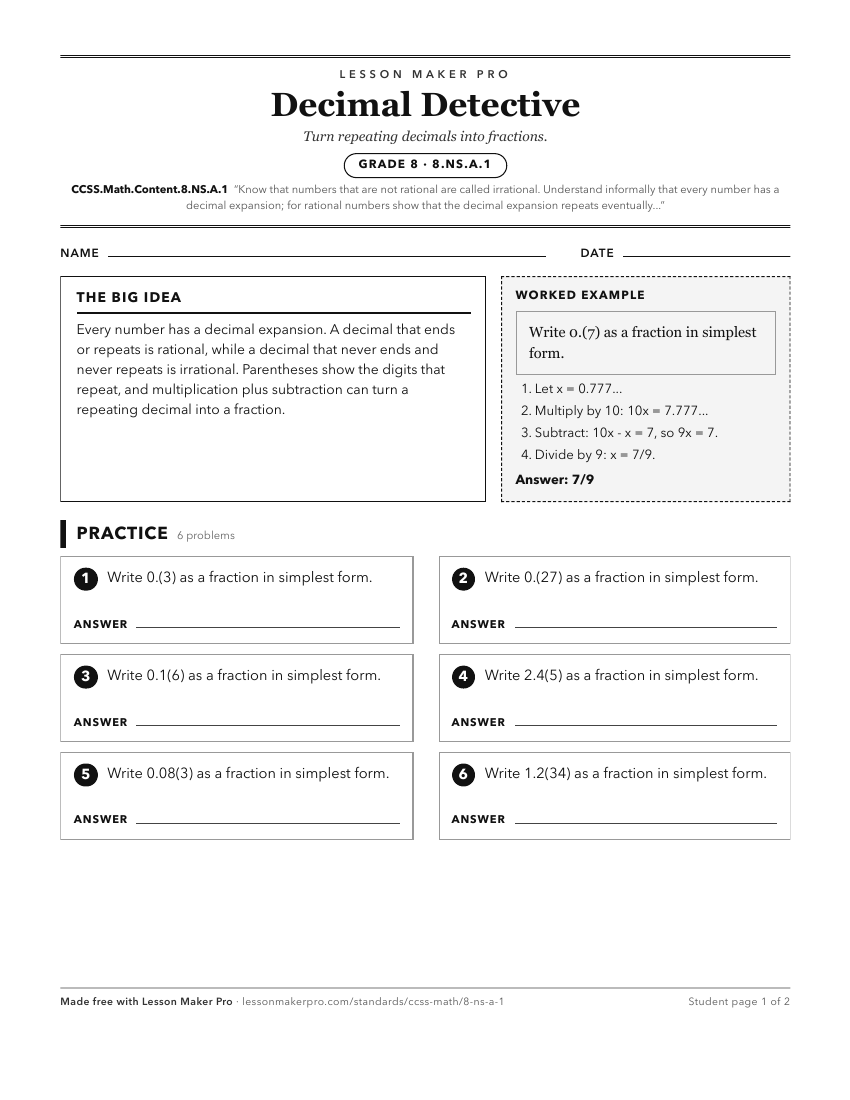
A ready-to-print activity worksheet aligned to CCSS.Math.Content.8.NS.A.1, with an answer key for the teacher on its own page. No account needed.
PDF, US Letter, prints cleanly in black and white.
Download the worksheetLearning progression
Where This Standard Sits
See the whole path on the The Number System progression map.
Before This Standard
If students are struggling here, check these first.
- CCSS.Math.Content.7.NS.A.2d
Students extend rational decimal patterns from long division to distinguish irrational decimals and rewrite repeating decimals as fractions.
- CCSS.Math.Content.7.NS.A.2b
Knowing rational numbers as integer quotients supports identifying irrationals and expressing repeating decimals as fractions.
- CCSS.Math.Content.7.EE.B.4a
Solving linear equations with rational numbers supports the algebra used to turn repeating decimals into fractions.
What This Unlocks
Mastery here sets students up for these next.
- CCSS.Math.Content.8.EE.A.2
Understanding rational versus irrational numbers supports recognizing why a root such as √2 is not a rational number.
- CCSS.Math.Content.8.NS.A.2
Understanding irrationals and decimal expansions supports using rational decimals to approximate, compare, and place irrational numbers.
- CCSS.Math.Content.HSN-CN.A.1
Understanding rational and irrational real numbers supports interpreting the real parts a and b in complex numbers.
- CCSS.Math.Content.HSN-RN.B.3
Knowing irrational means not rational and recognizing rational forms supports explaining why operations stay rational or create irrational results.
Keep exploring
Related Standards
- CCSS.Math.Content.8.NS.A
Know that there are numbers that are not rational, and approximate them by rational numbers.
- CCSS.Math.Content.HSN-RN.B
Use properties of rational and irrational numbers.
- CCSS.Math.Content.6.NS.C
Apply and extend previous understandings of numbers to the system of rational numbers.
Turn this exact standard into a lesson
Grade, subject, topic, and the complete standard are prefilled. Create one free, no account needed.
Also for this standard:Make a WorksheetMake a QuizMake a Sub Lesson