CCSS.
The Standard
Interpret and compute quotients of fractions, and solve word problems involving division of fractions by fractions, e.g., by using visual fraction models and equations to represent the problem.
Common Core State Standards for Mathematics · The Number System
Teacher's field guide
What This Standard Means
What Students Need to Do
- Students explain fraction division as finding the number of groups or finding the size of each equal share. They compute quotients and solve story problems using models, equations, and multiplication checks.
What Mastery Looks Like
- Students choose whether a problem asks for group size or number of groups. They solve accurately, show the division with a model or equation, and check by multiplication.
Common Misconceptions
- Students may invert the first fraction, invert both fractions, or multiply straight across without changing the divisor. They may also treat the quotient as only the number of complete groups and ignore a partial group.
How to Assess It
- Exit ticket: Draw a model for 3/4 ÷ 2/5, find the quotient, and write a multiplication equation that checks your answer.
Lesson moves
Ways to Teach It
Give pairs fraction strips to model 2/3 ÷ 3/4, then label the complete and partial groups they find.
Ask students to explain in writing why multiplying by the reciprocal gives the same result as division.
Make matching cards with fraction division expressions, quotients, visual models, and multiplication checks, then have students assemble complete sets.
Measure 2 1/2 cups of rice and determine how many 3/4-cup servings it makes, including the remaining partial serving.
Free download
Printable 6.NS.A.1 Worksheet
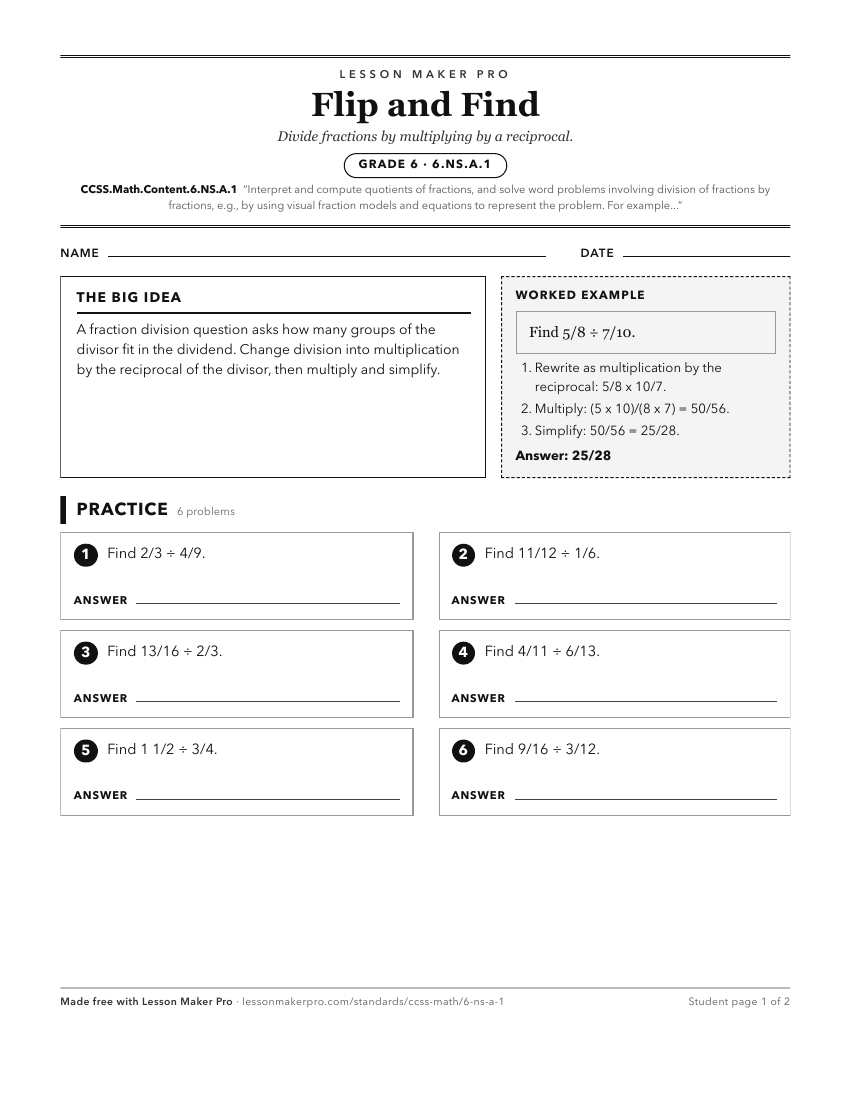
A ready-to-print activity worksheet aligned to CCSS.Math.Content.6.NS.A.1, with an answer key for the teacher on its own page. No account needed.
PDF, US Letter, prints cleanly in black and white.
Download the worksheetLearning progression
Where This Standard Sits
See the whole path on the The Number System progression map.
Before This Standard
If students are struggling here, check these first.
- CCSS.Math.Content.5.NF.B.3
Understanding a fraction as a quotient supports interpreting fractional quotients and modeling division situations with fractions.
- CCSS.Math.Content.5.NF.B.7
Grade 6 generalizes the Grade 5 unit-fraction division models to quotients where both divisor and dividend are fractions.
- CCSS.Math.Content.5.NF.B.4
Fraction multiplication supports the invert-and-multiply method and equations used to compute and represent division of fractions.
What This Unlocks
Mastery here sets students up for these next.
- CCSS.Math.Content.7.RP.A.1
Computing unit rates from fractional quantities requires interpreting the ratio as division and carrying out fraction division accurately.
- CCSS.Math.Content.7.NS.A.2
Fraction quotient models and equations carry over when dividing positive and negative rational numbers, especially signed fractions.
- CCSS.Math.Content.7.NS.A.2c
Fraction division methods carry over when division extends to positive and negative rational numbers using operation properties.
- CCSS.Math.Content.7.NS.A.2b
Dividing fractions supports seeing integer quotients as rational numbers and interpreting non-whole quotients in contexts.
- CCSS.Math.Content.7.NS.A.3
Dividing fractions carries into rational-number division, while seventh grade adds negative signs and mixed real-world contexts.
Keep exploring
Related Standards
- CCSS.Math.Content.4.NF.B.4c
Solve word problems involving multiplication of a fraction by a whole number, e.g., by using visual fraction models and equations to represent the problem.
- CCSS.Math.Content.5.NF.B.7c
Solve real world problems involving division of unit fractions by non-zero whole numbers and division of whole numbers by unit fractions, e.g., by using visual ...
- CCSS.Math.Content.5.NF.B.6
Solve real world problems involving multiplication of fractions and mixed numbers, e.g., by using visual fraction models or equations to represent the problem.
Turn this exact standard into a lesson
Grade, subject, topic, and the complete standard are prefilled. Create one free, no account needed.
Also for this standard:Make a WorksheetMake a QuizMake a Sub Lesson