CCSS.
Standard Cluster
- CCSS.Math.Content.5.NF.B
- Apply and extend previous understandings of multiplication and division to multiply and divide fractions.
Apply and extend previous understandings of multiplication to multiply a fraction or whole number by a fraction.
Common Core State Standards for Mathematics · Number and Operations—Fractions
Cluster contents
Standards in This Cluster
CCSS.Math.Content.5.NF.B.4 is a cluster heading. These are the individual standards under it.
- CCSS.Math.Content.5.NF.B.4a
Interpret the product (a/b) × q as a parts of a partition of q into b equal parts; equivalently, as the result of a sequence of operations a × q ÷ b.
- CCSS.Math.Content.5.NF.B.4b
Find the area of a rectangle with fractional side lengths by tiling it with unit squares of the appropriate unit fraction side lengths, and show that the area i...
Teacher's field guide
What This Cluster Means
What Students Need to Do
- Students represent products such as 3 × 2/5 and 2/3 × 3/4 with equations, diagrams, and area models. They explain what each factor means and why multiplying by a fraction can make a quantity smaller.
What Mastery Looks Like
- A student can solve problems such as 3 × 2/5 and 2/3 × 3/4 using diagrams and equations. They multiply numerators and denominators accurately and connect the calculation to the model.
Common Misconceptions
- Students may expect multiplication always to make a number larger. They may add numerators and denominators, cancel across factors incorrectly, or forget to write whole numbers as fractions over 1.
How to Assess It
- Exit ticket: Draw a model for 2/3 × 3/4, find the product, and explain why the answer is less than 3/4.
Adopted as
This framework is adopted as written in Connecticut, Delaware, District of Columbia, Illinois, Michigan, Nevada, New Hampshire, New Mexico, Vermont.
- Alabama: 5_NF_B_12
- California: 5_NF_4
- Connecticut: CCSS.Math.Content.5.NF.B.4
- Delaware: CCSS.Math.Content.5.NF.B.4
- District of Columbia: CCSS.Math.Content.5.NF.B.4
- Michigan: CCSS.Math.Content.5.NF.B.4
- Mississippi: 5_NF_4
- Nevada: CCSS.Math.Content.5.NF.B.4
- New Hampshire: CCSS.Math.Content.5.NF.B.4
- New Mexico: CCSS.Math.Content.5.NF.B.4
- Vermont: CCSS.Math.Content.5.NF.B.4
- Washington: CCSS.Math.Content.5.NF.B.4
Lesson moves
Ways to Teach It
Give students fraction strips to build three groups of 2/5, then sketch the model and write the matching equation.
Ask students to respond to: Why is 2/3 × 3/4 less than 3/4, even though the operation is multiplication?
Run a card sort matching fraction products, area models, repeated groups, and simplified answers.
Plan a rectangular garden measuring 2/3 meter by 3/4 meter, then draw it on grid paper and find its area.
Free download
Printable 5.NF.B.4 Worksheet
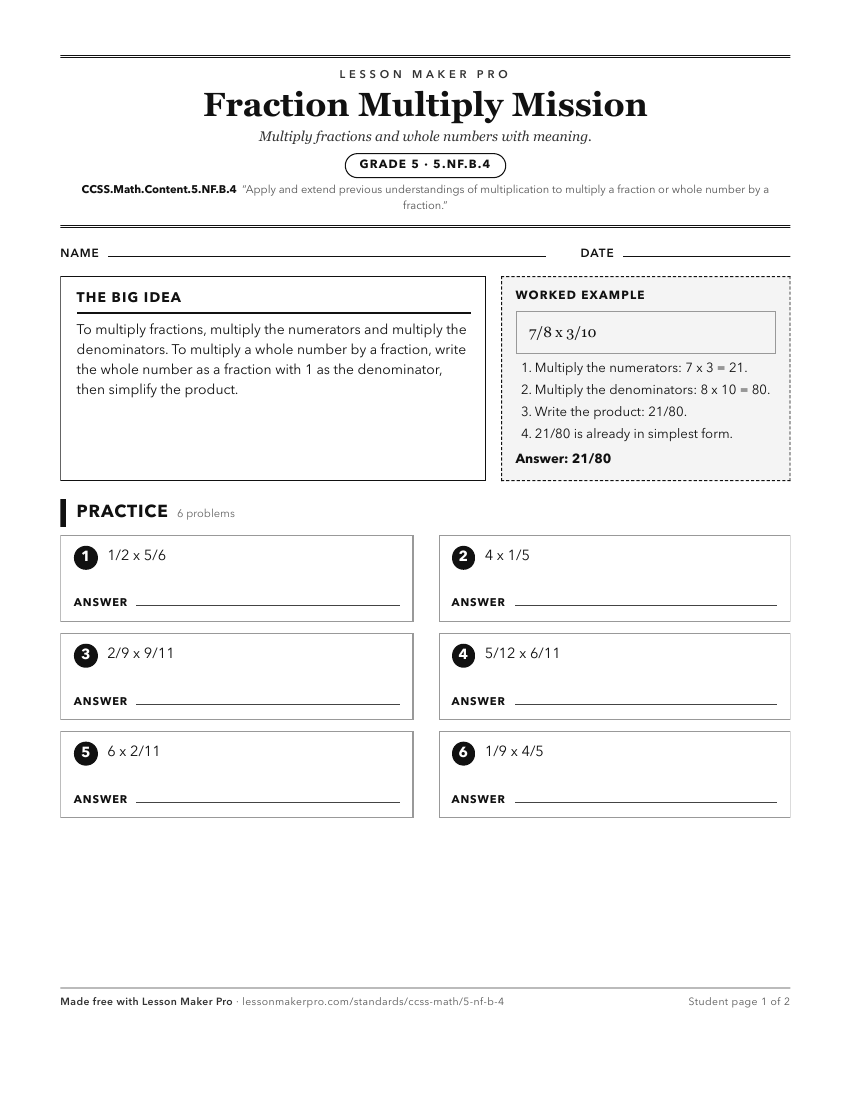
A ready-to-print activity worksheet aligned to CCSS.Math.Content.5.NF.B.4, with an answer key for the teacher on its own page. No account needed.
PDF, US Letter, prints cleanly in black and white.
Download the worksheetLearning progression
Where This Standard Sits
See the whole path on the Number & Operations: Fractions progression map.
Before This Standard
If students are struggling here, check these first.
- CCSS.Math.Content.3.NF.A.1
Multiplying fractions requires understanding a/b as a quantity made of unit fractions and interpreting parts of a whole.
- CCSS.Math.Content.4.NF.B.4
Multiplying fractions by whole numbers prepares students to see fraction multiplication as scaling and combining equal fractional parts.
- CCSS.Math.Content.4.NF.A.1
Understanding equivalent fractions supports renaming and interpreting products, but students can begin fraction multiplication with area and scaling models.
What This Unlocks
Mastery here sets students up for these next.
- CCSS.Math.Content.5.NF.B.5a
Students must understand multiplying by fractions, especially factors less or greater than 1, to predict whether products grow or shrink.
- CCSS.Math.Content.5.NF.B.6
Students must understand fraction multiplication and models before representing and solving real world fraction and mixed number multiplication problems.
- CCSS.Math.Content.7.NS.A.2a
Multiplying rational numbers with signs depends on knowing fraction multiplication before adding negative factors and operation properties.
- CCSS.Math.Content.6.RP.A.3c
Percent problems use 30/100 times a quantity, so fraction multiplication directly carries into finding parts and interpreting percents.
- CCSS.Math.Content.5.NF.B.5b
Students must understand multiplying by fractions before explaining how fraction factors greater or less than 1 change a product.
- CCSS.Math.Content.5.NF.B.5
Multiplying fractions in 5.NF.B.4 gives the product-size and factor relationships students interpret as resizing in 5.NF.B.5.
Keep exploring
Related Standards
- CCSS.Math.Content.5.NF.B
Apply and extend previous understandings of multiplication and division to multiply and divide fractions.
- CCSS.Math.Content.6.NS.A
Apply and extend previous understandings of multiplication and division to divide fractions by fractions.
- CCSS.Math.Content.5.NF.B.7
Apply and extend previous understandings of division to divide unit fractions by whole numbers and whole numbers by unit fractions.
Turn this cluster into a lesson
Grade, subject, topic, and the complete cluster are prefilled. Create one free, no account needed.
Also for this cluster:Make a WorksheetMake a QuizMake a Sub Lesson