CCSS.
The Standard
Explaining why multiplying a given number by a fraction greater than 1 results in a product greater than the given number (recognizing multiplication by whole numbers greater than 1 as a familiar case); explaining why multiplying a given number by a fraction less than 1 results in a product smaller than the given number; and relating the principle of fraction equivalence a/b = (n×a)/(n×b) to the effect of multiplying a/b by 1.
Common Core State Standards for Mathematics
Teacher's field guide
What This Standard Means
What Students Need to Do
- Students treat multiplication by a fraction as scaling. They explain how a factor greater than 1 enlarges a number, while a factor below 1 shrinks it. They connect equivalent fractions to multiplying by a form of 1.
What Mastery Looks Like
- Students predict whether a product will be greater than, less than, or equal to the starting number. They justify the comparison and explain that multiplying both fraction parts by the same number multiplies its value by 1.
Common Misconceptions
- Students may think multiplication always makes a number larger. They may also think multiplying the numerator and denominator by the same number changes a fraction's value.
How to Assess It
- Give this exit ticket: Without calculating, compare 10 × 3/2 and 10 × 3/5 to 10, then explain why 2/3 equals 8/12.
Lesson moves
Ways to Teach It
Use fraction strips to model 4 × 3/2 and 4 × 2/3, then compare each product with 4.
Ask students to explain why multiplying by 7/6 increases a number while multiplying by 6/7 decreases it.
Play a card sort where students place multiplication expressions under greater than, less than, or equal to the starting number.
Adjust a four-serving recipe by factors of 3/2 and 1/2, then discuss why ingredient amounts increase or decrease.
Free download
Printable 5.NF.B.5b Worksheet
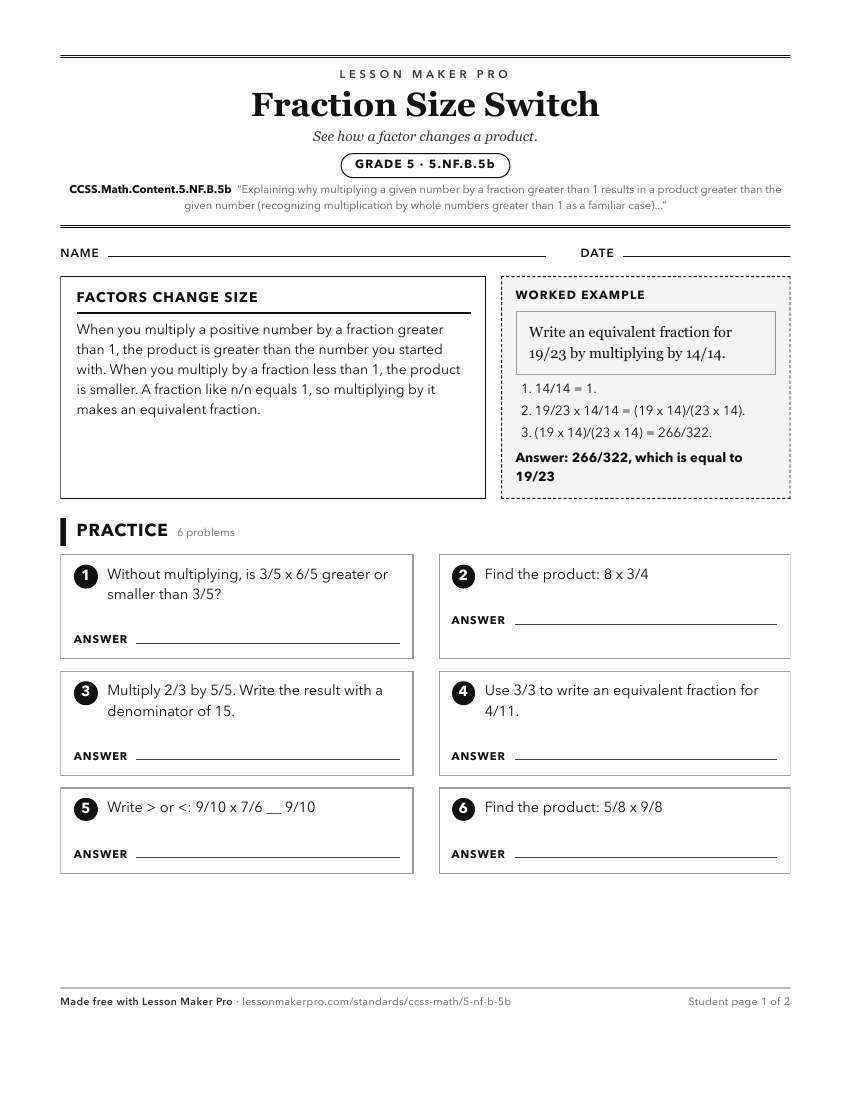
A ready-to-print activity worksheet aligned to CCSS.Math.Content.5.NF.B.5b, with an answer key for the teacher on its own page. No account needed.
PDF, US Letter, prints cleanly in black and white.
Download the worksheetLearning progression
Where This Standard Sits
Before This Standard
If students are struggling here, check these first.
- CCSS.Math.Content.4.NF.A.1
Equivalent fraction models support seeing n/n as 1 and explaining why multiplying numerator and denominator preserves value.
- CCSS.Math.Content.5.NF.B.4
Students must understand multiplying by fractions before explaining how fraction factors greater or less than 1 change a product.
- CCSS.Math.Content.4.NF.A.2
Comparing fraction sizes and benchmarks supports deciding whether a fractional multiplier is greater or less than 1 and predicting product size.
Keep exploring
Related Standards
Turn this exact standard into a lesson
Grade, subject, topic, and the complete standard are prefilled. Create one free, no account needed.
Also for this standard:Make a WorksheetMake a QuizMake a Sub Lesson