CCSS.
The Standard
Compare two fractions with different numerators and different denominators, e.g., by creating common denominators or numerators, or by comparing to a benchmark fraction such as 1/2. Recognize that comparisons are valid only when the two fractions refer to the same whole. Record the results of comparisons with symbols >, =, or <, and justify the conclusions, e.g., by using a visual fraction model.
Common Core State Standards for Mathematics · Number and Operations—Fractions
Teacher's field guide
What This Standard Means
What Students Need to Do
- Students compare fractions with different numerators and denominators. They use equivalent fractions, common numerators, benchmarks such as 1/2, or visual models, then record and justify each comparison.
What Mastery Looks Like
- Students correctly compare two fractions and choose an efficient method, such as using 1/2, equivalent fractions, or a model. They use the correct symbol and explain why both fractions must refer to the same size whole.
Common Misconceptions
- Students may think the fraction with the larger denominator or numerator is always greater. They may reverse the comparison symbol or compare fractions that refer to different size wholes.
How to Assess It
- Give an exit ticket: Compare 3/4 and 5/8 using <, >, or =. Draw equal size fraction bars and explain your choice.
Lesson moves
Ways to Teach It
Build 3/4 and 5/8 with equal length fraction strips, place them side by side, and record the comparison symbol.
Discuss: Mia says 2/5 is greater than 1/2 because 2 is greater than 1. Write a response correcting her reasoning.
Play Fraction War with fraction cards, awarding each pair only when the winner records the correct symbol and explains a comparison strategy.
Compare recipe amounts of 3/4 cup oats and 5/8 cup raisins, then explain which ingredient uses more of the same size cup.
Free download
Printable 4.NF.A.2 Worksheet
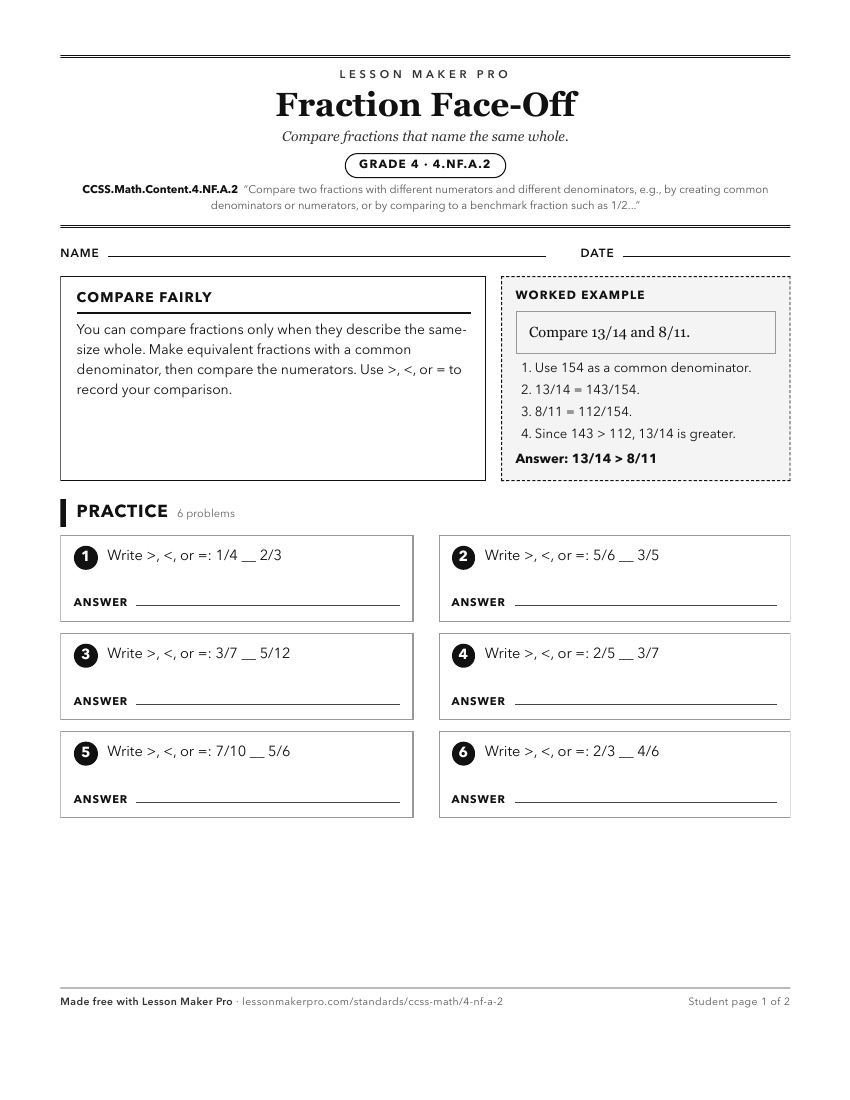
A ready-to-print activity worksheet aligned to CCSS.Math.Content.4.NF.A.2, with an answer key for the teacher on its own page. No account needed.
PDF, US Letter, prints cleanly in black and white.
Download the worksheetLearning progression
Where This Standard Sits
See the whole path on the Number & Operations: Fractions progression map.
Before This Standard
If students are struggling here, check these first.
- CCSS.Math.Content.4.NF.A.1
Generating equivalent fractions supports comparing unlike denominators by making common denominators or numerators, but benchmarks and models can also work.
- CCSS.Math.Content.3.NF.A.3d
Comparing after common denominators or numerators requires knowing how same-denominator and same-numerator fractions order and justify size.
- CCSS.Math.Content.3.NF.A.1
Comparing unlike fractions requires seeing each fraction as a quantity made of unit parts of the same whole.
What This Unlocks
Mastery here sets students up for these next.
- CCSS.Math.Content.5.NF.B.5a
Comparing fractions to benchmarks, especially 1, supports judging whether a multiplier makes a product larger or smaller.
- CCSS.Math.Content.6.NS.C.7
Comparing fractions with symbols and benchmarks supports ordering positive rational numbers before extending comparisons to negatives and absolute value.
- CCSS.Math.Content.5.NF.B.5b
Comparing fraction sizes and benchmarks supports deciding whether a fractional multiplier is greater or less than 1 and predicting product size.
- CCSS.Math.Content.4.NF.C.7
Fraction comparison carries over size reasoning, same-whole checks, symbols, and visual justification to comparing decimals to hundredths.
- CCSS.Math.Content.5.NF.B.5
Comparing fractions to benchmarks supports deciding whether a fractional factor is greater or less than 1 for scaling.
Keep exploring
Related Standards
- CCSS.Math.Content.3.NF.A.3b
Recognize and generate simple equivalent fractions, e.g., 1/2 = 2/4, 4/6 = 2/3). Explain why the fractions are equivalent, e.g., by using a visual fraction mode...
- CCSS.Math.Content.3.NF.A.3
Explain equivalence of fractions in special cases, and compare fractions by reasoning about their size.
Turn this exact standard into a lesson
Grade, subject, topic, and the complete standard are prefilled. Create one free, no account needed.
Also for this standard:Make a WorksheetMake a QuizMake a Sub Lesson