CCSS.
The Standard
Compare two decimals to hundredths by reasoning about their size. Recognize that comparisons are valid only when the two decimals refer to the same whole. Record the results of comparisons with the symbols >, =, or <, and justify the conclusions, e.g., by using a visual model.
Common Core State Standards for Mathematics · Number and Operations—Fractions
Teacher's field guide
What This Standard Means
What Students Need to Do
- Students compare decimals through the hundredths place using place value, symbols, and visual models. They explain their reasoning and make sure both amounts refer to the same-sized whole.
What Mastery Looks Like
- Students correctly compare decimals such as 0.48 and 0.5, including decimals with different numbers of digits. They use place value or a visual model to justify the symbol they chose and check that both decimals use the same whole.
Common Misconceptions
- Students may treat decimals as whole numbers and claim 0.45 is greater than 0.7 because 45 is greater than 7. They may also compare shaded amounts from different-sized wholes or think added zeros change a decimal's value.
How to Assess It
- Exit ticket: Compare 0.62 and 0.6 using a symbol, then shade two same-sized hundred grids and explain your answer.
Lesson moves
Ways to Teach It
Have students shade decimal pairs on same-sized hundred grids, then place the correct comparison symbol between the grids.
Ask students to respond: Ben says 0.8 is less than 0.75 because 8 is less than 75. Is he correct?
Deal digit cards to build two decimals, compare them, and award a point only when the player gives a correct place-value explanation.
Give pairs of prices, such as $2.35 and $2.50, and have students identify the lower price and explain the comparison.
Free download
Printable 4.NF.C.7 Worksheet
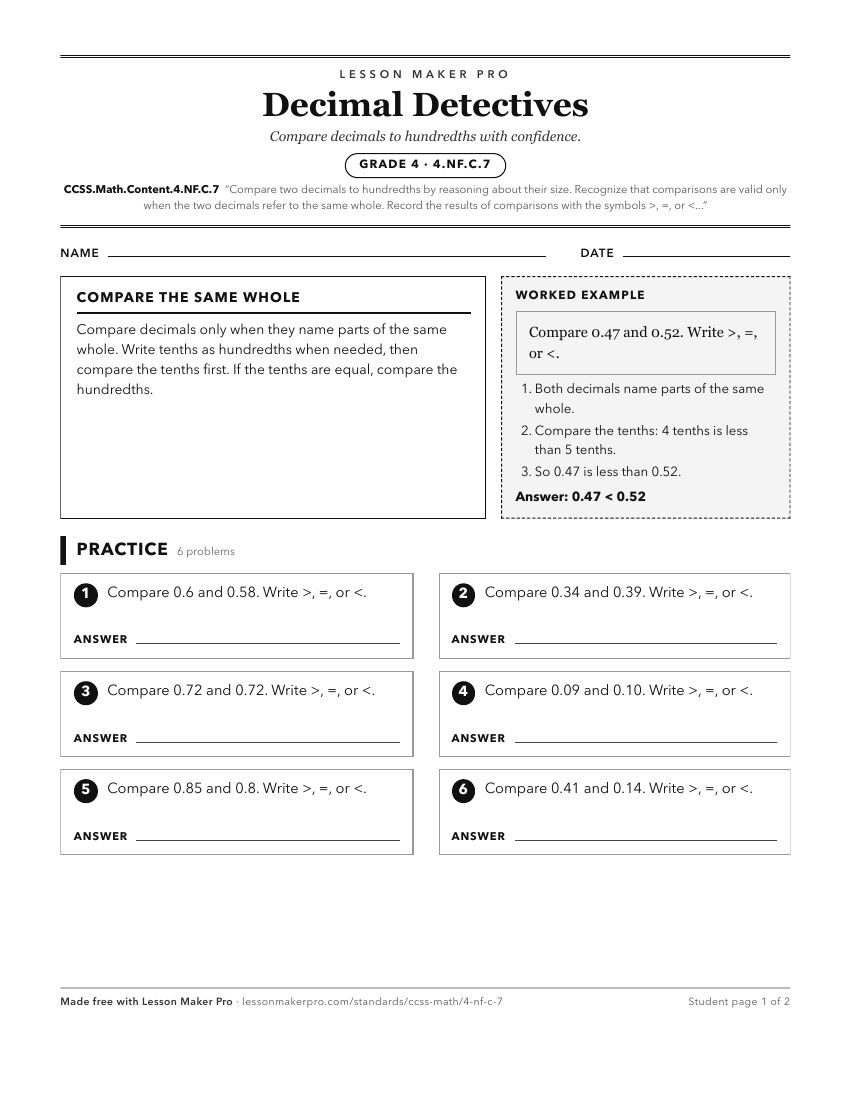
A ready-to-print activity worksheet aligned to CCSS.Math.Content.4.NF.C.7, with an answer key for the teacher on its own page. No account needed.
PDF, US Letter, prints cleanly in black and white.
Download the worksheetLearning progression
Where This Standard Sits
See the whole path on the Number & Operations: Fractions progression map.
Before This Standard
If students are struggling here, check these first.
- CCSS.Math.Content.4.NF.C.5
Converting tenths to hundredths supports comparing decimals like 0.3 and 0.25 using common-sized parts of the same whole.
- CCSS.Math.Content.4.NF.C.6
Comparing decimals to hundredths requires knowing that decimal notation represents tenths and hundredths of the same whole.
- CCSS.Math.Content.4.NF.A.2
Fraction comparison carries over size reasoning, same-whole checks, symbols, and visual justification to comparing decimals to hundredths.
What This Unlocks
Mastery here sets students up for these next.
- CCSS.Math.Content.5.NBT.A.3
Comparing hundredths using place value and same-whole reasoning extends directly to reading, writing, and comparing thousandths.
- CCSS.Math.Content.5.NBT.A.3b
Students extend decimal size reasoning, place value comparison, and inequality symbols from hundredths to include the thousandths place.
Keep exploring
Related Standards
- CCSS.Math.Content.3.NF.A.3d
Compare two fractions with the same numerator or the same denominator by reasoning about their size. Recognize that comparisons are valid only when the two frac...
- CCSS.Math.Content.2.NBT.A.4
Compare two three-digit numbers based on meanings of the hundreds, tens, and ones digits, using >, =, and < symbols to record the results of comparisons.
Turn this exact standard into a lesson
Grade, subject, topic, and the complete standard are prefilled. Create one free, no account needed.
Also for this standard:Make a WorksheetMake a QuizMake a Sub Lesson