CCSS.
The Standard
Recognize and generate simple equivalent fractions, e.g., 1/2 = 2/4, 4/6 = 2/3). Explain why the fractions are equivalent, e.g., by using a visual fraction model.
Common Core State Standards for Mathematics
Teacher's field guide
What This Standard Means
What Students Need to Do
- Students find different fraction names for the same amount. They create matching fractions and use a drawing, fraction strip, or number line to justify the match.
What Mastery Looks Like
- Students can use fraction strips, number lines, or shaded shapes to find matching fraction names. They can explain that both fractions cover the same amount of the same whole.
Common Misconceptions
- Students may think a larger denominator means a larger fraction. They may change only the numerator or denominator, or trust matching numbers without checking equal-sized wholes.
How to Assess It
- Give students a rectangle showing 2/3 shaded. Ask them to partition it into sixths, name the new fraction, and explain why both names match.
Lesson moves
Ways to Teach It
Give pairs fraction strips and ask them to place smaller pieces over larger pieces to record three exact matches.
Show 3/4 and 6/8 models, then ask students to write two sentences explaining why the fractions name the same amount.
Play a matching game with cards showing fractions, shaded models, and number lines, with students collecting sets that represent equal amounts.
Use a recipe card for 1/2 cup, then have students show how two 1/4-cup scoops measure the same amount.
Free download
Printable 3.NF.A.3b Worksheet
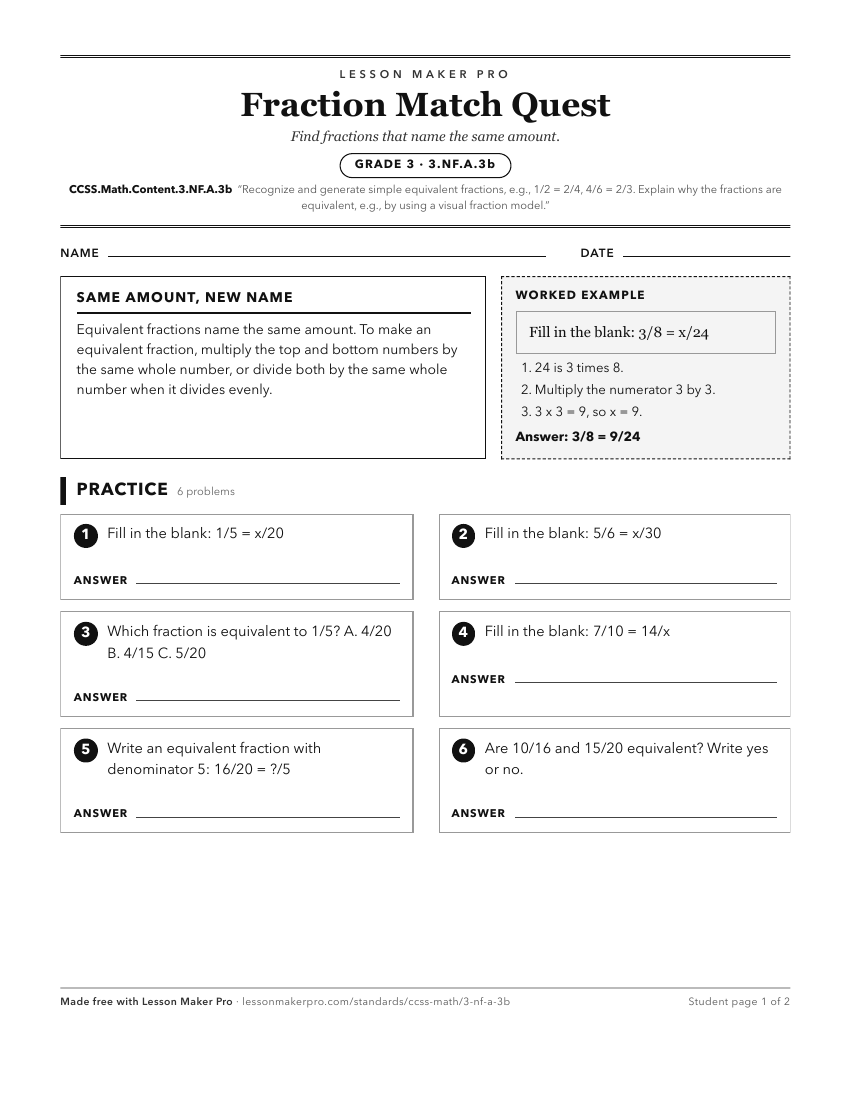
A ready-to-print activity worksheet aligned to CCSS.Math.Content.3.NF.A.3b, with an answer key for the teacher on its own page. No account needed.
PDF, US Letter, prints cleanly in black and white.
Download the worksheetLearning progression
Where This Standard Sits
Before This Standard
If students are struggling here, check these first.
- CCSS.Math.Content.3.NF.A.1
Understanding a/b as a parts of size 1/b is needed to see and explain why different partitions can name the same amount.
- CCSS.Math.Content.3.NF.A.3a
Knowing equivalent fractions name the same size or number-line point is necessary to justify and create examples like 1/2 = 2/4.
- CCSS.Math.Content.3.G.A.2
Partitioning equal-area shapes into unit fractions supports seeing how regrouped parts can name the same whole amount.
What This Unlocks
Mastery here sets students up for these next.
Keep exploring
Related Standards
- CCSS.Math.Content.3.NF.A.3c
Express whole numbers as fractions, and recognize fractions that are equivalent to whole numbers.
- CCSS.Math.Content.5.NF.A
Use equivalent fractions as a strategy to add and subtract fractions.
- CCSS.Math.Content.4.NF.A.2
Compare two fractions with different numerators and different denominators, e.g., by creating common denominators or numerators, or by comparing to a benchmark ...
Turn this exact standard into a lesson
Grade, subject, topic, and the complete standard are prefilled. Create one free, no account needed.
Also for this standard:Make a WorksheetMake a QuizMake a Sub Lesson