CCSS.
The Standard
Express whole numbers as fractions, and recognize fractions that are equivalent to whole numbers.
Common Core State Standards for Mathematics
Teacher's field guide
What This Standard Means
What Students Need to Do
- Students write a whole number as a fraction with 1 as the denominator. They decide when a fraction names a whole number by grouping numerator pieces into complete units. They show equivalent names at the same point on a number line.
What Mastery Looks Like
- A student can rewrite any small whole number with 1 as the denominator. Given 8/4 or 9/3, the student names the whole number, proves it with a model, and marks both names at one point.
Common Misconceptions
- Some students think every fraction with a denominator of 1 equals 1, so they read 6/1 as 1. Others believe only fractions like 4/4 can equal whole numbers and miss that 8/4 equals 2. On number lines, they may place 4/4 at 4 instead of 1.
How to Assess It
- Exit ticket: Write 5 as a fraction with denominator 1, find the whole number equal to 12/3, and mark 4/4 and 1 on one number line.
Lesson moves
Ways to Teach It
Build two wholes with fraction strips, then record how six one-third pieces show that 6/3 equals 2.
Students answer the prompt How can 8/4 and 2 name the same amount, using a drawing and two written sentences.
Play a card match with whole-number cards, fraction cards such as 12/4, and number-line cards showing the same point.
Cut three paper pizzas into fourths, count 12 fourths, and connect 12/4 to three whole pizzas.
Free download
Printable 3.NF.A.3c Worksheet
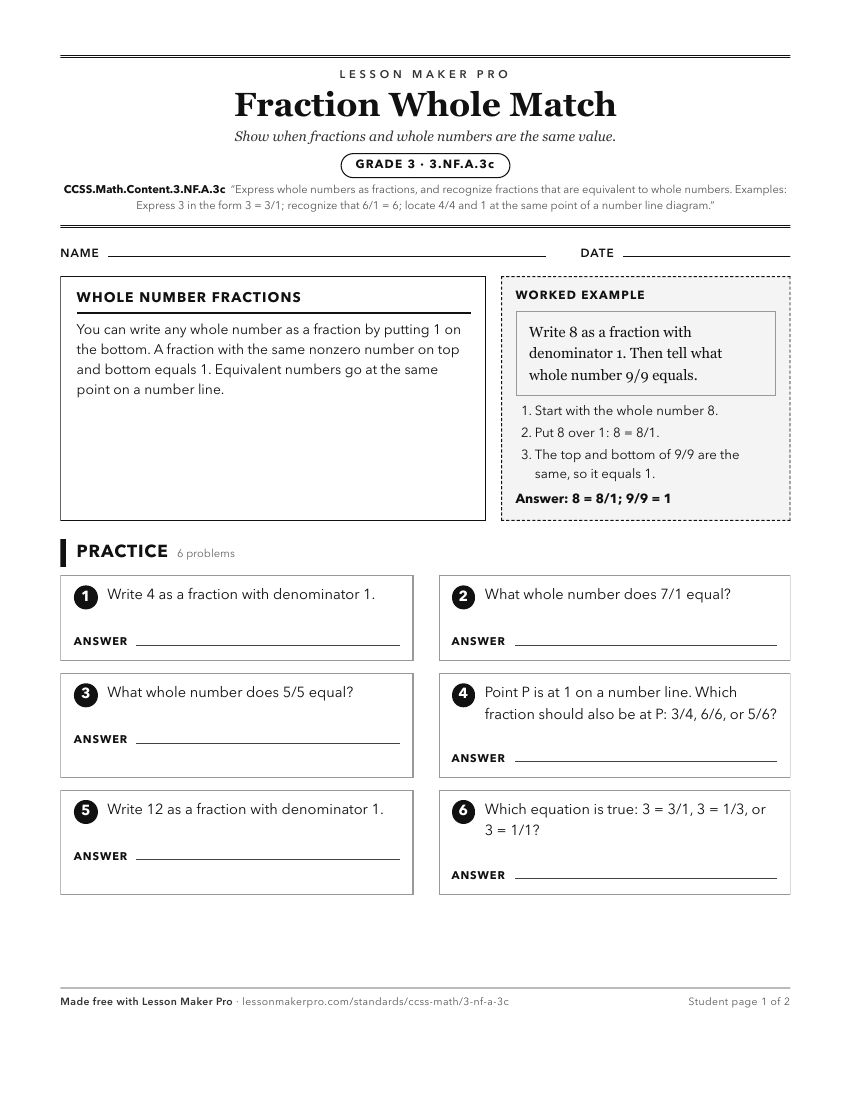
A ready-to-print activity worksheet aligned to CCSS.Math.Content.3.NF.A.3c, with an answer key for the teacher on its own page. No account needed.
PDF, US Letter, prints cleanly in black and white.
Download the worksheetLearning progression
Where This Standard Sits
Before This Standard
If students are struggling here, check these first.
- CCSS.Math.Content.3.NF.A.2
Number line fractions help students see 3/1 or 6/2 landing on the same point as a whole number.
- CCSS.Math.Content.3.NF.A.1
Students need numerator, denominator, and unit-fraction meaning to see b/b as one whole and make whole-number fractions.
- CCSS.Math.Content.3.NF.A.3a
Recognizing 3/3 as 1 requires seeing different fraction names as the same size or same point on a number line.
What This Unlocks
Mastery here sets students up for these next.
Keep exploring
Related Standards
- CCSS.Math.Content.3.NF.A.3b
Recognize and generate simple equivalent fractions, e.g., 1/2 = 2/4, 4/6 = 2/3). Explain why the fractions are equivalent, e.g., by using a visual fraction mode...
- CCSS.Math.Content.4.NF.B
Build fractions from unit fractions by applying and extending previous understandings of operations on whole numbers.
- CCSS.Math.Content.3.NF.A
Develop understanding of fractions as numbers.
- CCSS.Math.Content.4.NF.C
Understand decimal notation for fractions, and compare decimal fractions.
Turn this exact standard into a lesson
Grade, subject, topic, and the complete standard are prefilled. Create one free, no account needed.
Also for this standard:Make a WorksheetMake a QuizMake a Sub Lesson