CCSS.
Standard Cluster
Understand decimal notation for fractions, and compare decimal fractions.
Common Core State Standards for Mathematics
Cluster contents
Standards in This Cluster
CCSS.Math.Content.4.NF.C is a cluster heading. These are the individual standards under it.
- CCSS.Math.Content.4.NF.C.5
Express a fraction with denominator 10 as an equivalent fraction with denominator 100, and use this technique to add two fractions with respective denominators ...
- CCSS.Math.Content.4.NF.C.6
Use decimal notation for fractions with denominators 10 or 100.
- CCSS.Math.Content.4.NF.C.7
Compare two decimals to hundredths by reasoning about their size. Recognize that comparisons are valid only when the two decimals refer to the same whole. Recor...
Teacher's field guide
What This Cluster Means
What Students Need to Do
- Students connect fractions in tenths and hundredths to decimal notation. They compare two decimals through hundredths by using place value, fraction models, or equivalent fractions.
What Mastery Looks Like
- Students write fractions with denominators of 10 or 100 as decimals. They compare decimals through hundredths and justify each comparison with models, place value, or equivalent fractions.
Common Misconceptions
- Students may treat decimals like whole numbers and say 0.45 is greater than 0.5 because 45 is greater than 5. They may also think 0.6 and 0.60 have different values or confuse tenths with hundredths.
How to Assess It
- Use an exit ticket: Write 7/10 as a decimal, then compare 0.7 and 0.67 using >, <, or = and explain with place value.
Lesson moves
Ways to Teach It
Have students shade hundred grids for 0.4 and 0.37, label each model, and compare the shaded amounts.
Ask students to explain in writing why 0.5 is greater than 0.45, using tenths and hundredths.
Play Decimal War with cards showing decimals and fractions; partners compare values, explain their reasoning, and keep the greater card.
Give students store prices such as $1.25 and $1.40, then have them identify the greater price and explain the comparison.
Free download
Printable 4.NF.C Worksheet
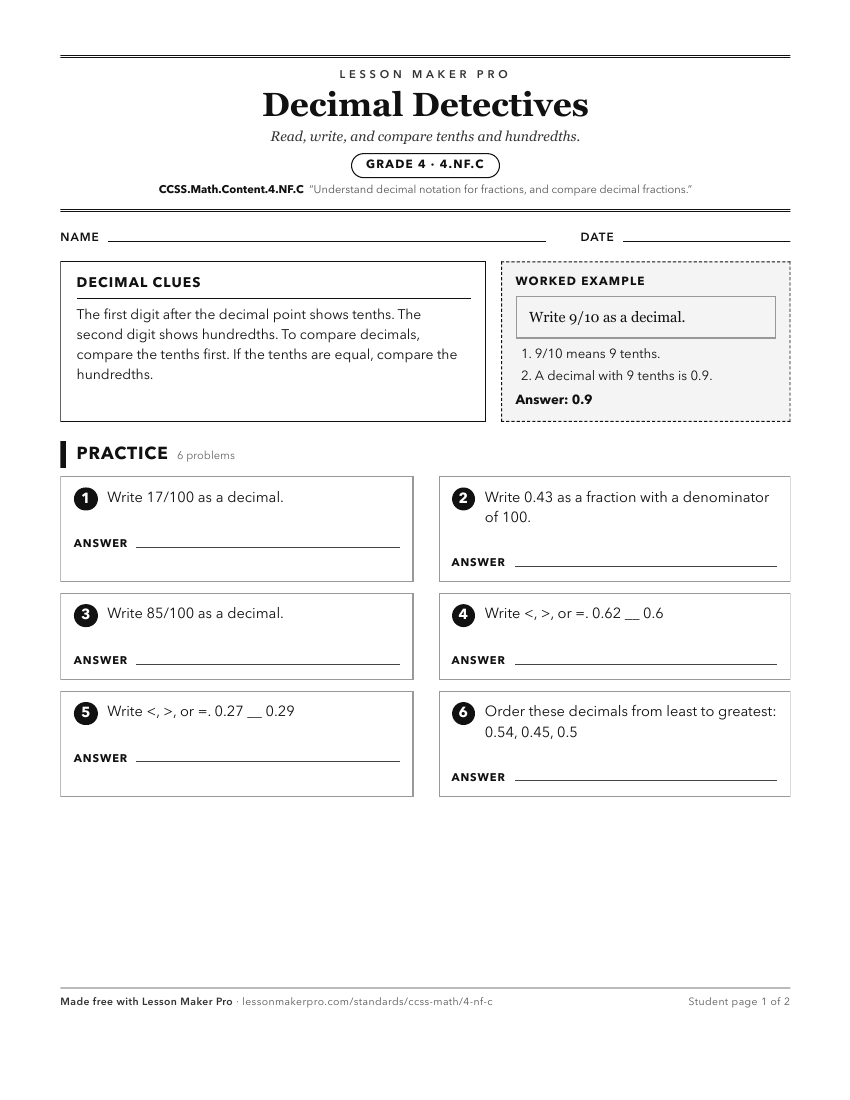
A ready-to-print activity worksheet aligned to CCSS.Math.Content.4.NF.C, with an answer key for the teacher on its own page. No account needed.
PDF, US Letter, prints cleanly in black and white.
Download the worksheetKeep exploring
Related Standards
- CCSS.Math.Content.3.NF.A.3c
Express whole numbers as fractions, and recognize fractions that are equivalent to whole numbers.
- CCSS.Math.Content.3.NF.A
Develop understanding of fractions as numbers.
- CCSS.Math.Content.4.NF.A.2
Compare two fractions with different numerators and different denominators, e.g., by creating common denominators or numerators, or by comparing to a benchmark ...
Turn this cluster into a lesson
Grade, subject, topic, and the complete cluster are prefilled. Create one free, no account needed.
Also for this cluster:Make a WorksheetMake a QuizMake a Sub Lesson