CCSS.
Standard Cluster
Develop understanding of fractions as numbers.
Common Core State Standards for Mathematics
Cluster contents
Standards in This Cluster
CCSS.Math.Content.3.NF.A is a cluster heading. These are the individual standards under it.
- CCSS.Math.Content.3.NF.A.1
Understand a fraction 1/b as the quantity formed by 1 part when a whole is partitioned into b equal parts; understand a fraction a/b as the quantity formed by a...
- CCSS.Math.Content.3.NF.A.2
Understand a fraction as a number on the number line; represent fractions on a number line diagram.
- CCSS.Math.Content.3.NF.A.2a
Represent a fraction 1/b on a number line diagram by defining the interval from 0 to 1 as the whole and partitioning it into b equal parts. Recognize that each ...
- CCSS.Math.Content.3.NF.A.2b
Represent a fraction a/b on a number line diagram by marking off a lengths 1/b from 0. Recognize that the resulting interval has size a/b and that its endpoint ...
- CCSS.Math.Content.3.NF.A.3
Explain equivalence of fractions in special cases, and compare fractions by reasoning about their size.
- CCSS.Math.Content.3.NF.A.3a
Understand two fractions as equivalent (equal) if they are the same size, or the same point on a number line.
- CCSS.Math.Content.3.NF.A.3b
Recognize and generate simple equivalent fractions, e.g., 1/2 = 2/4, 4/6 = 2/3). Explain why the fractions are equivalent, e.g., by using a visual fraction mode...
- CCSS.Math.Content.3.NF.A.3c
Express whole numbers as fractions, and recognize fractions that are equivalent to whole numbers.
- CCSS.Math.Content.3.NF.A.3d
Compare two fractions with the same numerator or the same denominator by reasoning about their size. Recognize that comparisons are valid only when the two frac...
Teacher's field guide
What This Cluster Means
What Students Need to Do
- Students represent unit fractions and other fractions with shapes and number lines. They explain numerator and denominator, find simple equivalents, and compare fractions that refer to the same whole.
What Mastery Looks Like
- Given 3/4, a student can partition a model into four equal parts, shade three, and locate it on a number line. The student can identify simple equivalent fractions and justify comparisons with a model or benchmark.
Common Misconceptions
- Students may think the denominator counts shaded pieces or that a larger denominator means a larger fraction. They may make unequal parts, compare different-sized wholes, or count tick marks instead of intervals.
How to Assess It
- Exit ticket: On a number line from 0 to 1, mark 3/4. Then compare 3/4 and 2/4, and justify your answer with a model.
Lesson moves
Ways to Teach It
Give pairs paper strips; students fold and label halves, thirds, fourths, and sixths, then stack strips to find equal lengths.
Write and discuss: Sam says one eighth is greater than one fourth because 8 is greater than 4. Is he right?
Play Fraction Line-Up: students draw fraction cards, place themselves from 0 to 1, and defend their positions using benchmark fractions.
Use measuring cups and water to test how many one-fourth cups fill one cup, then record matching fraction equations.
Free download
Printable 3.NF.A Worksheet
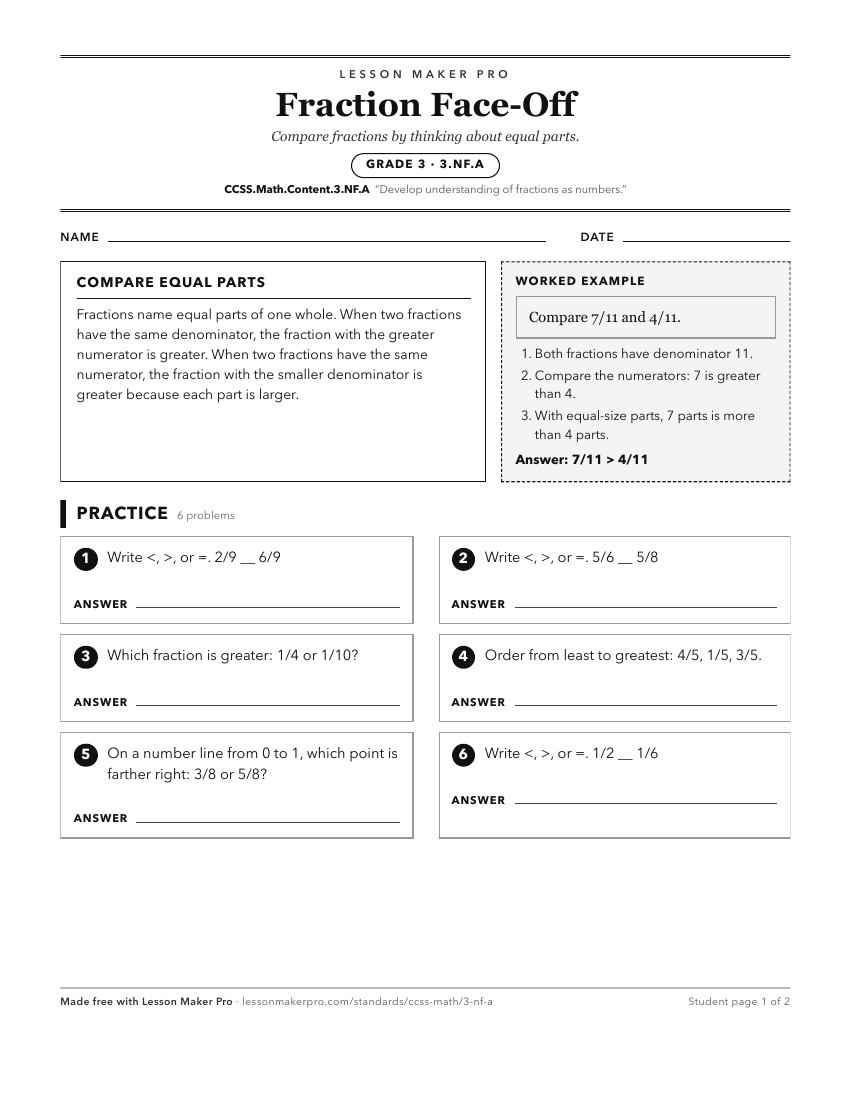
A ready-to-print activity worksheet aligned to CCSS.Math.Content.3.NF.A, with an answer key for the teacher on its own page. No account needed.
PDF, US Letter, prints cleanly in black and white.
Download the worksheetKeep exploring
Related Standards
Turn this cluster into a lesson
Grade, subject, topic, and the complete cluster are prefilled. Create one free, no account needed.
Also for this cluster:Make a WorksheetMake a QuizMake a Sub Lesson