CCSS.
Standard Cluster
Build fractions from unit fractions by applying and extending previous understandings of operations on whole numbers.
Common Core State Standards for Mathematics
Cluster contents
Standards in This Cluster
CCSS.Math.Content.4.NF.B is a cluster heading. These are the individual standards under it.
- CCSS.Math.Content.4.NF.B.3
Understand a fraction a/b with a > 1 as a sum of fractions 1/b.
- CCSS.Math.Content.4.NF.B.3a
Understand addition and subtraction of fractions as joining and separating parts referring to the same whole.
- CCSS.Math.Content.4.NF.B.3b
Decompose a fraction into a sum of fractions with the same denominator in more than one way, recording each decomposition by an equation. Justify decompositions...
- CCSS.Math.Content.4.NF.B.3c
Add and subtract mixed numbers with like denominators, e.g., by replacing each mixed number with an equivalent fraction, and/or by using properties of operation...
- CCSS.Math.Content.4.NF.B.3d
Solve word problems involving addition and subtraction of fractions referring to the same whole and having like denominators, e.g., by using visual fraction mod...
- CCSS.Math.Content.4.NF.B.4
Apply and extend previous understandings of multiplication to multiply a fraction by a whole number.
- CCSS.Math.Content.4.NF.B.4a
Understand a fraction a/b as a multiple of 1/b.
- CCSS.Math.Content.4.NF.B.4b
Understand a multiple of a/b as a multiple of 1/b, and use this understanding to multiply a fraction by a whole number.
- CCSS.Math.Content.4.NF.B.4c
Solve word problems involving multiplication of a fraction by a whole number, e.g., by using visual fraction models and equations to represent the problem.
Teacher's field guide
What This Cluster Means
What Students Need to Do
- Students break fractions into sums of smaller fractions, then combine or separate fractions with the same denominator. They also connect repeated addition to multiplying a fraction by a whole number and solve related word problems.
What Mastery Looks Like
- Students can represent a fraction as a sum of unit fractions and decompose it in more than one way. They accurately add and subtract fractions with matching denominators and multiply a fraction by a whole number.
Common Misconceptions
- Students may add denominators when adding fractions, or treat the numerator and denominator as separate whole numbers. They may also confuse multiplying a fraction by a whole number with multiplying both parts of the fraction.
How to Assess It
- Give an exit ticket: Draw a model for 7/4, decompose it two ways, find 7/4 minus 3/4, and calculate 3 times 2/5.
Lesson moves
Ways to Teach It
Give pairs fraction strips and ask them to build 7/4, then record two different addition equations that match their models.
Ask students to explain why 2/5 plus 1/5 equals 3/5 rather than 3/10, using a drawing or written argument.
Play Fraction Target: students draw fraction cards with matching denominators and combine them using addition or subtraction to reach a target fraction.
Use a recipe needing 3/4 cup of oats per batch, and have students model and calculate the amount needed for four batches.
Free download
Printable 4.NF.B Worksheet
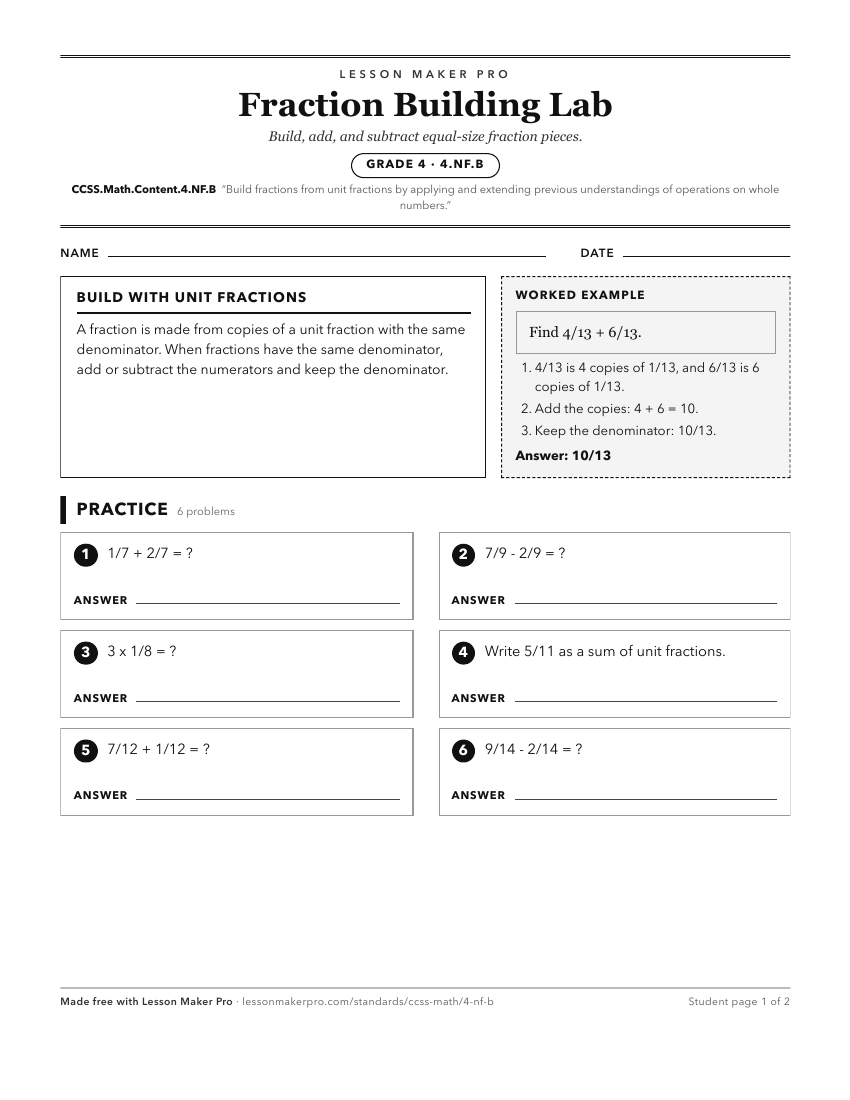
A ready-to-print activity worksheet aligned to CCSS.Math.Content.4.NF.B, with an answer key for the teacher on its own page. No account needed.
PDF, US Letter, prints cleanly in black and white.
Download the worksheetKeep exploring
Related Standards
- CCSS.Math.Content.5.NF.B.4
Apply and extend previous understandings of multiplication to multiply a fraction or whole number by a fraction.
- CCSS.Math.Content.5.NF.B.7
Apply and extend previous understandings of division to divide unit fractions by whole numbers and whole numbers by unit fractions.
- CCSS.Math.Content.6.NS.A
Apply and extend previous understandings of multiplication and division to divide fractions by fractions.
Turn this cluster into a lesson
Grade, subject, topic, and the complete cluster are prefilled. Create one free, no account needed.
Also for this cluster:Make a WorksheetMake a QuizMake a Sub Lesson