CCSS.
The Standard
Understand addition and subtraction of fractions as joining and separating parts referring to the same whole.
Common Core State Standards for Mathematics
Teacher's field guide
What This Standard Means
What Students Need to Do
- Students combine or remove equal fractional pieces from the same whole. They represent the action with pictures, words, and equations while keeping the unit fraction size unchanged.
What Mastery Looks Like
- A student can model and solve problems such as 3/8 plus 2/8 or 7/10 minus 4/10. The student explains that the pieces must have the same size and refer to the same whole.
Common Misconceptions
- Students may add or subtract denominators along with numerators. They may also combine fractions from different-sized wholes as if the pieces were equal.
How to Assess It
- Give an exit ticket: “Draw a fraction bar and solve 5/8 minus 2/8. Explain why the denominator stays 8.”
Lesson moves
Ways to Teach It
Give pairs paper fraction strips to join 2/6 and 3/6, then remove 1/6 and record each equation.
Ask, “Why can two fourths and one fourth be combined, but pieces from different-sized pizzas may not be combined?”
Play fraction match: students pair diagram cards with addition or subtraction equations and explain each match to a partner.
Use a pan of brownies cut into eighths, then model pieces served and pieces remaining with fraction equations.
Free download
Printable 4.NF.B.3a Worksheet
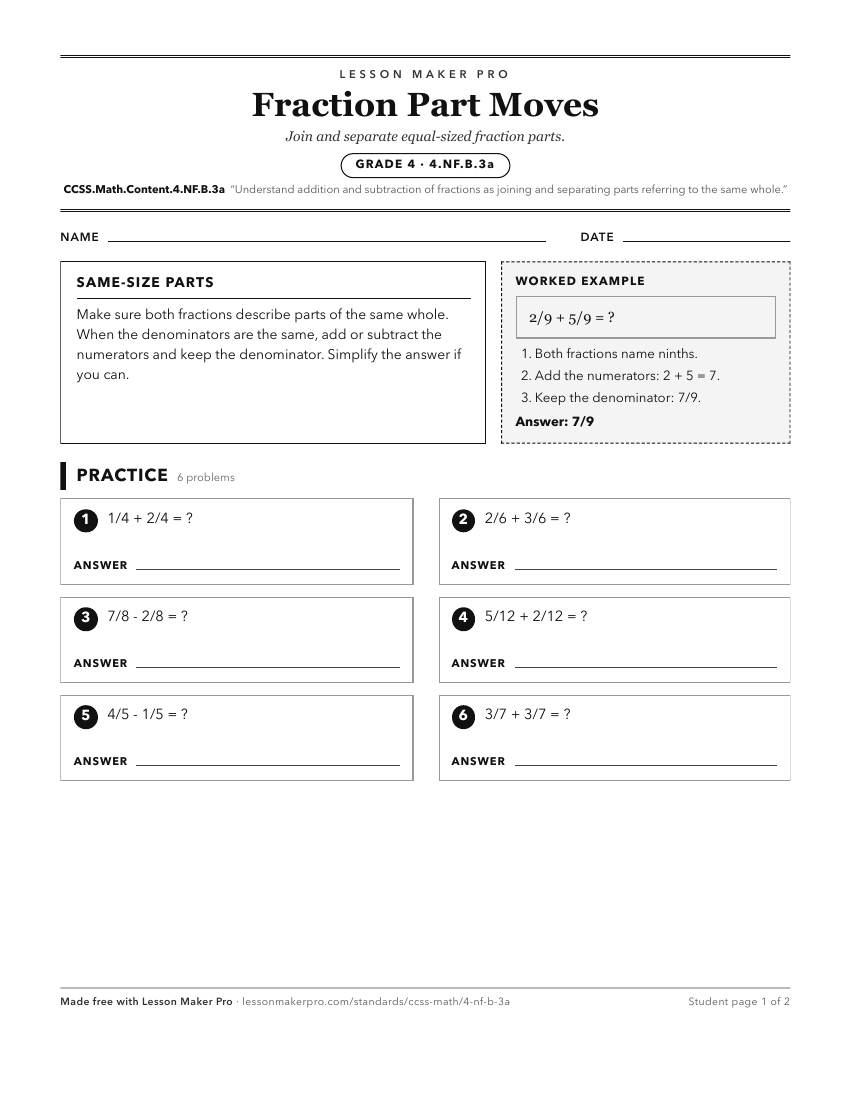
A ready-to-print activity worksheet aligned to CCSS.Math.Content.4.NF.B.3a, with an answer key for the teacher on its own page. No account needed.
PDF, US Letter, prints cleanly in black and white.
Download the worksheetLearning progression
Where This Standard Sits
Before This Standard
If students are struggling here, check these first.
- CCSS.Math.Content.3.NF.A.1
Students must see fractions as equal-size parts of one whole before joining or separating those parts in addition and subtraction.
- CCSS.Math.Content.2.OA.A.1
Whole-number joining and separating word problems support seeing fraction addition and subtraction as combining or removing parts of one whole.
- CCSS.Math.Content.2.G.A.3
Partitioning equal shares and naming parts supports seeing fraction addition and subtraction as joining or separating parts of one whole.
What This Unlocks
Mastery here sets students up for these next.
- CCSS.Math.Content.4.NF.B.3d
Word problems require interpreting fraction addition and subtraction as joining or separating like-sized parts of the same whole.
- CCSS.Math.Content.4.NF.B.3b
Decomposing a fraction requires seeing same-denominator fraction addition as joining parts of the same whole.
- CCSS.Math.Content.4.NF.B.3c
Mixed-number operations require combining or separating the fractional parts as same-size parts of the same whole.
- CCSS.Math.Content.4.NF.C.5
Adding tenths and hundredths relies on seeing fraction addition as joining parts of the same whole after making like units.
- CCSS.Math.Content.4.MD.B.4
Students use joining and separating same-unit fractions to combine or compare fractional measurements shown on the line plot.
- CCSS.Math.Content.4.NF.B.3
Joining same-denominator parts supports seeing 3 fifths as 1 fifth plus 1 fifth plus 1 fifth.
Keep exploring
Related Standards
- CCSS.Math.Content.5.NF.A.2
Solve word problems involving addition and subtraction of fractions referring to the same whole, including cases of unlike denominators, e.g., by using visual f...
- CCSS.Math.Content.6.NS.A
Apply and extend previous understandings of multiplication and division to divide fractions by fractions.
- CCSS.Math.Content.K.OA.A
Understand addition as putting together and adding to, and understand subtraction as taking apart and taking from.
Turn this exact standard into a lesson
Grade, subject, topic, and the complete standard are prefilled. Create one free, no account needed.
Also for this standard:Make a WorksheetMake a QuizMake a Sub Lesson