CCSS.
The Standard
Understand a fraction 1/b as the quantity formed by 1 part when a whole is partitioned into b equal parts; understand a fraction a/b as the quantity formed by a parts of size 1/b.
Common Core State Standards for Mathematics · Number and Operations—Fractions
Teacher's field guide
What This Standard Means
What Students Need to Do
- Students split one whole into equal parts and name one part as a unit fraction. They build other fractions by counting parts of that same size.
What Mastery Looks Like
- A student can explain that the denominator tells how many equal parts make the whole. The student can show 3/4 as three pieces, each sized 1/4, using a model.
Common Misconceptions
- Students may count unequal pieces as valid fractional parts or think a larger denominator means larger pieces. They may label three of four equal pieces as 4/3 by reversing the numerator and denominator.
How to Assess It
- Give students a blank rectangle and ask: Show 3/5, then explain what 1/5 and 3/5 mean. Check for five equal parts and three selected parts.
Lesson moves
Ways to Teach It
Give pairs paper strips to fold into equal fourths, label each piece 1/4, then combine and label three pieces 3/4.
Display two partitioned circles, one equal and one unequal, and ask, “Which model can show thirds, and why?”
Play Fraction Build: call a fraction, and students cover that many unit fraction sections on matching fraction mats.
Use a granola bar diagram divided into six equal sections, and ask how much remains after two sections are eaten.
Free download
Printable 3.NF.A.1 Worksheet
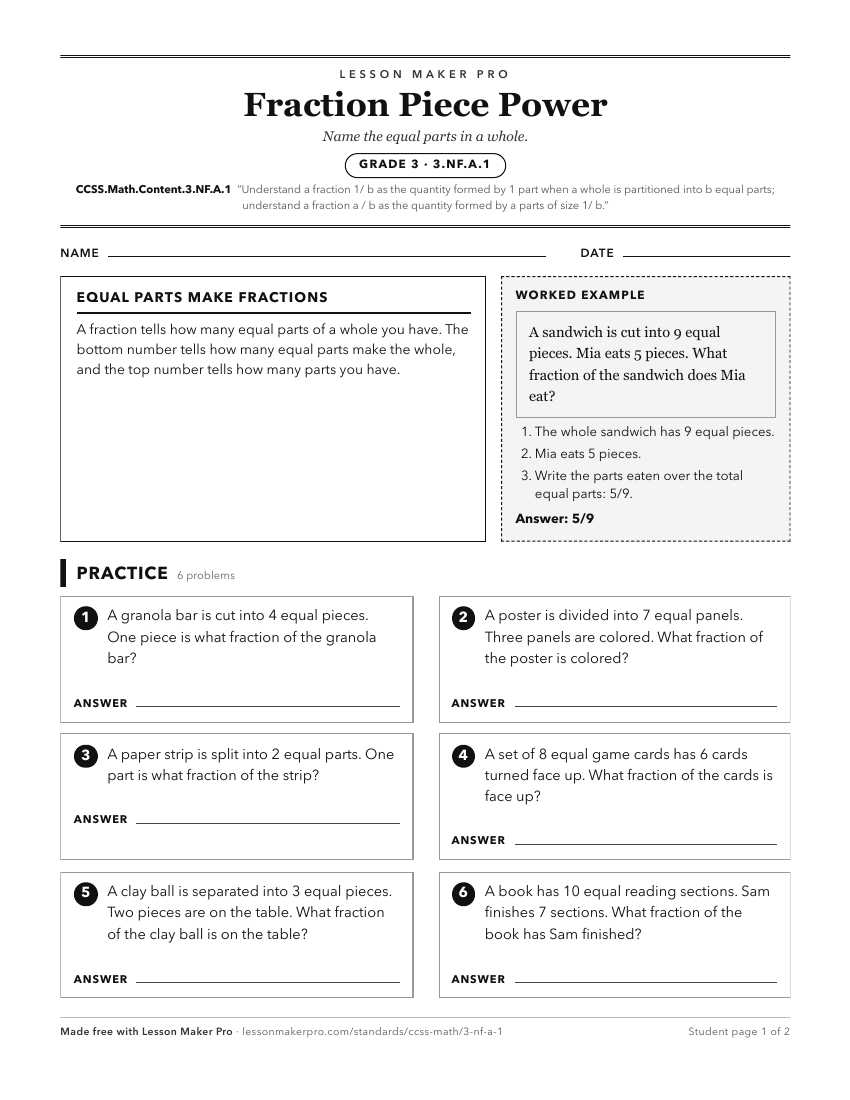
A ready-to-print activity worksheet aligned to CCSS.Math.Content.3.NF.A.1, with an answer key for the teacher on its own page. No account needed.
PDF, US Letter, prints cleanly in black and white.
Download the worksheetLearning progression
Where This Standard Sits
See the whole path on the Number & Operations: Fractions progression map.
Before This Standard
If students are struggling here, check these first.
- CCSS.Math.Content.2.G.A.3
Naming equal shares as halves, thirds, and fourths prepares students to see 1/b as one equal part of a whole.
- CCSS.Math.Content.1.G.A.3
Students must understand equal shares and wholes made of shares before interpreting 1/b and a/b as parts of a whole.
- CCSS.Math.Content.3.OA.A.2
Equal-sharing division supports the idea of partitioning one whole into equal parts to name unit fractions.
What This Unlocks
Mastery here sets students up for these next.
- CCSS.Math.Content.3.NF.A.3c
Students need numerator, denominator, and unit-fraction meaning to see b/b as one whole and make whole-number fractions.
- CCSS.Math.Content.3.NF.A.3d
Comparing same-numerator or same-denominator fractions depends on knowing a/b as a parts of equal unit fraction size.
- CCSS.Math.Content.5.NF.B.3
Students must understand a/b as a quantity made of unit fractions before using it as the result of whole-number division.
- CCSS.Math.Content.5.NF.B.7
Students must understand unit fractions as equal parts and a/b as quantities before interpreting division with unit fractions.
- CCSS.Math.Content.5.NF.B.4b
Interpreting fractional side lengths and unit-fraction tiles requires knowing a/b as a quantity made from unit fraction parts.
- CCSS.Math.Content.5.NF.B.4a
Interpreting a/b times q requires knowing a/b as a equal parts of size 1/b from an equal partition.
Keep exploring
Related Standards
- CCSS.Math.Content.4.NF.B.4a
Understand a fraction a/b as a multiple of 1/b.
- CCSS.Math.Content.3.NF.A.2a
Represent a fraction 1/b on a number line diagram by defining the interval from 0 to 1 as the whole and partitioning it into b equal parts. Recognize that each ...
- CCSS.Math.Content.4.NF.B.4b
Understand a multiple of a/b as a multiple of 1/b, and use this understanding to multiply a fraction by a whole number.
- CCSS.Math.Content.4.NF.B.3
Understand a fraction a/b with a > 1 as a sum of fractions 1/b.
Turn this exact standard into a lesson
Grade, subject, topic, and the complete standard are prefilled. Create one free, no account needed.
Also for this standard:Make a WorksheetMake a QuizMake a Sub Lesson