CCSS.
The Standard
Understand a fraction a/b with a > 1 as a sum of fractions 1/b.
Common Core State Standards for Mathematics · Number and Operations—Fractions
Teacher's field guide
What This Standard Means
What Students Need to Do
- Students treat a fraction with numerator greater than 1 as repeated copies of one unit fraction. They use models and equations to show, for example, that 5/8 is five copies of 1/8.
What Mastery Looks Like
- A student can model 7/4 with seven one-fourth pieces. They can write the matching repeated sum and explain that 7 counts the pieces while 4 names their size.
Common Misconceptions
- Students may think the numerator names each piece's size, or add denominators when combining identical unit fractions. Some write 5/8 as five copies of 1/5 instead of 1/8.
How to Assess It
- Exit ticket: Draw a model for 6/7, then write it as a sum of unit fractions and state how many copies of 1/7 it contains.
Lesson moves
Ways to Teach It
Give pairs fraction strips; have them cover a 5/6 strip with 1/6 pieces, then sketch and write the matching sum.
Ask, “Why does 4/7 equal four copies of 1/7, and what does the denominator tell us?”
Play a matching game with cards showing fractions, unit fraction sums, and shaded models, with students forming sets of three.
Plan snack bags using 1/8 cup scoops, then write the total for five scoops as a fraction and a unit fraction sum.
Free download
Printable 4.NF.B.3 Worksheet
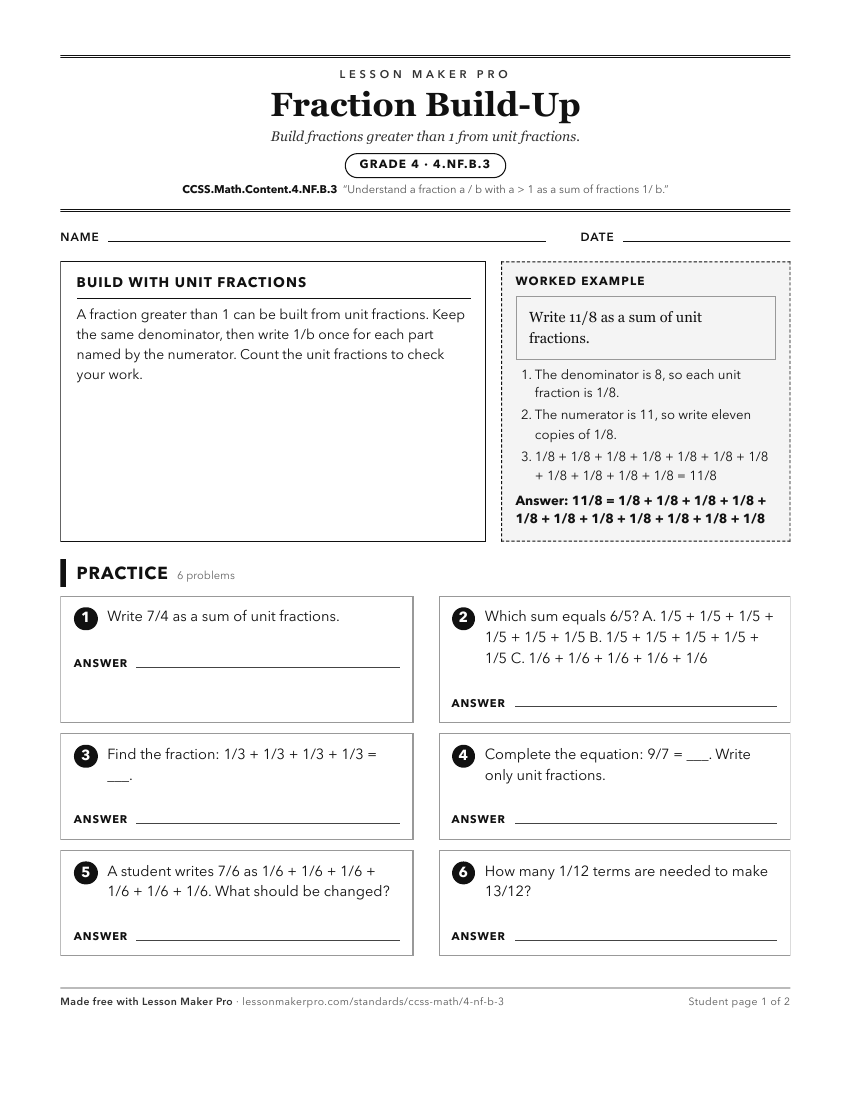
A ready-to-print activity worksheet aligned to CCSS.Math.Content.4.NF.B.3, with an answer key for the teacher on its own page. No account needed.
PDF, US Letter, prints cleanly in black and white.
Download the worksheetLearning progression
Where This Standard Sits
See the whole path on the Number & Operations: Fractions progression map.
Before This Standard
If students are struggling here, check these first.
- CCSS.Math.Content.3.NF.A.1
Students must know a/b means a equal unit-fraction parts before seeing it as adding a copies of 1/b.
- CCSS.Math.Content.3.NF.A.2b
Marking a/b as a steps of 1/b on the number line supports seeing a/b as repeated unit fractions.
- CCSS.Math.Content.4.NF.B.3a
Joining same-denominator parts supports seeing 3 fifths as 1 fifth plus 1 fifth plus 1 fifth.
What This Unlocks
Mastery here sets students up for these next.
Keep exploring
Related Standards
- CCSS.Math.Content.4.NF.B.4a
Understand a fraction a/b as a multiple of 1/b.
- CCSS.Math.Content.4.NF.A.1
Explain why a fraction a/b is equivalent to a fraction (n × a)/(n × b) by using visual fraction models, with attention to how the number and size of the parts d...
- CCSS.Math.Content.4.NF.B.4b
Understand a multiple of a/b as a multiple of 1/b, and use this understanding to multiply a fraction by a whole number.
Turn this exact standard into a lesson
Grade, subject, topic, and the complete standard are prefilled. Create one free, no account needed.
Also for this standard:Make a WorksheetMake a QuizMake a Sub Lesson