CCSS.
The Standard
Decompose a fraction into a sum of fractions with the same denominator in more than one way, recording each decomposition by an equation. Justify decompositions, e.g., by using a visual fraction model.
Common Core State Standards for Mathematics
Teacher's field guide
What This Standard Means
What Students Need to Do
- Students break a fraction or mixed number into sums of fractions that share its denominator. They record more than one equation and use a fraction model to show that each sum equals the original amount.
What Mastery Looks Like
- Students write several correct addition equations for one fraction while keeping the denominator the same. They use a fraction bar or number line to show why each equation names the same amount, including examples with mixed numbers.
Common Misconceptions
- Students may add denominators when combining parts, or think each decomposition must use only unit fractions. Mixed numbers also cause confusion, especially when students do not recognize one whole as a fraction such as 8/8.
How to Assess It
- Give students 7/8 and ask them to write two different addition equations for it, then draw a fraction bar proving one equation.
Lesson moves
Ways to Teach It
Give pairs fraction strips and have them build 5/6 in three ways, then record an equation for each arrangement.
Ask students to explain why 3/4 can equal 1/4 + 2/4 but cannot equal 1/4 + 2/8.
Play Fraction Breakdown: draw a fraction card, write a new decomposition, and earn a point if a partner verifies it.
Use a measuring cup diagram to show two ways to combine same-denominator amounts that total 1 3/4 cups.
Free download
Printable 4.NF.B.3b Worksheet
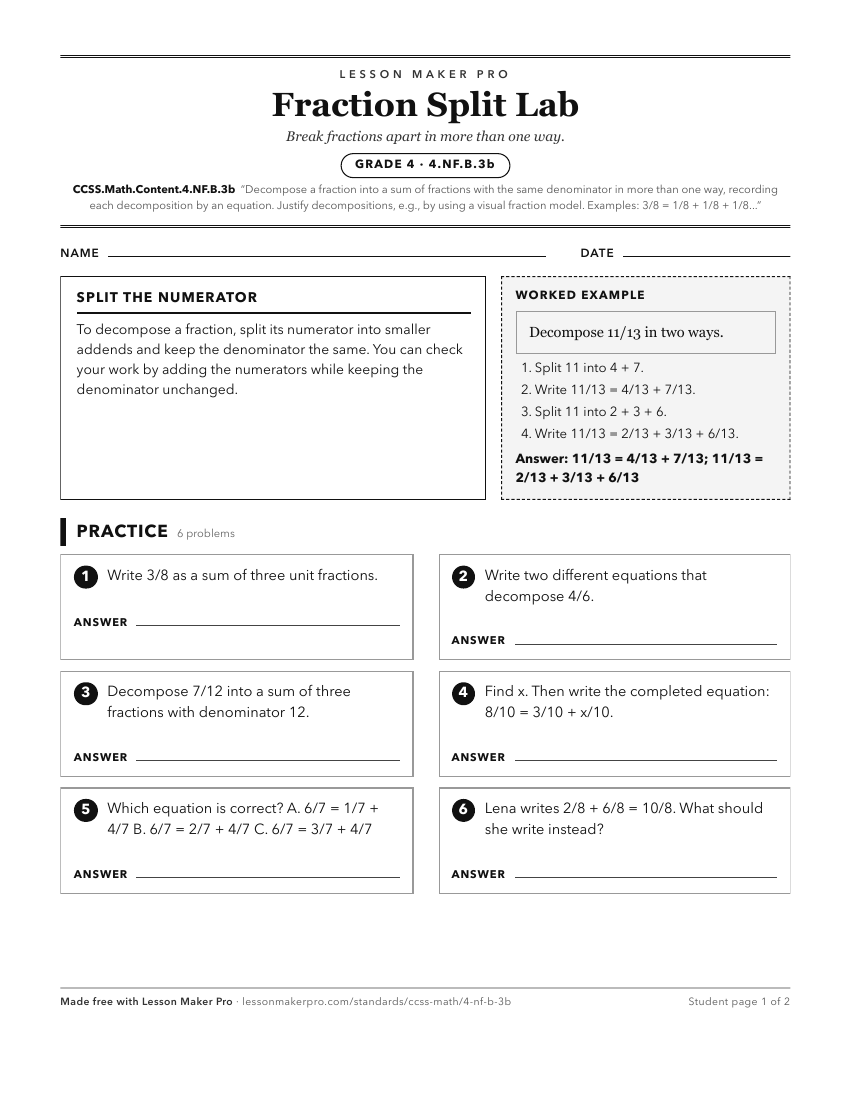
A ready-to-print activity worksheet aligned to CCSS.Math.Content.4.NF.B.3b, with an answer key for the teacher on its own page. No account needed.
PDF, US Letter, prints cleanly in black and white.
Download the worksheetLearning progression
Where This Standard Sits
Before This Standard
If students are struggling here, check these first.
- CCSS.Math.Content.4.NF.B.3a
Decomposing a fraction requires seeing same-denominator fraction addition as joining parts of the same whole.
- CCSS.Math.Content.4.NF.B.3
Decomposing fractions with like denominators relies on seeing a/b as composed of unit fractions that can be grouped different ways.
- CCSS.Math.Content.3.NF.A.1
Decomposing a fraction requires seeing a/b as a count of unit fractions 1/b that can be regrouped into sums.
What This Unlocks
Mastery here sets students up for these next.
Keep exploring
Related Standards
- CCSS.Math.Content.5.NF.B.3
Interpret a fraction as division of the numerator by the denominator (a/b = a ÷ b). Solve word problems involving division of whole numbers leading to answers i...
- CCSS.Math.Content.3.NF.A.3b
Recognize and generate simple equivalent fractions, e.g., 1/2 = 2/4, 4/6 = 2/3). Explain why the fractions are equivalent, e.g., by using a visual fraction mode...
- CCSS.Math.Content.5.NF.B.7c
Solve real world problems involving division of unit fractions by non-zero whole numbers and division of whole numbers by unit fractions, e.g., by using visual ...
- CCSS.Math.Content.4.NF.A.2
Compare two fractions with different numerators and different denominators, e.g., by creating common denominators or numerators, or by comparing to a benchmark ...
Turn this exact standard into a lesson
Grade, subject, topic, and the complete standard are prefilled. Create one free, no account needed.
Also for this standard:Make a WorksheetMake a QuizMake a Sub Lesson