CCSS.
The Standard
Represent a fraction a/b on a number line diagram by marking off a lengths 1/b from 0. Recognize that the resulting interval has size a/b and that its endpoint locates the number a/b on the number line.
Common Core State Standards for Mathematics
Teacher's field guide
What This Standard Means
What Students Need to Do
- Students split each whole on a number line into equal spaces based on the denominator. They count the numerator’s spaces from 0 and mark the endpoint as the fraction.
What Mastery Looks Like
- Students divide each whole into the number of equal spaces named by the denominator. They count the numerator’s spaces from 0, mark the endpoint, and explain its distance from 0.
Common Misconceptions
- Students may count tick marks instead of spaces, or divide the entire line rather than each whole into equal parts. They may switch the numerator and denominator or stop counting at 1. Some label a segment instead of marking the endpoint.
How to Assess It
- Give students a number line from 0 to 2 and ask: “Plot 5/4, circle its location, and write how many fourth-size spaces you counted.”
Lesson moves
Ways to Teach It
Make a masking tape number line, then place equal paper strips end to end from 0 to locate fractions such as 5/4.
Ask students to explain in writing how 7/3 names both a distance from 0 and a point on the number line.
Give pairs fraction cards and blank number lines; one student plots each fraction while the partner checks the partitions and counted spaces.
Use rulers to measure classroom objects to the nearest fourth inch, then plot each measurement on a number line.
Free download
Printable 3.NF.A.2b Worksheet
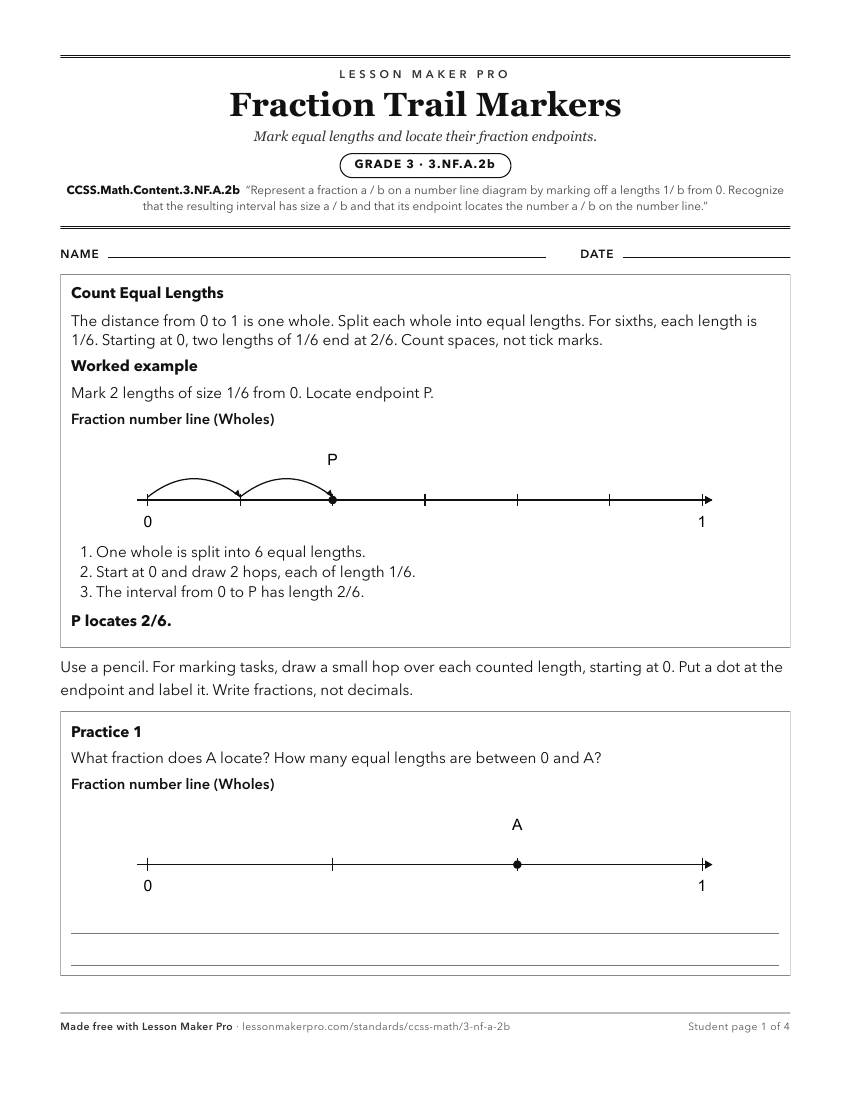
A ready-to-print activity worksheet aligned to CCSS.Math.Content.3.NF.A.2b, with an answer key for the teacher on its own page. No account needed.
PDF, US Letter, prints cleanly in black and white.
Download the worksheetLearning progression
Where This Standard Sits
Before This Standard
If students are struggling here, check these first.
- CCSS.Math.Content.3.NF.A.2a
Students use unit fractions on the number line to count off multiple equal lengths and locate a/b.
- CCSS.Math.Content.3.NF.A.1
Students need the meaning of a/b as a parts of size 1/b to mark those unit fractions from 0.
- CCSS.Math.Content.2.MD.B.6
Fraction points require the same number line ideas of equal spacing, distance from 0, and endpoints locating numbers.
What This Unlocks
Mastery here sets students up for these next.
Keep exploring
Related Standards
- CCSS.Math.Content.3.NF.A.2
Understand a fraction as a number on the number line; represent fractions on a number line diagram.
- CCSS.Math.Content.4.NF.A.1
Explain why a fraction a/b is equivalent to a fraction (n × a)/(n × b) by using visual fraction models, with attention to how the number and size of the parts d...
Turn this exact standard into a lesson
Grade, subject, topic, and the complete standard are prefilled. Create one free, no account needed.
Also for this standard:Make a WorksheetMake a QuizMake a Sub Lesson