CCSS.
The Standard
Explain why a fraction a/b is equivalent to a fraction (n × a)/(n × b) by using visual fraction models, with attention to how the number and size of the parts differ even though the two fractions themselves are the same size. Use this principle to recognize and generate equivalent fractions.
Common Core State Standards for Mathematics · Number and Operations—Fractions
Teacher's field guide
What This Standard Means
What Students Need to Do
- Students use fraction strips, area models, or number lines to show that one amount can have different fraction names. They make equivalent fractions by multiplying both numbers by the same whole number.
What Mastery Looks Like
- Students correctly identify and generate equivalent fractions. They use a fraction strip, area model, or number line to explain how both fractions name the same amount.
Common Misconceptions
- Students may add the same number to the numerator and denominator instead of multiplying both. They may also think more pieces means a larger fraction, ignoring that each piece becomes smaller.
How to Assess It
- Exit ticket: Complete 3/4 = ?/12, draw a fraction model showing both fractions, and write one sentence explaining why they are equal.
Lesson moves
Ways to Teach It
Have students fold two equal paper strips into different numbers of parts, then shade and label equivalent amounts.
Show 2/3 and 4/6, then ask students to write why more shaded pieces do not mean a greater amount.
Play a matching game with fraction cards and picture cards, requiring students to explain each equivalent pair they collect.
Measure 1/2 cup of water using two 1/4-cup scoops, then have students sketch and label the equivalence.
Free download
Printable 4.NF.A.1 Worksheet
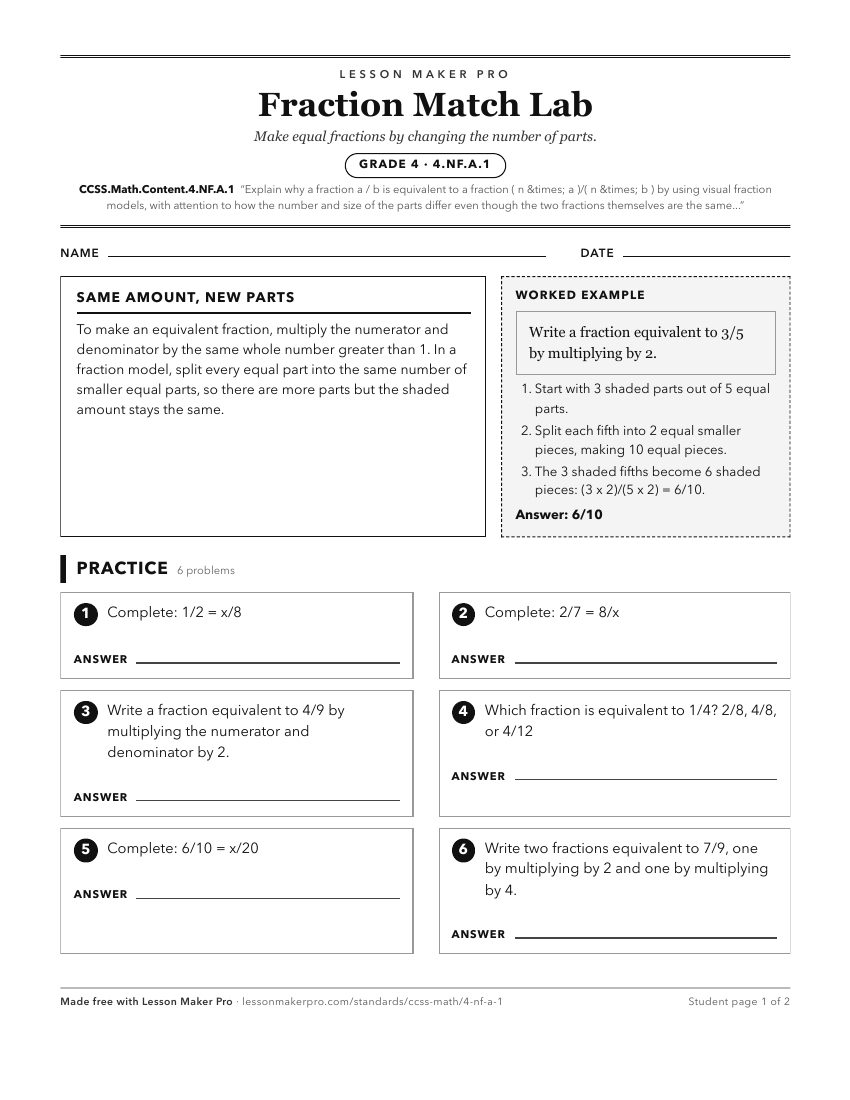
A ready-to-print activity worksheet aligned to CCSS.Math.Content.4.NF.A.1, with an answer key for the teacher on its own page. No account needed.
PDF, US Letter, prints cleanly in black and white.
Download the worksheetLearning progression
Where This Standard Sits
See the whole path on the Number & Operations: Fractions progression map.
Before This Standard
If students are struggling here, check these first.
- CCSS.Math.Content.3.NF.A.1
Students must understand a/b as a parts of size 1/b before explaining how subdividing parts creates equivalent fractions.
- CCSS.Math.Content.3.NF.A.3a
Students must understand equivalence as same size or same point before explaining how multiplying numerator and denominator preserves that value.
- CCSS.Math.Content.3.NF.A.3b
Students generalize simple visual equivalence to multiplying numerator and denominator while tracking changed part number and size.
What This Unlocks
Mastery here sets students up for these next.
- CCSS.Math.Content.5.NF.A.2
Generating equivalent fractions is needed to rename unlike denominators before adding or subtracting fractions in word problems.
- CCSS.Math.Content.5.NF.A.1
Adding unlike denominators requires generating equivalent fractions with common denominators while preserving each fraction’s value.
- CCSS.Math.Content.5.NF.B.5b
Equivalent fraction models support seeing n/n as 1 and explaining why multiplying numerator and denominator preserves value.
- CCSS.Math.Content.4.NF.A.2
Generating equivalent fractions supports comparing unlike denominators by making common denominators or numerators, but benchmarks and models can also work.
- CCSS.Math.Content.4.NF.C.5
Converting tenths to hundredths for addition requires understanding that multiplying numerator and denominator creates an equivalent fraction.
- CCSS.Math.Content.5.NF.B.4
Understanding equivalent fractions supports renaming and interpreting products, but students can begin fraction multiplication with area and scaling models.
Keep exploring
Related Standards
Turn this exact standard into a lesson
Grade, subject, topic, and the complete standard are prefilled. Create one free, no account needed.
Also for this standard:Make a WorksheetMake a QuizMake a Sub Lesson