CCSS.
The Standard
Partition circles and rectangles into two, three, or four equal shares, describe the shares using the words halves, thirds, half of, a third of, etc., and describe the whole as two halves, three thirds, four fourths. Recognize that equal shares of identical wholes need not have the same shape.
Common Core State Standards for Mathematics · Geometry
Teacher's field guide
What This Standard Means
What Students Need to Do
- Students split circles and rectangles fairly among two, three, or four people and name the resulting shares. They compare partitions and decide whether each part has the same amount of space.
What Mastery Looks Like
- Students make fair partitions in circles and rectangles and correctly label each share. They explain that equal shares contain the same amount, even when their shapes differ.
Common Misconceptions
- Students may count pieces without checking whether each piece has the same amount of space. They may also think equal shares must have matching shapes or confuse thirds with three pieces of any size.
How to Assess It
- Exit ticket: Divide a circle into four equal shares and label one fourth. Then explain why identical rectangles split vertically and diagonally can both show halves.
Lesson moves
Ways to Teach It
Fold paper circles and rectangles to make halves, thirds, and fourths, then unfold and label each share.
Show two differently partitioned rectangles and ask, "Can both show halves? How do you know the shares are fair?"
Play Fair Share Sort: students sort shape cards into halves, thirds, fourths, or unequal groups, then justify one choice.
Draw ways to share a pizza or pan of brownies fairly among two, three, or four people.
Free download
Printable 2.G.A.3 Worksheet
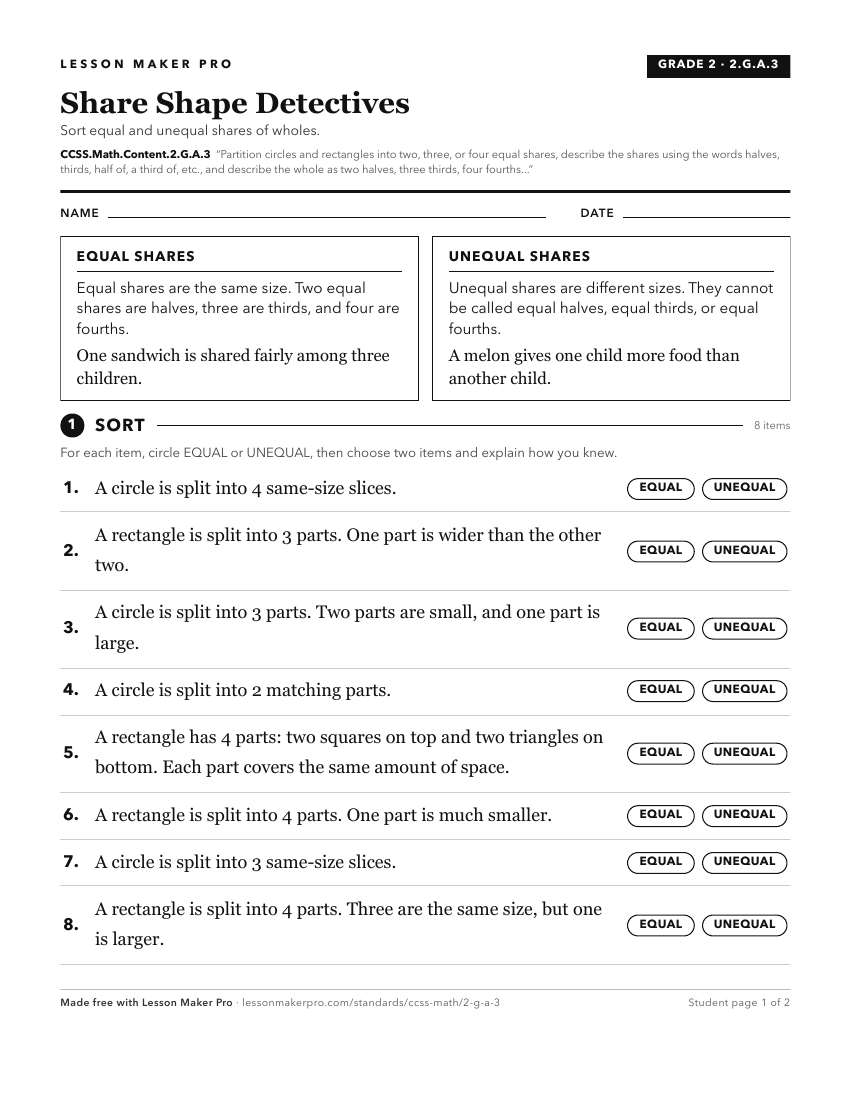
A ready-to-print activity worksheet aligned to CCSS.Math.Content.2.G.A.3, with an answer key for the teacher on its own page. No account needed.
PDF, US Letter, prints cleanly in black and white.
Download the worksheetBefore This Standard
If students are struggling here, check these first.
- CCSS.Math.Content.1.G.A.3
Second grade extends equal partitioning language from halves and fourths to thirds and compares different-shaped equal shares.
- CCSS.Math.Content.K.G.A.2
Naming circles and rectangles supports partitioning them, but equal shares and fraction language are new skills not dependent on orientation naming.
- CCSS.Math.Content.1.G.A.1
Recognizing circles and rectangles by defining attributes supports partitioning the correct whole regardless of size or orientation.
What This Unlocks
Mastery here sets students up for these next.
- CCSS.Math.Content.3.G.A.2
Equal-share partitioning and fraction names for halves, thirds, and fourths carry into describing each equal-area part as a unit fraction.
- CCSS.Math.Content.3.NF.A.1
Naming equal shares as halves, thirds, and fourths prepares students to see 1/b as one equal part of a whole.
- CCSS.Math.Content.3.OA.A.2
Partitioning wholes into equal shares supports understanding division as equal sharing or making equal groups.
- CCSS.Math.Content.3.NF.A.3a
Naming equal shares and seeing different-shaped shares as equal supports judging when two fractions represent the same size.
- CCSS.Math.Content.3.NF.A.2
Equal-share partitioning gives meaning to halves, thirds, and fourths before placing those same unit fractions as lengths on a number line.
- CCSS.Math.Content.4.NF.B.3a
Partitioning equal shares and naming parts supports seeing fraction addition and subtraction as joining or separating parts of one whole.
Keep exploring
Related Standards
Turn this exact standard into a lesson
Grade, subject, topic, and the complete standard are prefilled. Create one free, no account needed.
Also for this standard:Make a WorksheetMake a QuizMake a Sub Lesson