CCSS.
The Standard
Correctly name shapes regardless of their orientations or overall size.
Common Core State Standards for Mathematics · Geometry
Teacher's field guide
What This Standard Means
What Students Need to Do
- Students name common flat and solid shapes even when the shapes are turned, flipped, larger, or smaller. They focus on defining features rather than orientation or size.
What Mastery Looks Like
- Students correctly name familiar shapes when they are turned, flipped, large, or small. They use features such as sides, corners, flat faces, or curved surfaces to support their answers.
Common Misconceptions
- Students may think a rotated square is a diamond or that a long rectangle is a different shape. They may also use size, color, or position instead of shape features when naming a shape.
How to Assess It
- Show a large sideways triangle, a small rotated square, and a tall rectangle. Ask students to name each shape and explain how they know.
Lesson moves
Ways to Teach It
Give pairs paper shapes in varied sizes and positions, then have students sort them by shape name.
Show a rotated square and ask, “Is this still a square? Tell which features prove your answer.”
Play Shape Flash: briefly show shape cards in unusual positions, and students hold up or say the matching name.
Photograph shapes around school, then label each object’s shape without using its size or position as evidence.
Free download
Printable K.G.A.2 Worksheet
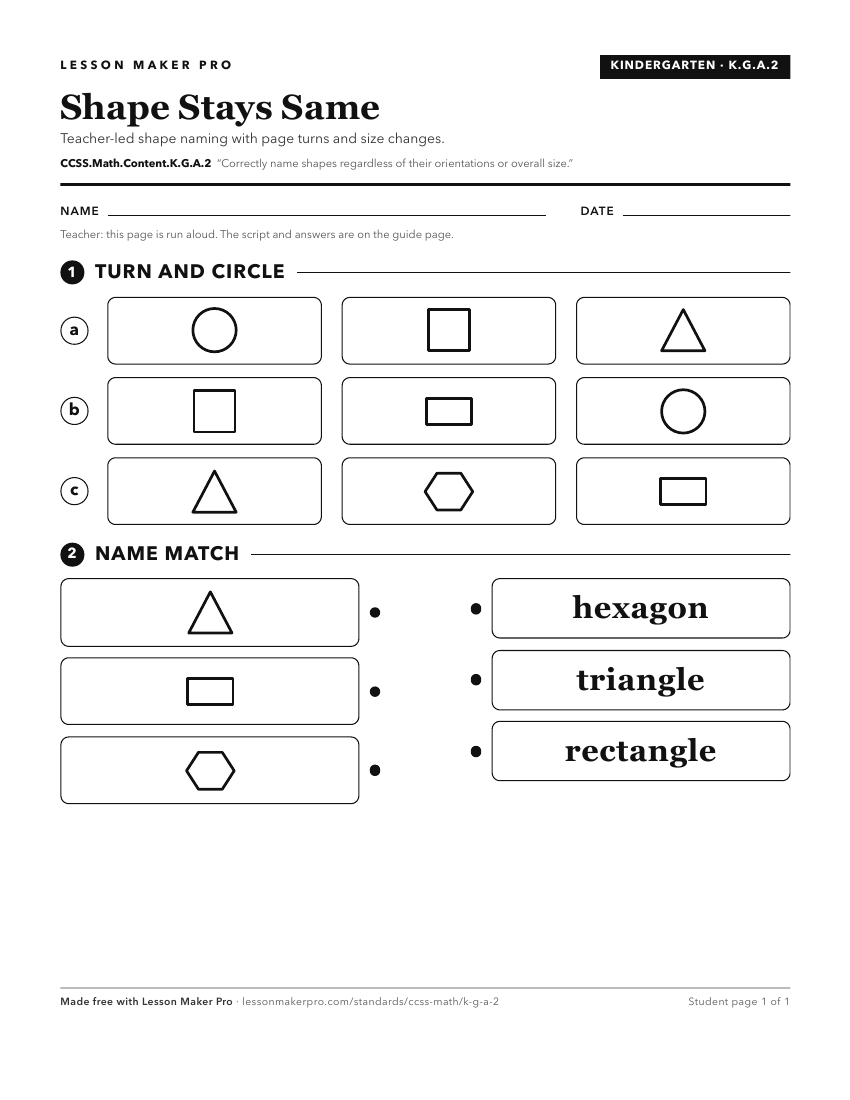
A ready-to-print activity worksheet aligned to CCSS.Math.Content.K.G.A.2, with an answer key for the teacher on its own page. No account needed.
PDF, US Letter, prints cleanly in black and white.
Download the worksheetBefore This Standard
If students are struggling here, check these first.
What This Unlocks
Mastery here sets students up for these next.
- CCSS.Math.Content.2.G.A.1
Naming shapes across size and orientation supports later identifying and drawing them by angles, sides, and faces.
- CCSS.Math.Content.1.G.A.2
Naming shapes across size and orientation supports recognizing the parts used when composing and recomposing composite shapes.
- CCSS.Math.Content.1.G.A.1
Recognizing shape names across size and orientation supports seeing which attributes define a shape and which do not.
- CCSS.Math.Content.1.G.A.3
Recognizing circles and rectangles in different sizes and orientations supports choosing and discussing the shapes students partition into equal shares.
- CCSS.Math.Content.K.G.B.5
Naming shapes across sizes and orientations supports choosing and representing the same shapes when building or drawing real-world models.
- CCSS.Math.Content.K.G.B.4
Naming shapes across sizes and orientations supports comparing their parts and attributes, but students can begin comparing without fluent shape names.
Keep exploring
Related Standards
Turn this exact standard into a lesson
Grade, subject, topic, and the complete standard are prefilled. Create one free, no account needed.
Also for this standard:Make a WorksheetMake a QuizMake a Sub Lesson