CCSS.
The Standard
Distinguish between defining attributes (e.g., triangles are closed and three-sided) versus non-defining attributes (e.g., color, orientation, overall size); build and draw shapes to possess defining attributes.
Common Core State Standards for Mathematics · Geometry
Teacher's field guide
What This Standard Means
What Students Need to Do
- Students decide which features determine a shape’s name and which features can change. They use sides, corners, lines, and closure to explain their choices. They also draw and build shapes that match given features.
What Mastery Looks Like
- Students correctly name shapes in different colors, sizes, and positions. They explain their choices using sides, corners, straight or curved lines, and whether the shape is closed. They can draw or build a requested shape with those features.
Common Misconceptions
- Students may think a rotated square is no longer a square. They may classify shapes by color or size instead of counting sides and corners. They may call any shape with a pointed top a triangle, even when it is open or has four sides.
How to Assess It
- Show a large blue triangle, a small rotated red triangle, and an open three-segment figure. Ask, “Which are triangles, and how do you know?”
Lesson moves
Ways to Teach It
Give students craft sticks and clay, then ask them to build closed shapes with three or four sides in different sizes and positions.
Show two different triangles and ask, “What can change and what must stay the same for both to be triangles?”
Play Shape Detective by giving clues such as, “I am closed and have four equal sides,” while students select the matching card.
Take a classroom shape hunt, then have students sketch one object and label the sides, corners, and lines they notice.
Free download
Printable 1.G.A.1 Worksheet
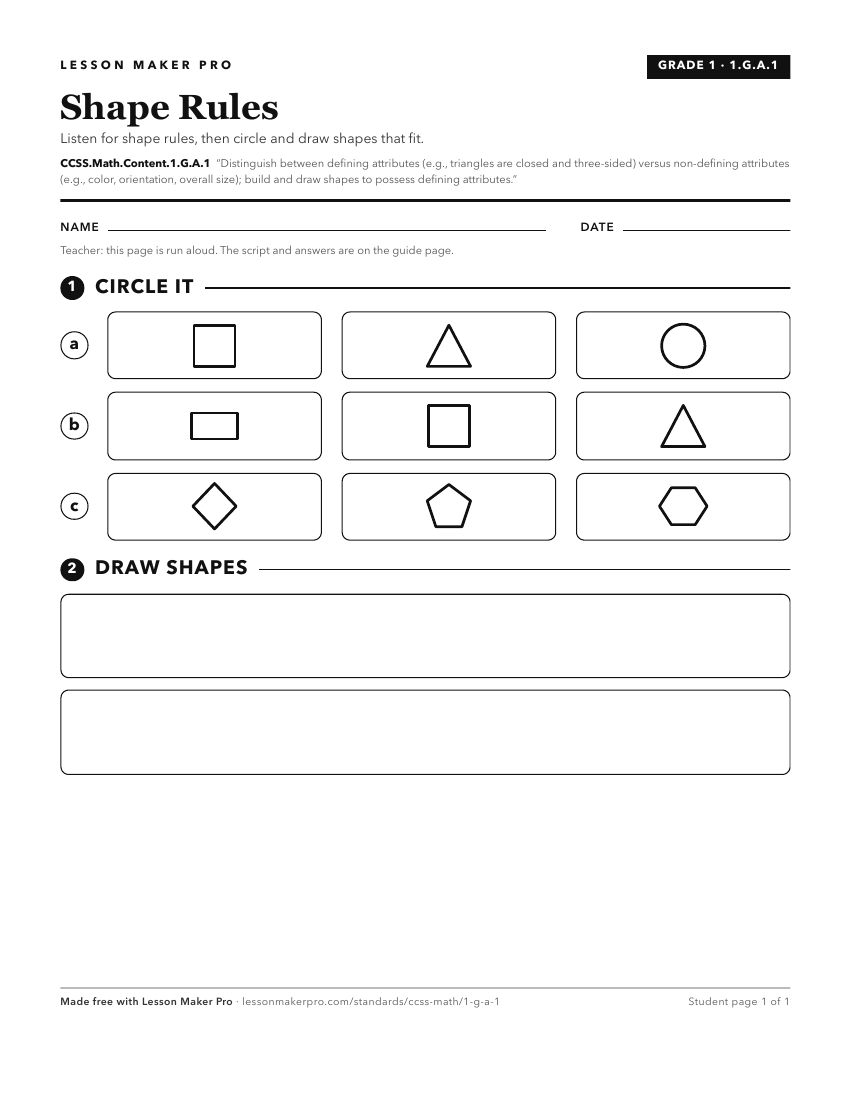
A ready-to-print activity worksheet aligned to CCSS.Math.Content.1.G.A.1, with an answer key for the teacher on its own page. No account needed.
PDF, US Letter, prints cleanly in black and white.
Download the worksheetBefore This Standard
If students are struggling here, check these first.
- CCSS.Math.Content.K.G.B.4
Comparing shapes by sides, corners, size, and orientation prepares students to tell which attributes define a shape and which do not.
- CCSS.Math.Content.K.G.A.2
Recognizing shape names across size and orientation supports seeing which attributes define a shape and which do not.
- CCSS.Math.Content.K.G.B.5
Building and drawing shapes gives students experience noticing sides and corners before using those attributes to define shapes.
What This Unlocks
Mastery here sets students up for these next.
- CCSS.Math.Content.3.G.A.1
Classifying quadrilaterals by shared properties requires knowing which shape attributes define membership rather than color, size, or orientation.
- CCSS.Math.Content.3.MD.C.5a
Recognizing squares by their defining attributes supports understanding a unit square as a specific square used to measure area.
- CCSS.Math.Content.2.G.A.1
Grade 2 shape recognition depends on using defining attributes like sides, angles, and faces rather than color, size, or orientation.
- CCSS.Math.Content.3.MD.C.5
Knowing closed plane shapes and their attributes supports seeing the inside of a figure as something that can be measured.
- CCSS.Math.Content.2.G.A.3
Recognizing circles and rectangles by defining attributes supports partitioning the correct whole regardless of size or orientation.
Keep exploring
Related Standards
Turn this exact standard into a lesson
Grade, subject, topic, and the complete standard are prefilled. Create one free, no account needed.
Also for this standard:Make a WorksheetMake a QuizMake a Sub Lesson