CCSS.
The Standard
Partition circles and rectangles into two and four equal shares, describe the shares using the words halves, fourths, and quarters, and use the phrases half of, fourth of, and quarter of. Describe the whole as two of, or four of the shares. Understand for these examples that decomposing into more equal shares creates smaller shares.
Common Core State Standards for Mathematics · Geometry
Teacher's field guide
What This Standard Means
What Students Need to Do
- Students split circles and rectangles into equal shares and name the pieces as halves, fourths, or quarters. They connect each share to the whole and compare the sizes of halves and fourths.
What Mastery Looks Like
- Students divide a circle or rectangle into equal pieces and name each piece correctly. They explain that two halves or four fourths make the whole, and that fourths are smaller than halves.
Common Misconceptions
- Students may call any two pieces halves, even when the pieces are different sizes. They may think fourths are larger than halves because four is greater than two. Some may not see that two halves or four fourths rebuild one whole.
How to Assess It
- Give students a rectangle divided into four unequal pieces. Ask them to explain whether each piece is one fourth, then draw a correct partition.
Lesson moves
Ways to Teach It
Give students paper circles and rectangles to fold, cut, and label as halves, fourths, and quarters.
Show two differently partitioned rectangles and ask which pieces are fair shares and how students know.
Play Match the Whole: students pair whole-shape cards with cards showing two halves or four fourths.
Use a sandwich and a round tortilla to compare equal sharing between two people and four people.
Free download
Printable 1.G.A.3 Worksheet
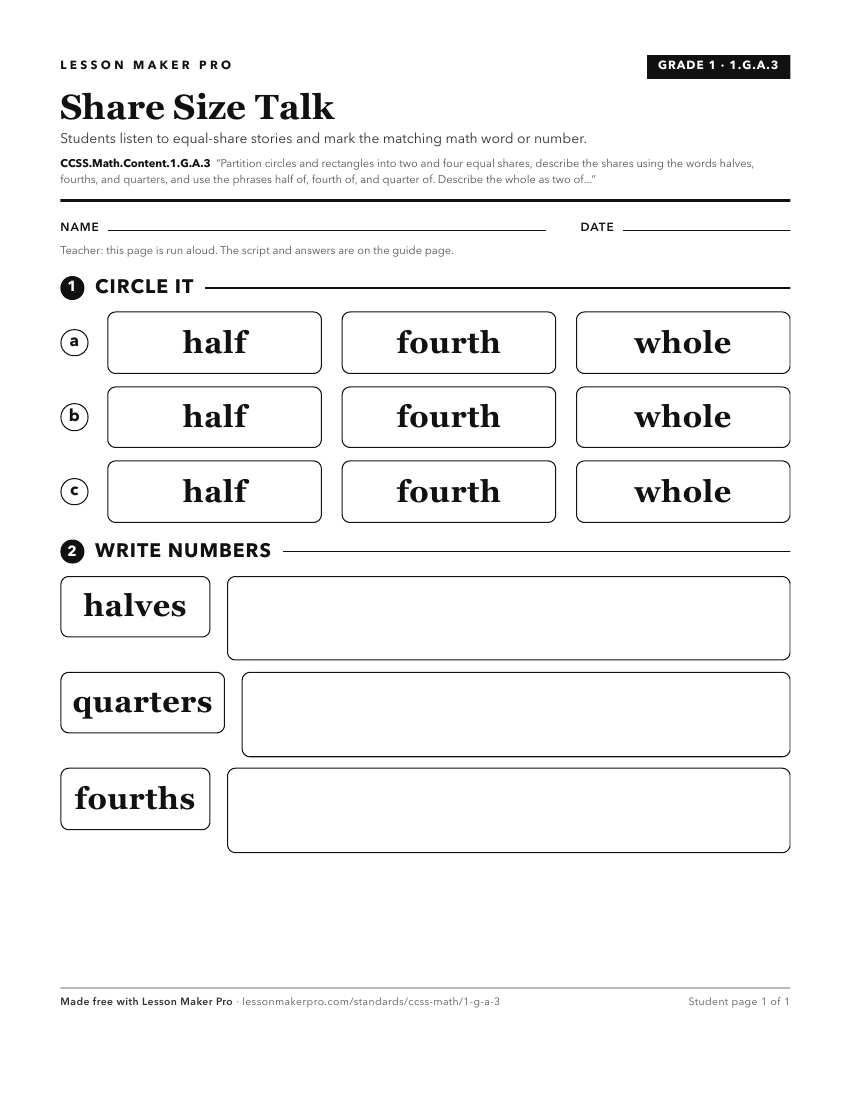
A ready-to-print activity worksheet aligned to CCSS.Math.Content.1.G.A.3, with an answer key for the teacher on its own page. No account needed.
PDF, US Letter, prints cleanly in black and white.
Download the worksheetBefore This Standard
If students are struggling here, check these first.
- CCSS.Math.Content.K.CC.B.4
Counting and cardinality support seeing a whole as two or four shares and comparing the number of equal parts.
- CCSS.Math.Content.K.G.A.2
Recognizing circles and rectangles in different sizes and orientations supports choosing and discussing the shapes students partition into equal shares.
- CCSS.Math.Content.1.G.A.2
Composing shapes supports seeing equal parts as making one whole, but partitioning circles and rectangles can begin without composite-shape work.
What This Unlocks
Mastery here sets students up for these next.
- CCSS.Math.Content.2.G.A.3
Second grade extends equal partitioning language from halves and fourths to thirds and compares different-shaped equal shares.
- CCSS.Math.Content.3.NF.A.1
Students must understand equal shares and wholes made of shares before interpreting 1/b and a/b as parts of a whole.
- CCSS.Math.Content.2.G.A.2
Equal-share partitioning supports seeing a rectangle as a whole made of same-size parts before arranging squares in rows and columns.
- CCSS.Math.Content.1.MD.B.3
Understanding halves of a circle supports seeing the minute hand halfway around the clock as a half-hour.
Keep exploring
Related Standards
- CCSS.Math.Content.5.NBT.B.6
Find whole-number quotients of whole numbers with up to four-digit dividends and two-digit divisors, using strategies based on place value, the properties of op...
- CCSS.Math.Content.3.G.A.2
Partition shapes into parts with equal areas. Express the area of each part as a unit fraction of the whole.
- CCSS.Math.Content.3.OA.A.2
Interpret whole-number quotients of whole numbers, e.g., interpret 56 ÷ 8 as the number of objects in each share when 56 objects are partitioned equally into 8 ...
Turn this exact standard into a lesson
Grade, subject, topic, and the complete standard are prefilled. Create one free, no account needed.
Also for this standard:Make a WorksheetMake a QuizMake a Sub Lesson