CCSS.
The Standard
Interpret whole-number quotients of whole numbers, e.g., interpret 56 ÷ 8 as the number of objects in each share when 56 objects are partitioned equally into 8 shares, or as a number of shares when 56 objects are partitioned into equal shares of 8 objects each.
Common Core State Standards for Mathematics · Operations and Algebraic Thinking
Teacher's field guide
What This Standard Means
What Students Need to Do
- Students interpret division as sharing a total equally or making equal groups of a set size. They identify whether the quotient names the group size or the number of groups.
What Mastery Looks Like
- A student can model the same division equation as equal sharing or as making groups of a fixed size. The student explains what the quotient counts and labels it correctly.
Common Misconceptions
- Students may confuse the number of groups with the number in each group. They may divide correctly but label the quotient with the wrong unit or write a story that does not match the equation.
How to Assess It
- Exit ticket: For 32 ÷ 8, write one story where the quotient is the group size and another where it is the number of groups.
Lesson moves
Ways to Teach It
Give pairs 24 counters and cups; have them model four equal shares, then groups of four, and label each quotient.
Ask students to write two stories for 30 ÷ 5, one finding group size and one finding the number of groups.
Play Division Sort: students match equation cards, picture cards, and labels reading “groups” or “in each group.”
Pack 36 pencils into boxes of six, then decide how many boxes are needed and explain what the quotient names.
Free download
Printable 3.OA.A.2 Worksheet
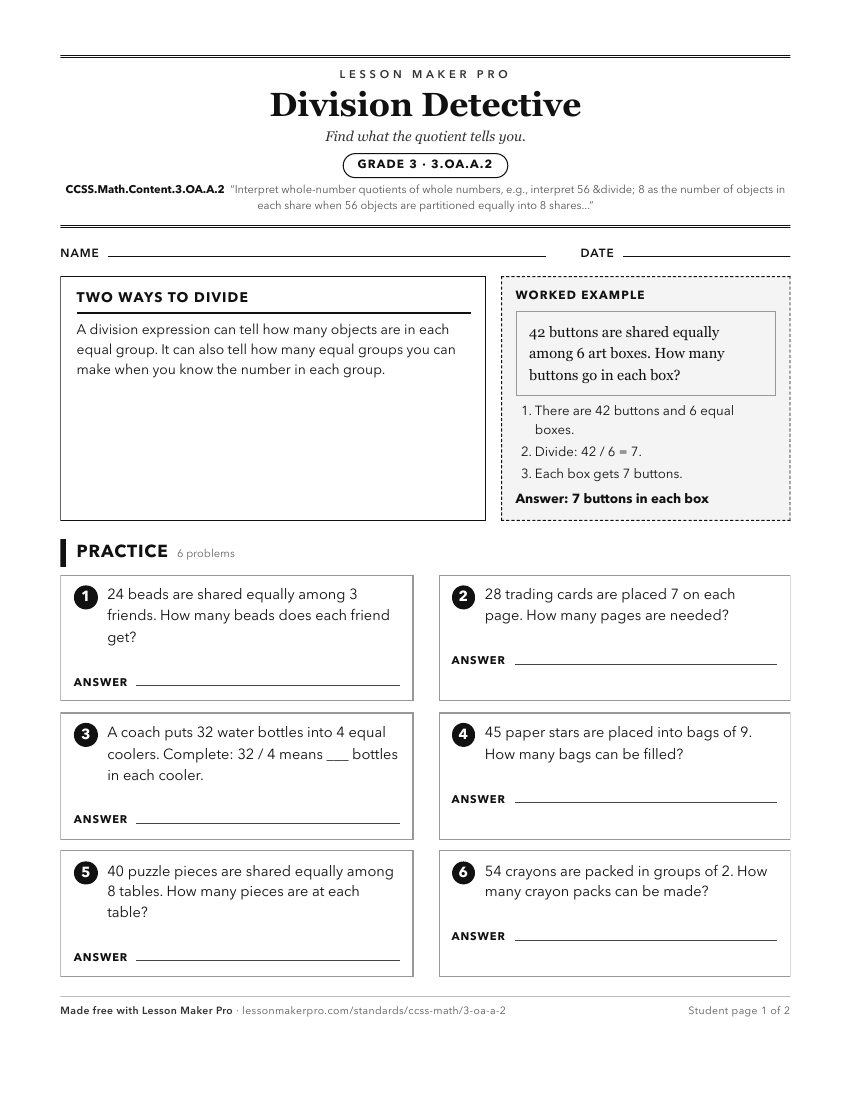
A ready-to-print activity worksheet aligned to CCSS.Math.Content.3.OA.A.2, with an answer key for the teacher on its own page. No account needed.
PDF, US Letter, prints cleanly in black and white.
Download the worksheetLearning progression
Where This Standard Sits
See the whole path on the Operations & Algebraic Thinking progression map.
Before This Standard
If students are struggling here, check these first.
- CCSS.Math.Content.3.OA.A.1
Understanding products as equal groups supports seeing division as finding an unknown group size or number of groups.
- CCSS.Math.Content.2.OA.C.4
Equal rows and repeated addition introduce equal groups, which supports understanding division as sharing or grouping equal amounts.
- CCSS.Math.Content.2.G.A.3
Partitioning wholes into equal shares supports understanding division as equal sharing or making equal groups.
What This Unlocks
Mastery here sets students up for these next.
- CCSS.Math.Content.3.OA.A.4
Interpreting division situations supports understanding what the unknown represents in division equations, though equation solving can begin with fact families.
- CCSS.Math.Content.5.NF.B.3
Understanding equal sharing and measurement meanings of whole-number division supports seeing a fraction as a quotient in division word problems.
- CCSS.Math.Content.5.NF.B.7
Fraction division uses the same equal-sharing and equal-groups meanings of division, extended to fractional amounts and unit fractions.
- CCSS.Math.Content.5.NF.B.7a
Equal sharing and quotient meanings from whole-number division carry over to interpreting a unit fraction split into equal parts.
- CCSS.Math.Content.3.OA.C.7
Interpreting quotients gives division meaning that supports division facts and using multiplication as the inverse within 100.
- CCSS.Math.Content.3.OA.B.6
Interpreting a quotient as an unknown share or group count is needed before linking that quotient to a missing factor.
Keep exploring
Related Standards
- CCSS.Math.Content.5.NBT.B.6
Find whole-number quotients of whole numbers with up to four-digit dividends and two-digit divisors, using strategies based on place value, the properties of op...
- CCSS.Math.Content.5.NF.B.7b
Interpret division of a whole number by a unit fraction, and compute such quotients.
Turn this exact standard into a lesson
Grade, subject, topic, and the complete standard are prefilled. Create one free, no account needed.
Also for this standard:Make a WorksheetMake a QuizMake a Sub Lesson