CCSS.
The Standard
Interpret products of whole numbers, e.g., interpret 5 × 7 as the total number of objects in 5 groups of 7 objects each.
Common Core State Standards for Mathematics · Operations and Algebraic Thinking
Teacher's field guide
What This Standard Means
What Students Need to Do
- Students read a multiplication expression as equal groups. They identify the number of groups, the number in each group, and the total represented.
What Mastery Looks Like
- Students explain a product as a number of equal groups with the same number in each group. They create a matching story, drawing, or array and identify what each factor represents.
Common Misconceptions
- Students may reverse the meaning of the factors, calling 5 × 7 seven groups of five when the context specifies five groups of seven. They may also add the factors or count only the number of groups.
How to Assess It
- Give students 4 × 6. Ask them to draw a matching picture and write one sentence explaining what each factor represents.
Lesson moves
Ways to Teach It
Give pairs 24 counters and cups, then have them model 4 × 6 as four cups with six counters in each.
Ask students to write a story for 3 × 8, then explain what the 3 and 8 mean in their story.
Play Match the Product by pairing multiplication cards with equal-group pictures and short situation cards.
Use egg cartons to model equal groups, then write multiplication expressions for filled rows or sections. R
Free download
Printable 3.OA.A.1 Worksheet
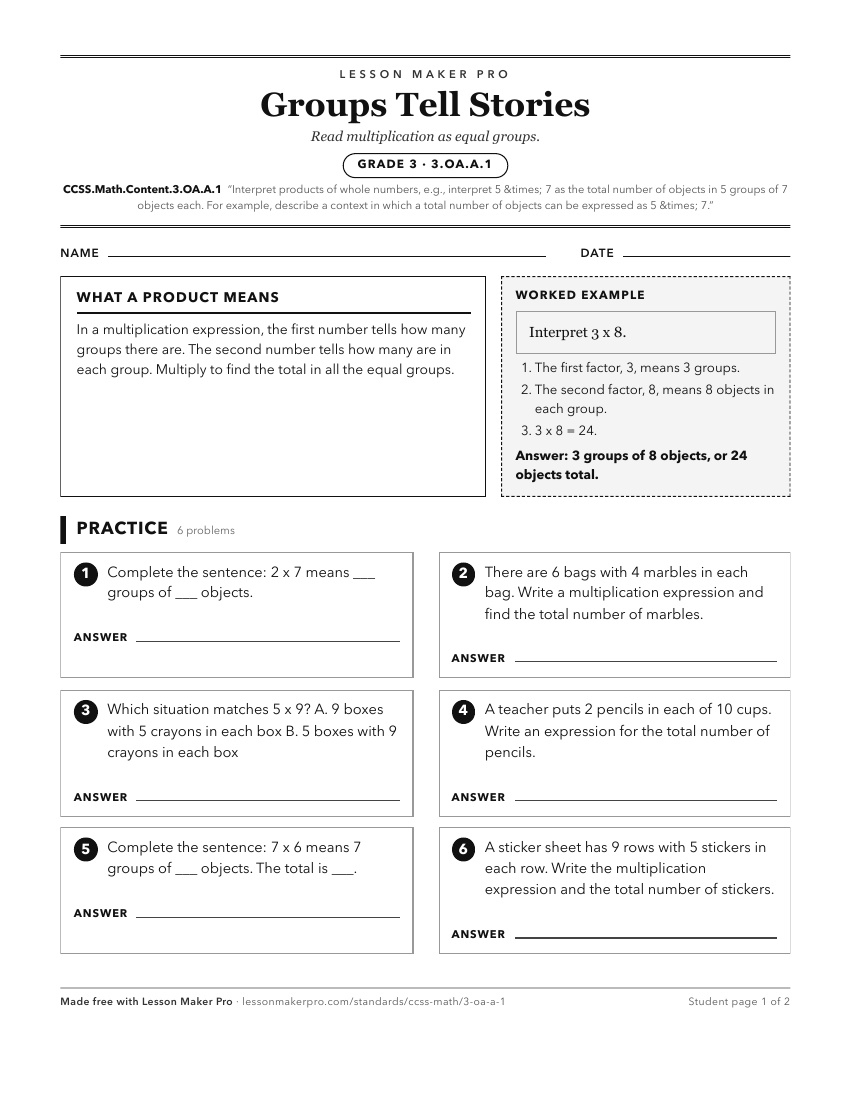
A ready-to-print activity worksheet aligned to CCSS.Math.Content.3.OA.A.1, with an answer key for the teacher on its own page. No account needed.
PDF, US Letter, prints cleanly in black and white.
Download the worksheetLearning progression
Where This Standard Sits
See the whole path on the Operations & Algebraic Thinking progression map.
Before This Standard
If students are struggling here, check these first.
- CCSS.Math.Content.2.OA.C.4
Writing array totals as equal addends prepares students to see multiplication as equal groups and a total number of objects.
- CCSS.Math.Content.1.NBT.A.1
Counting objects and matching quantities to numerals supports seeing a product as several equal groups with a total.
- CCSS.Math.Content.1.OA.C.5
Counting on to combine quantities supports seeing equal groups as repeated additions when interpreting a product.
What This Unlocks
Mastery here sets students up for these next.
- CCSS.Math.Content.3.OA.A.4
Understanding products as equal groups supports finding unknown products or factors in multiplication and related division equations.
- CCSS.Math.Content.3.MD.C.7
Understanding a product as equal groups carries over to seeing tiled rectangles as rows of equal-size units.
- CCSS.Math.Content.3.OA.B.6
Seeing multiplication as groups and total lets students read division as finding the missing group size or number of groups.
- CCSS.Math.Content.3.OA.C.7
Understanding multiplication as equal groups supports fact strategies and connects products to division facts within 100.
- CCSS.Math.Content.4.OA.A.1
Multiplicative comparison depends on seeing 5 × 7 as five equal copies of 7 combined into one quantity.
- CCSS.Math.Content.3.MD.C.7a
Interpreting multiplication as equal groups carries over to seeing rectangle rows of unit squares as side-length products.
Keep exploring
Related Standards
- CCSS.Math.Content.HSA-SSE.A.1b
Interpret complicated expressions by viewing one or more of their parts as a single entity.
- CCSS.Math.Content.3.OA.A.2
Interpret whole-number quotients of whole numbers, e.g., interpret 56 ÷ 8 as the number of objects in each share when 56 objects are partitioned equally into 8 ...
- CCSS.Math.Content.6.EE.A.2b
Identify parts of an expression using mathematical terms (sum, term, product, factor, quotient, coefficient); view one or more parts of an expression as a singl...
Turn this exact standard into a lesson
Grade, subject, topic, and the complete standard are prefilled. Create one free, no account needed.
Also for this standard:Make a WorksheetMake a QuizMake a Sub Lesson