CCSS.
The Standard
Find the area of a rectangle with fractional side lengths by tiling it with unit squares of the appropriate unit fraction side lengths, and show that the area is the same as would be found by multiplying the side lengths. Multiply fractional side lengths to find areas of rectangles, and represent fraction products as rectangular areas.
Common Core State Standards for Mathematics
Teacher's field guide
What This Standard Means
What Students Need to Do
- Students find rectangular area when the side lengths are fractions. They partition a whole-unit grid, connect the counted pieces to multiplication, and represent the product with a shaded rectangle.
What Mastery Looks Like
- Students partition a rectangle accurately, count the small parts, and state the area in square units. They write a matching multiplication equation and simplify the product when possible.
Common Misconceptions
- Students may add the side lengths instead of multiplying them. They may count grid strips rather than small rectangles, or label area with linear units. Some multiply correctly but cannot connect the numerator and denominator to the shaded model.
How to Assess It
- Give this exit ticket: “Draw a model for a rectangle measuring 2/3 unit by 3/4 unit. Label its area and write the matching multiplication equation.”
Lesson moves
Ways to Teach It
Give students grid paper and colored pencils to build a 2/3-by-3/4 rectangle, count twelfths, and match the model to an equation.
Ask, “Why is a 1/3-by-1/4 tile 1/12 square unit?” and require a labeled sketch in each explanation.
Play area match: students pair dimension cards, shaded rectangle models, fraction products, and simplified areas, then justify each set.
Have students find the area of a 3/4-meter-by-2/5-meter garden bed and sketch how much of one square meter it covers.
Free download
Printable 5.NF.B.4b Worksheet
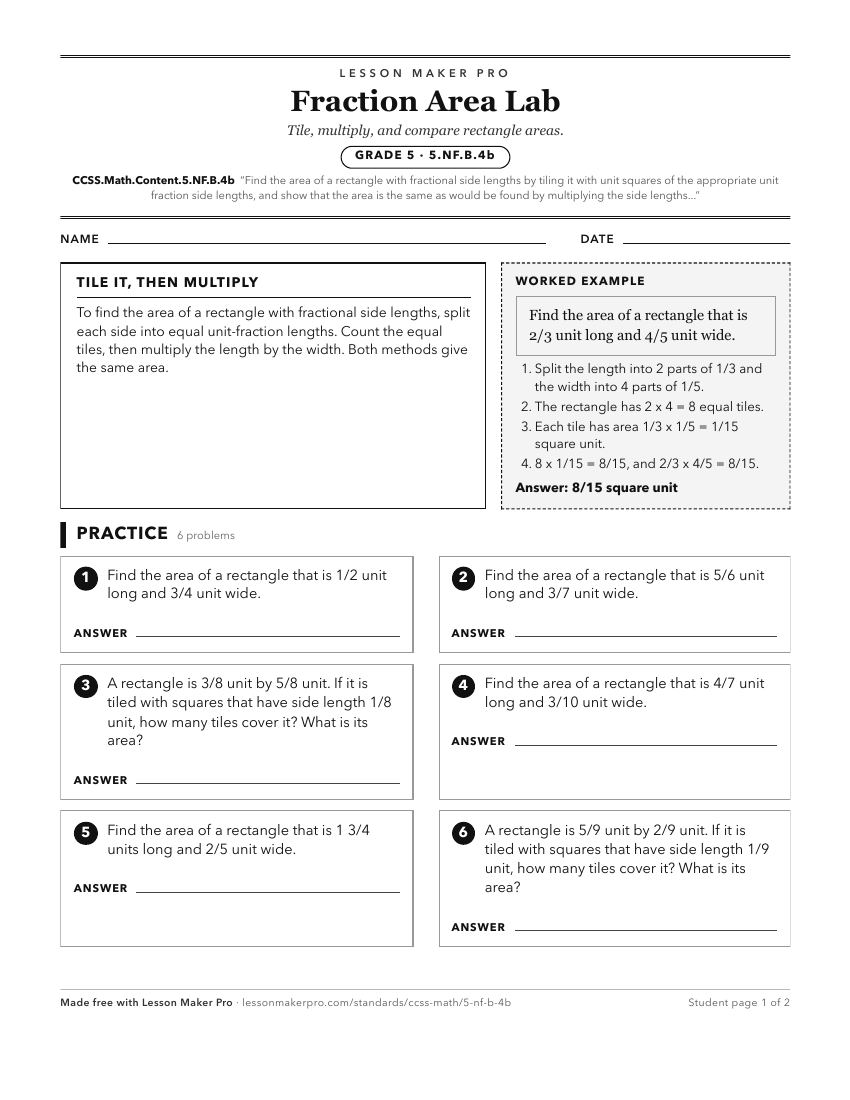
A ready-to-print activity worksheet aligned to CCSS.Math.Content.5.NF.B.4b, with an answer key for the teacher on its own page. No account needed.
PDF, US Letter, prints cleanly in black and white.
Download the worksheetLearning progression
Where This Standard Sits
Before This Standard
If students are struggling here, check these first.
- CCSS.Math.Content.3.NF.A.1
Interpreting fractional side lengths and unit-fraction tiles requires knowing a/b as a quantity made from unit fraction parts.
- CCSS.Math.Content.3.MD.C.7a
Students extend tiling rectangles and multiplying side lengths from whole-number units to fractional unit squares and fraction products.
- CCSS.Math.Content.5.NF.B.4a
Interpreting a fraction times a quantity supports seeing fractional side lengths as repeated partitions whose counts give rectangle area.
What This Unlocks
Mastery here sets students up for these next.
- CCSS.Math.Content.6.G.A.1
Rectangle area with fractional side lengths supports finding component areas when polygons are decomposed into rectangles and triangles.
- CCSS.Math.Content.6.G.A.2
Fractional rectangle area and unit-fraction tiling carry into prism volume as base area, unit-cube packing, and multiplying fractional edges.
Keep exploring
Related Standards
- CCSS.Math.Content.3.G.A.2
Partition shapes into parts with equal areas. Express the area of each part as a unit fraction of the whole.
- CCSS.Math.Content.3.MD.C.7c
Use tiling to show in a concrete case that the area of a rectangle with whole-number side lengths a and b + c is the sum of a × b and a × c. Use area models to ...
- CCSS.Math.Content.3.MD.C.7b
Multiply side lengths to find areas of rectangles with whole-number side lengths in the context of solving real world and mathematical problems, and represent w...
Turn this exact standard into a lesson
Grade, subject, topic, and the complete standard are prefilled. Create one free, no account needed.
Also for this standard:Make a WorksheetMake a QuizMake a Sub Lesson