CCSS.
The Standard
Express a fraction with denominator 10 as an equivalent fraction with denominator 100, and use this technique to add two fractions with respective denominators 10 and 100.
Common Core State Standards for Mathematics · Number and Operations—Fractions
Teacher's field guide
What This Standard Means
What Students Need to Do
- Students rename tenths as equivalent hundredths by scaling both parts of the fraction. They then add tenths and hundredths using a common denominator of 100.
What Mastery Looks Like
- A student can use a hundred grid to show that 6/10 and 60/100 name the same amount. The student can accurately find 6/10 + 7/100 = 67/100.
Common Misconceptions
- Students may multiply the denominator by 10 but leave the numerator unchanged. They may also add denominators, treating 3/10 + 4/100 as 7/110.
How to Assess It
- Exit ticket: Rewrite 7/10 in hundredths, then solve 7/10 + 8/100 and explain why the denominator stays 100.
Lesson moves
Ways to Teach It
Give pairs hundred grids to shade 4/10 and 7/100, relabel the tenths as hundredths, and find the combined amount.
Ask students to explain which is correct, 5/10 = 50/100 or 5/10 = 5/100, using a drawing.
Run a card match with tenths fractions, equivalent hundredths fractions, addition expressions, and sums.
Use a dollar grid to show 3/10 of a dollar plus 4/100 of a dollar, then name the total.
Free download
Printable 4.NF.C.5 Worksheet
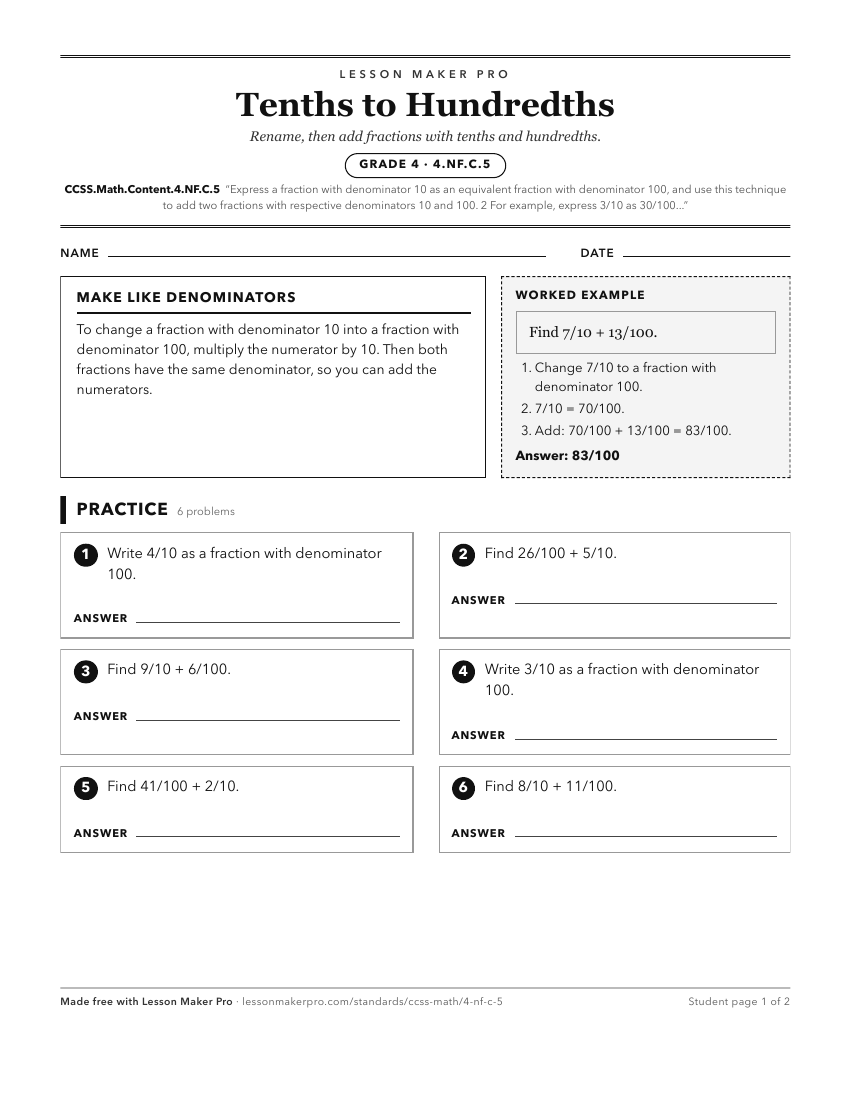
A ready-to-print activity worksheet aligned to CCSS.Math.Content.4.NF.C.5, with an answer key for the teacher on its own page. No account needed.
PDF, US Letter, prints cleanly in black and white.
Download the worksheetLearning progression
Where This Standard Sits
See the whole path on the Number & Operations: Fractions progression map.
Before This Standard
If students are struggling here, check these first.
- CCSS.Math.Content.4.NF.A.1
Converting tenths to hundredths for addition requires understanding that multiplying numerator and denominator creates an equivalent fraction.
- CCSS.Math.Content.4.NF.B.3a
Adding tenths and hundredths relies on seeing fraction addition as joining parts of the same whole after making like units.
- CCSS.Math.Content.4.NBT.A.1
Understanding base-ten units helps students see one tenth as ten hundredths when rewriting and adding tenths with hundredths.
What This Unlocks
Mastery here sets students up for these next.
Keep exploring
Related Standards
- CCSS.Math.Content.3.NF.A.3c
Express whole numbers as fractions, and recognize fractions that are equivalent to whole numbers.
- CCSS.Math.Content.5.NF.A
Use equivalent fractions as a strategy to add and subtract fractions.
- CCSS.Math.Content.4.NF.A.2
Compare two fractions with different numerators and different denominators, e.g., by creating common denominators or numerators, or by comparing to a benchmark ...
Turn this exact standard into a lesson
Grade, subject, topic, and the complete standard are prefilled. Create one free, no account needed.
Also for this standard:Make a WorksheetMake a QuizMake a Sub Lesson