CCSS.
The Standard
Apply and extend previous understandings of multiplication to multiply a fraction by a whole number.
Common Core State Standards for Mathematics · Number and Operations—Fractions
Teacher's field guide
What This Standard Means
What Students Need to Do
- Students treat a fraction as a number of equal unit fractions, then make several groups of that fraction. They represent the product with drawings, repeated addition, and equations, including products greater than one.
What Mastery Looks Like
- A student can show, for example, that 3 × 2/5 equals 6/5 using a drawing, repeated addition, and an equation. The student can solve a matching word problem and explain what the numerator and denominator mean.
Common Misconceptions
- Students may multiply both the numerator and denominator by the whole number. They may treat 3 × 2/5 as 3 + 2/5 or think the product cannot exceed one.
How to Assess It
- Exit ticket: Draw a model for 4 × 3/8, write the product, and explain why the denominator stays 8.
Lesson moves
Ways to Teach It
Give students fraction strips to build four groups of 2/6, combine the pieces, and record 4 × 2/6 = 8/6.
Ask students to explain why 5 × 3/8 changes the numerator but not the denominator, using a labeled drawing and two sentences.
Students draw a fraction card, roll a number cube, multiply the fraction by the roll, and check each answer with a partner.
Present this problem: Each table needs 3/4 meter of paper. How much paper do six tables need? Students sketch and solve.
Free download
Printable 4.NF.B.4 Worksheet
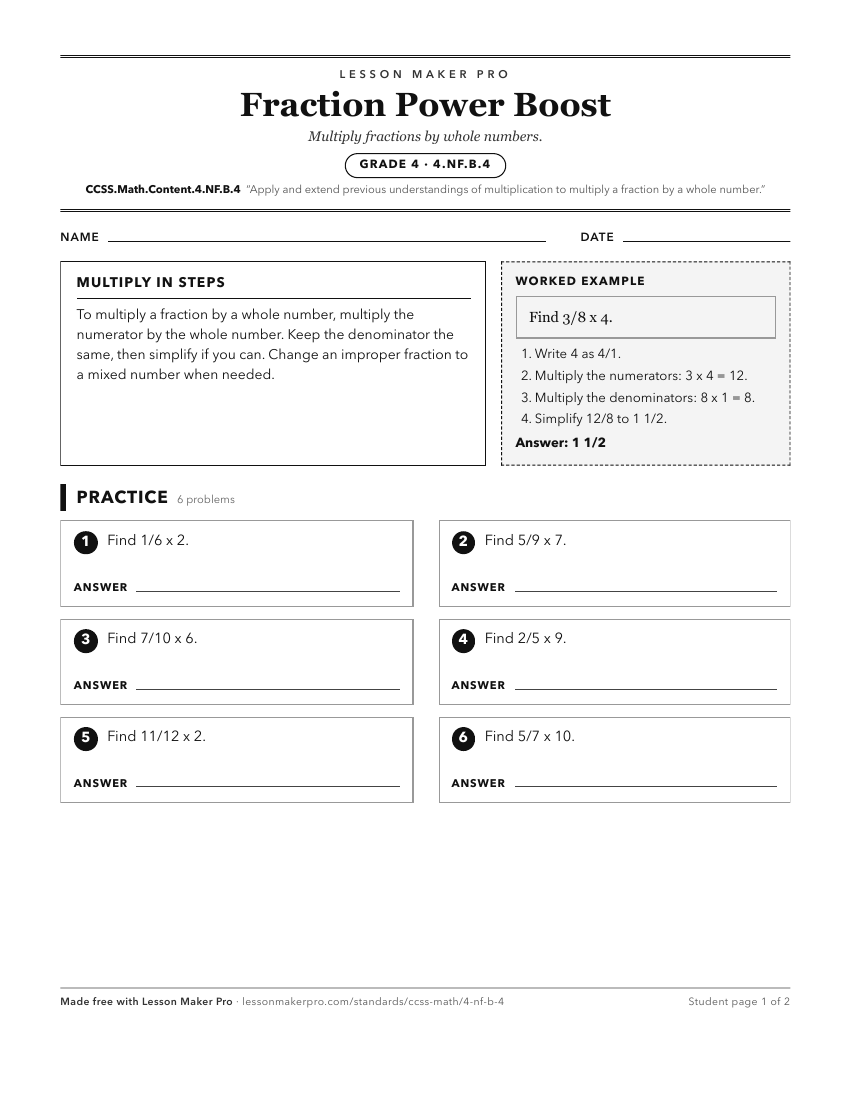
A ready-to-print activity worksheet aligned to CCSS.Math.Content.4.NF.B.4, with an answer key for the teacher on its own page. No account needed.
PDF, US Letter, prints cleanly in black and white.
Download the worksheetLearning progression
Where This Standard Sits
See the whole path on the Number & Operations: Fractions progression map.
Before This Standard
If students are struggling here, check these first.
- CCSS.Math.Content.4.NF.B.4a
Understanding a/b as repeated unit fractions is essential for interpreting a fraction times a whole number as repeated addition.
- CCSS.Math.Content.3.NF.A.1
Multiplying fractions by whole numbers depends on seeing a/b as a copies of 1/b that can be repeated or scaled.
- CCSS.Math.Content.3.OA.A.1
Multiplying a fraction by a whole number extends equal groups, now counting groups of fractional amounts instead of whole-number amounts.
What This Unlocks
Mastery here sets students up for these next.
- CCSS.Math.Content.5.NF.B.4a
Interpreting a fraction times q extends the Grade 4 idea of taking a fractional number of copies of a quantity.
- CCSS.Math.Content.5.NF.B.4
Multiplying fractions by whole numbers prepares students to see fraction multiplication as scaling and combining equal fractional parts.
- CCSS.Math.Content.5.NF.B.7
Multiplying fractions by whole numbers supports seeing fraction division through equal groups and inverse multiplication with unit fractions.
Keep exploring
Related Standards
Turn this exact standard into a lesson
Grade, subject, topic, and the complete standard are prefilled. Create one free, no account needed.
Also for this standard:Make a WorksheetMake a QuizMake a Sub Lesson