CCSS.
The Standard
Explain equivalence of fractions in special cases, and compare fractions by reasoning about their size.
Common Core State Standards for Mathematics · Number and Operations—Fractions
Teacher's field guide
What This Standard Means
What Students Need to Do
- Students use fraction strips, number lines, or drawings to find and explain equivalent fractions. They compare two fractions that refer to the same whole and record the result with <, >, or =.
What Mastery Looks Like
- Students identify and generate simple equivalent fractions, including fractions equal to whole numbers. They compare fractions with the same numerator or denominator and defend each answer using a model or size reasoning.
Common Misconceptions
- Students may think a larger denominator means a larger fraction. They may compare only numerators or denominators, or claim fractions are equivalent without using equal-sized wholes.
How to Assess It
- Give students 2/3 and 3/4. Ask them to circle the greater fraction, write a comparison symbol, and justify their answer with a drawing.
Lesson moves
Ways to Teach It
Fold and label paper strips to prove that 1/2, 2/4, and 4/8 cover the same length.
Display 3/8 and 3/5, then ask students to write which is greater and explain why the numerator alone does not decide.
Play fraction card war using pairs with matching numerators or denominators, and require each winner to explain the comparison.
Compare two same-sized pizzas cut into different numbers of equal slices, then decide which listed serving is larger.
Free download
Printable 3.NF.A.3 Worksheet
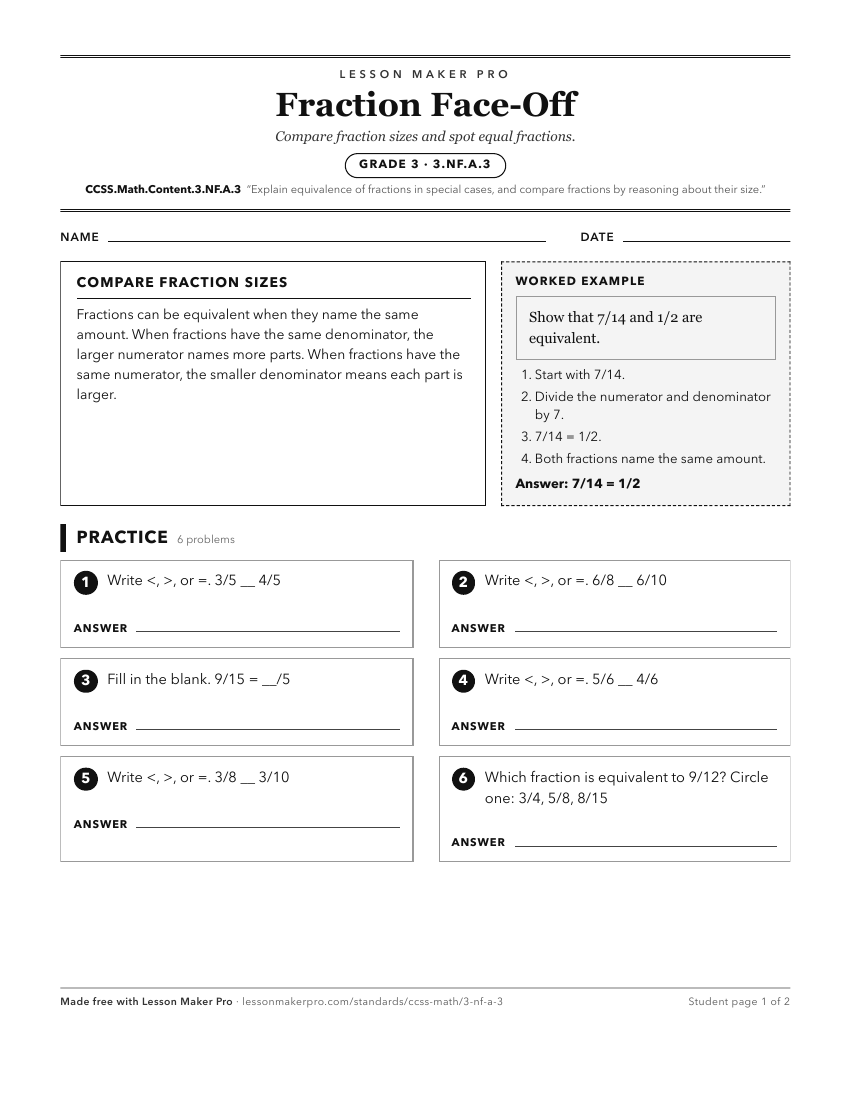
A ready-to-print activity worksheet aligned to CCSS.Math.Content.3.NF.A.3, with an answer key for the teacher on its own page. No account needed.
PDF, US Letter, prints cleanly in black and white.
Download the worksheetLearning progression
Where This Standard Sits
See the whole path on the Number & Operations: Fractions progression map.
Before This Standard
If students are struggling here, check these first.
- CCSS.Math.Content.3.NF.A.1
Equivalence and comparison require seeing a fraction as a size made from equal unit-fraction parts of one whole.
- CCSS.Math.Content.3.NF.A.2
Placing fractions on a number line supports seeing equal locations and relative size when comparing fractions.
- CCSS.Math.Content.1.OA.D.7
Knowing the equal sign means the same value supports interpreting statements like 1/2 = 2/4 in fraction equivalence.
Keep exploring
Related Standards
- CCSS.Math.Content.3.NF.A.3b
Recognize and generate simple equivalent fractions, e.g., 1/2 = 2/4, 4/6 = 2/3). Explain why the fractions are equivalent, e.g., by using a visual fraction mode...
- CCSS.Math.Content.3.NF.A.3a
Understand two fractions as equivalent (equal) if they are the same size, or the same point on a number line.
- CCSS.Math.Content.3.NF.A.3d
Compare two fractions with the same numerator or the same denominator by reasoning about their size. Recognize that comparisons are valid only when the two frac...
- CCSS.Math.Content.4.NF.A.2
Compare two fractions with different numerators and different denominators, e.g., by creating common denominators or numerators, or by comparing to a benchmark ...
Turn this exact standard into a lesson
Grade, subject, topic, and the complete standard are prefilled. Create one free, no account needed.
Also for this standard:Make a WorksheetMake a QuizMake a Sub Lesson