CCSS.
The Standard
Understand the meaning of the equal sign, and determine if equations involving addition and subtraction are true or false.
Common Core State Standards for Mathematics · Operations and Algebraic Thinking
Teacher's field guide
What This Standard Means
What Students Need to Do
- Students decide whether addition and subtraction equations are true or false by finding the value on each side. They understand that the equal sign means both sides have the same value.
What Mastery Looks Like
- Students calculate or model both sides and correctly label an equation true or false. They explain that a true equation has the same value on both sides, even when the operation comes after the equal sign.
Common Misconceptions
- Students may think the equal sign means “write the answer next” instead of “both sides have the same value.” They may also judge an equation by its layout or assume every equation is true.
How to Assess It
- Give students this exit ticket: Circle each true equation and fix each false one: 8 = 8, 6 = 9 - 3, 4 + 2 = 5 + 2.
Lesson moves
Ways to Teach It
Build both sides of equation cards with linking cubes, then compare the two trains and sort the cards into true and false groups.
Ask, “Is 3 + 4 = 5 + 2 true?” Students draw or write how they know.
Play Equation Sort: partners draw a card, solve both sides, and place it under True or False.
Compare two classroom supply baskets and write an equation showing whether the total number of items is equal.
Free download
Printable 1.OA.D.7 Worksheet
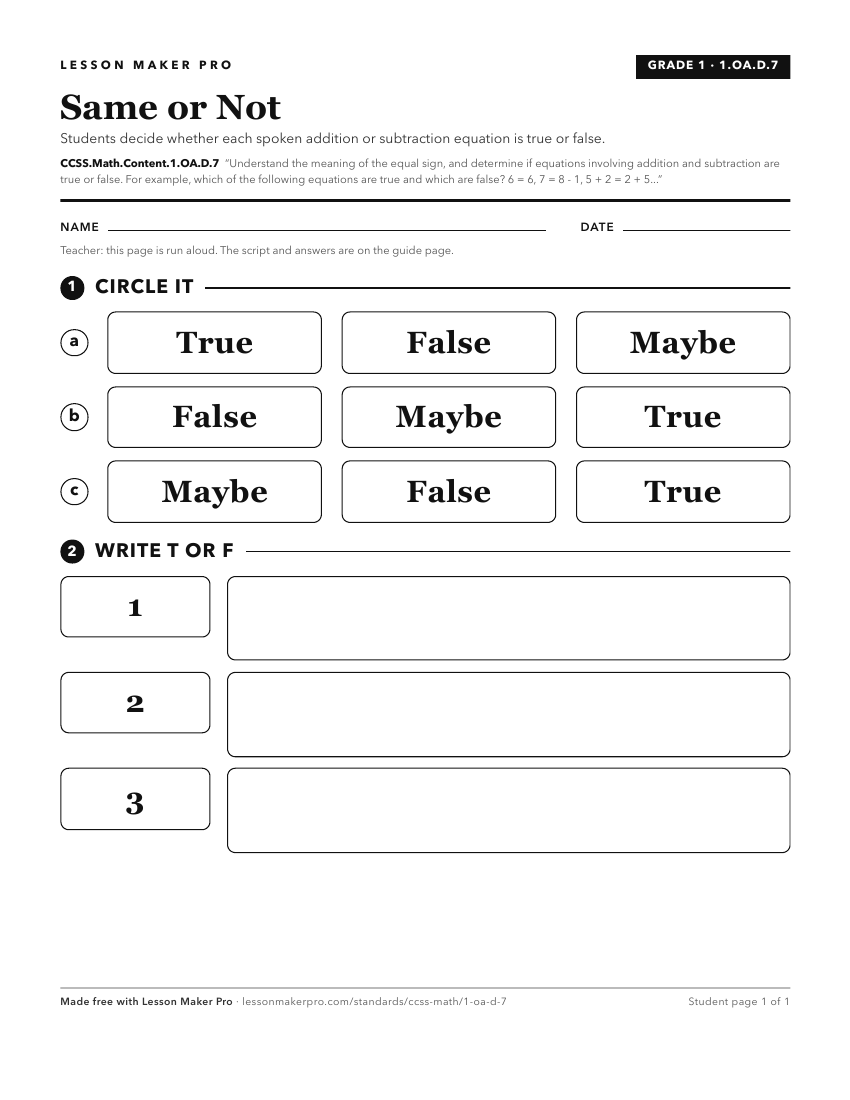
A ready-to-print activity worksheet aligned to CCSS.Math.Content.1.OA.D.7, with an answer key for the teacher on its own page. No account needed.
PDF, US Letter, prints cleanly in black and white.
Download the worksheetLearning progression
Where This Standard Sits
See the whole path on the Operations & Algebraic Thinking progression map.
Before This Standard
If students are struggling here, check these first.
- CCSS.Math.Content.K.OA.A.1
Writing and interpreting addition and subtraction equations helps students judge whether both sides of an equation show the same amount.
- CCSS.Math.Content.K.OA.A.5
Fluency with small sums and differences helps students evaluate each side while focusing on whether the equation is balanced.
- CCSS.Math.Content.K.CC.C.6
Comparing groups as equal or not supports seeing the equal sign as a relationship between two quantities in equations.
What This Unlocks
Mastery here sets students up for these next.
- CCSS.Math.Content.3.OA.A.4
Relational equal sign understanding carries over when interpreting multiplication and division equations with the unknown in any position.
- CCSS.Math.Content.1.OA.D.8
Students must read the equal sign as showing equal values before finding a missing number that makes an equation true.
- CCSS.Math.Content.3.NF.A.3
Knowing the equal sign means the same value supports interpreting statements like 1/2 = 2/4 in fraction equivalence.
- CCSS.Math.Content.2.OA.C.3
Understanding the equal sign supports writing an even number as two equal addends, but odd-even pairing can begin without it.
Keep exploring
Related Standards
- CCSS.Math.Content.1.OA.B
Understand and apply properties of operations and the relationship between addition and subtraction.
- CCSS.Math.Content.2.OA.A
Represent and solve problems involving addition and subtraction.
- CCSS.Math.Content.1.OA.D
Work with addition and subtraction equations.
- CCSS.Math.Content.1.OA.A
Represent and solve problems involving addition and subtraction.
Turn this exact standard into a lesson
Grade, subject, topic, and the complete standard are prefilled. Create one free, no account needed.
Also for this standard:Make a WorksheetMake a QuizMake a Sub Lesson