CCSS.
The Standard
Interpret multiplication as scaling (resizing), by:
Common Core State Standards for Mathematics
Teacher's field guide
What This Standard Means
What Students Need to Do
- Students explain how multiplying a quantity by a fraction changes its size without always calculating the product. They compare the product with one factor by deciding whether the other factor is less than, equal to, or greater than 1.
What Mastery Looks Like
- A student can predict that 12 × 3/2 is greater than 12 and 12 × 3/4 is less than 12, then justify each prediction. The student can also explain why multiplying by 1 leaves a quantity unchanged.
Common Misconceptions
- Students often think multiplication always makes a number larger. They may also judge a fraction by one part alone, rather than comparing the whole fraction with 1.
How to Assess It
- Without calculating, decide whether 18 × 5/4, 18 × 1, and 18 × 2/3 are greater than, equal to, or less than 18. Explain each choice using the scale factor.
Lesson moves
Ways to Teach It
Give students paper strips and ask them to build models showing one quantity scaled by 1/2, 1, and 3/2.
Ask students to explain why 20 × 4/5 is less than 20 without finding the exact product.
Play a sorting game where students group multiplication expressions as shrinking, staying equal, or enlarging based on the scale factor.
Use a recipe for four servings and ask students how ingredient amounts change when making half or one and a half batches.
Free download
Printable 5.NF.B.5 Worksheet
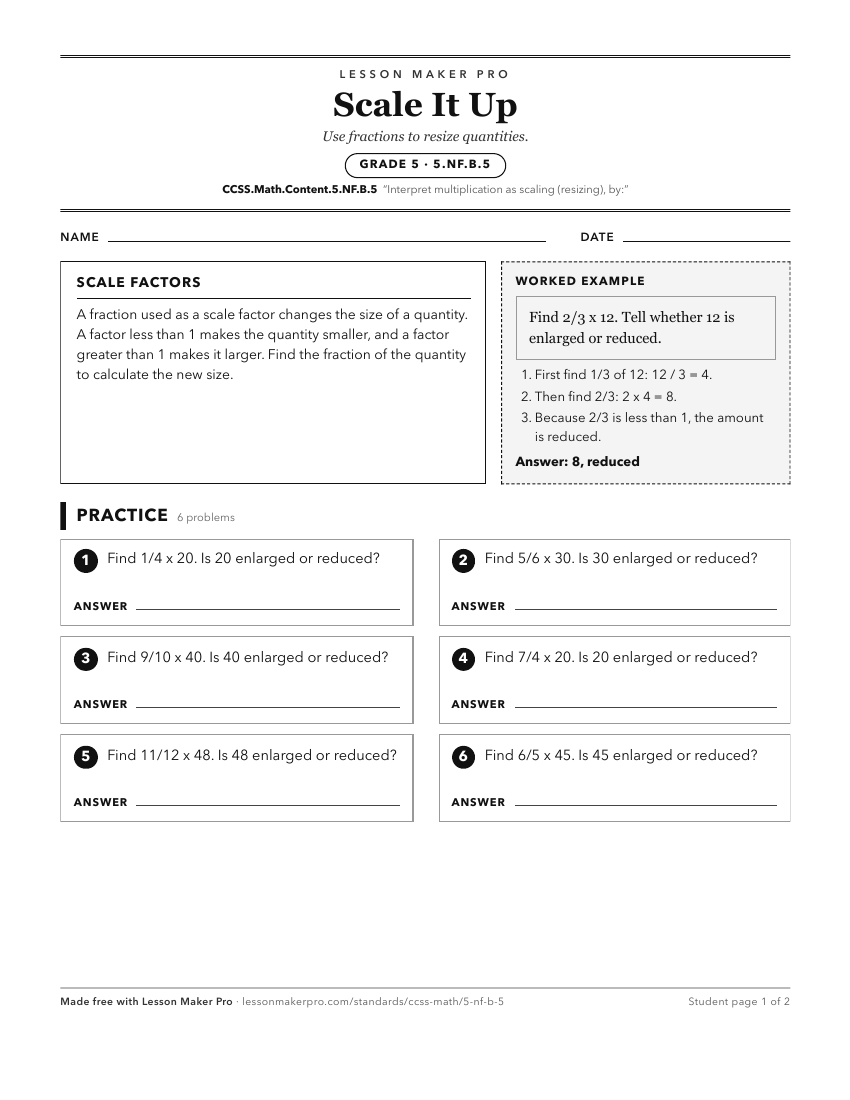
A ready-to-print activity worksheet aligned to CCSS.Math.Content.5.NF.B.5, with an answer key for the teacher on its own page. No account needed.
PDF, US Letter, prints cleanly in black and white.
Download the worksheetLearning progression
Where This Standard Sits
See the whole path on the Number & Operations: Fractions progression map.
Before This Standard
If students are struggling here, check these first.
- CCSS.Math.Content.5.NF.B.4
Multiplying fractions in 5.NF.B.4 gives the product-size and factor relationships students interpret as resizing in 5.NF.B.5.
- CCSS.Math.Content.4.OA.A.1
Whole-number “times as many” comparisons prepare students to see a factor as a scale that enlarges or shrinks quantities.
- CCSS.Math.Content.4.NF.A.2
Comparing fractions to benchmarks supports deciding whether a fractional factor is greater or less than 1 for scaling.
What This Unlocks
Mastery here sets students up for these next.
Keep exploring
Related Standards
- CCSS.Math.Content.HSN-VM.C.7
(+) Multiply matrices by scalars to produce new matrices, e.g., as when all of the payoffs in a game are doubled.
- CCSS.Math.Content.HSN-VM.B.5a
Represent scalar multiplication graphically by scaling vectors and possibly reversing their direction; perform scalar multiplication component-wise, e.g., as c(...
- CCSS.Math.Content.5.NF.B.5a
Comparing the size of a product to the size of one factor on the basis of the size of the other factor, without performing the indicated multiplication.
Turn this exact standard into a lesson
Grade, subject, topic, and the complete standard are prefilled. Create one free, no account needed.
Also for this standard:Make a WorksheetMake a QuizMake a Sub Lesson