CCSS.
The Standard
Represent scalar multiplication graphically by scaling vectors and possibly reversing their direction; perform scalar multiplication component-wise, e.g., as c(vx, vy) = (cvx, cvy).
Common Core State Standards for Mathematics
Teacher's field guide
What This Standard Means
What Students Need to Do
- Students multiply both coordinates of a vector by the same number. They connect that calculation to changes in the arrow’s length and direction on a coordinate plane.
What Mastery Looks Like
- Students correctly multiply both components by any positive, negative, or zero scalar. Their sketches show the correct length and direction, and they can explain how the scalar caused each change.
Common Misconceptions
- Students may multiply only one component or add the scalar instead. They may think a negative scalar changes only the signs, without recognizing the direction reversal. They may also miss that zero produces the zero vector.
How to Assess It
- Give the vector (-2, 3) and ask students to calculate and sketch 2v and -1/2v, then describe each change in length and direction.
Lesson moves
Ways to Teach It
Give students grid paper, arrow cutouts, and scalar cards, then have them redraw each arrow after applying the chosen scalar.
Have students write how positive, negative, and zero scalars change an arrow’s length and direction, using one example for each.
Play vector match: students pair component cards, scalar cards, and result cards, then check matches by sketching.
Model a boat’s velocity under a speed multiplier, including a negative scalar that represents traveling in the opposite direction.
Free download
Printable HSN-VM.B.5a Worksheet
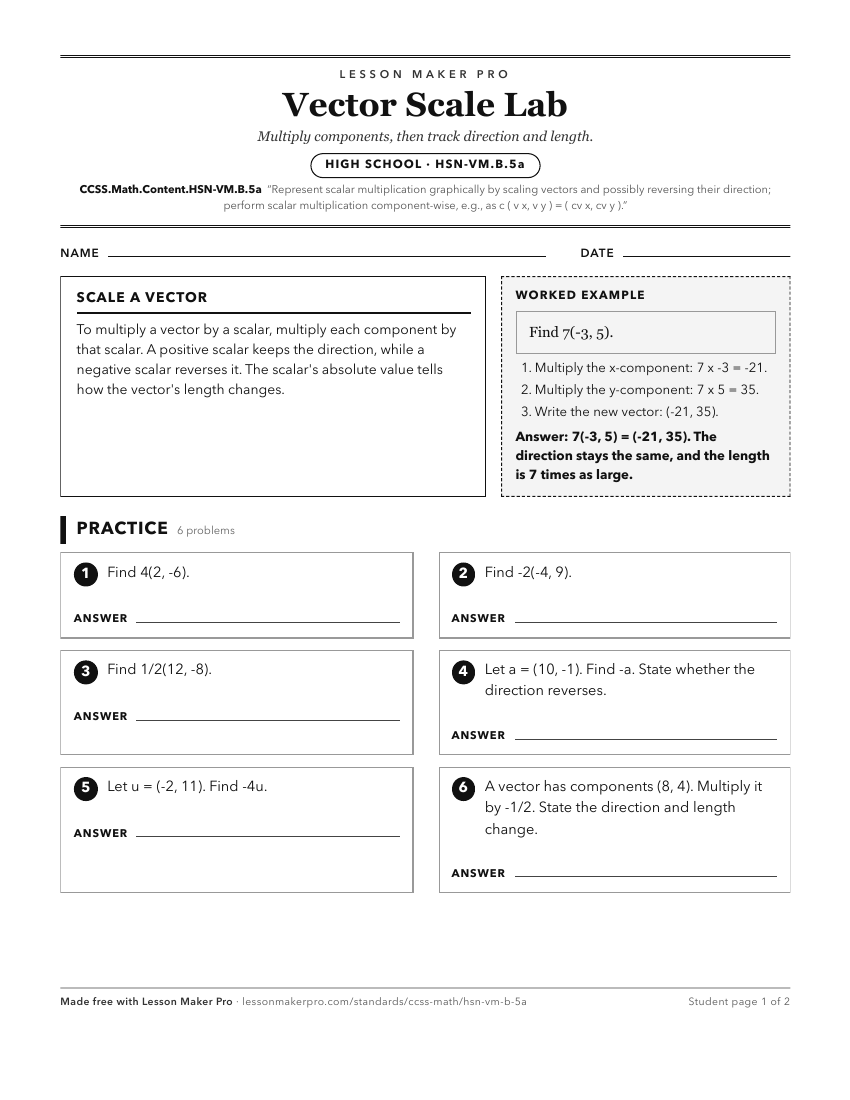
A ready-to-print activity worksheet aligned to CCSS.Math.Content.HSN-VM.B.5a, with an answer key for the teacher on its own page. No account needed.
PDF, US Letter, prints cleanly in black and white.
Download the worksheetLearning progression
Where This Standard Sits
Before This Standard
If students are struggling here, check these first.
- CCSS.Math.Content.HSN-VM.A.2
Finding displacement components supports multiplying each component and interpreting the scaled vector's length and direction on the plane.
- CCSS.Math.Content.HSN-VM.A.1
Scaling or reversing a vector requires understanding it as a directed segment with magnitude and direction.
- CCSS.Math.Content.7.NS.A.2
Component-wise vector scaling requires multiplying coordinates by positive, negative, and fractional scalars, including sign changes for direction reversal.
What This Unlocks
Mastery here sets students up for these next.
- CCSS.Math.Content.HSN-VM.B.5b
Understanding scalar multiplication as scaling and reversing vectors is needed to determine the resulting vector’s magnitude and direction.
- CCSS.Math.Content.HSN-VM.C.11
Matrix-vector multiplication uses scalar multiples of component entries and scaled column vectors to describe transformations of vectors.
- CCSS.Math.Content.HSN-VM.C.7
Multiplying each vector component by a scalar transfers directly to multiplying every matrix entry by that scalar.
Keep exploring
Related Standards
Turn this exact standard into a lesson
Grade, subject, topic, and the complete standard are prefilled. Create one free, no account needed.
Also for this standard:Make a WorksheetMake a QuizMake a Sub Lesson