CCSS.
The Standard
(+) Find the components of a vector by subtracting the coordinates of an initial point from the coordinates of a terminal point.
Common Core State Standards for Mathematics · Vector and Matrix Quantities
Teacher's field guide
What This Standard Means
What Students Need to Do
- Students find a vector's components from two points by subtracting each initial coordinate from the matching terminal coordinate. They interpret the components as horizontal and vertical change.
What Mastery Looks Like
- Students correctly compute horizontal and vertical changes using terminal minus initial. They write the result as an ordered pair or component vector and connect each sign to direction.
Common Misconceptions
- Students may subtract in the wrong order, using initial minus terminal, or mix the x and y coordinates. Some confuse vector components with the terminal point or write a positive value when movement is left or down.
How to Assess It
- Give A(3, -2) as the initial point and B(-1, 5) as the terminal point. Ask students to find vector AB and explain what each component means.
Lesson moves
Ways to Teach It
Place two points on a taped coordinate grid, then have students walk the horizontal and vertical changes and record the vector components.
Ask students to explain why the vector from A to B is the opposite of the vector from B to A.
Play Vector Match by pairing cards showing endpoint coordinates, component vectors, and matching arrows on coordinate grids.
Use starting and ending map coordinates to calculate a drone's displacement vector, then interpret each component as east-west or north-south movement.
Free download
Printable HSN-VM.A.2 Worksheet
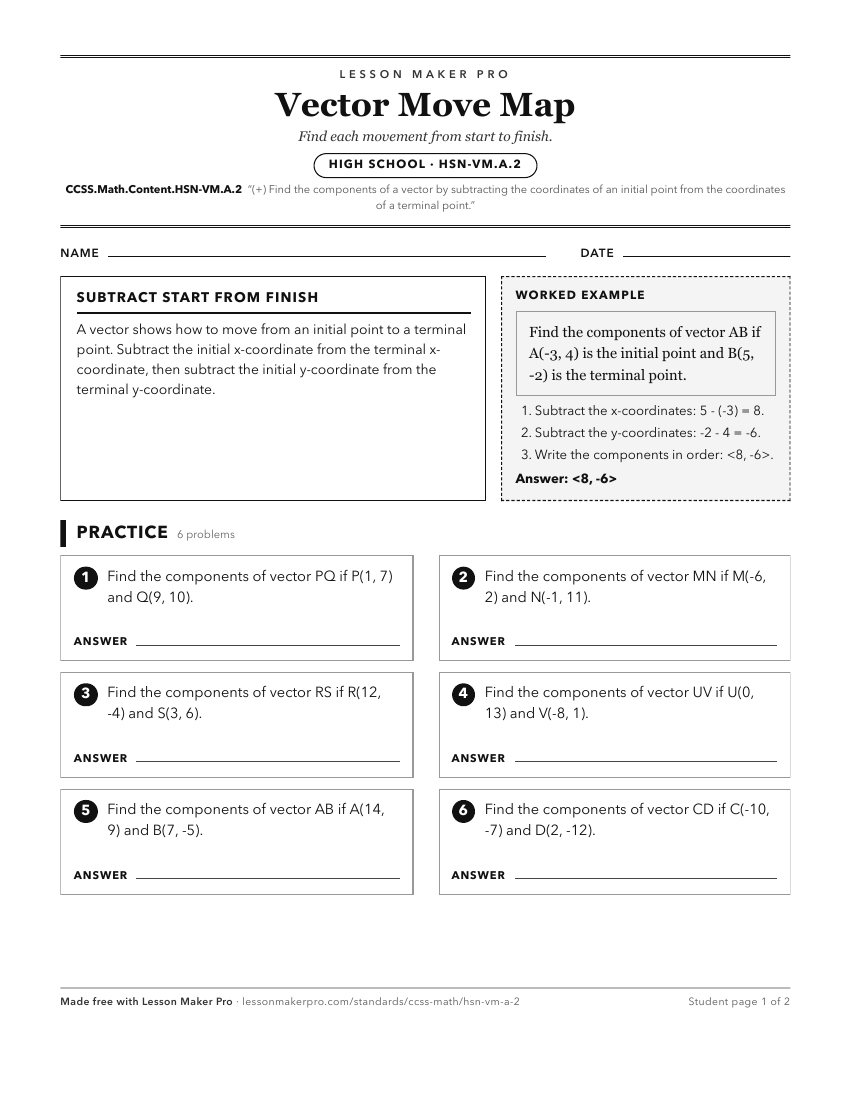
A ready-to-print activity worksheet aligned to CCSS.Math.Content.HSN-VM.A.2, with an answer key for the teacher on its own page. No account needed.
PDF, US Letter, prints cleanly in black and white.
Download the worksheetLearning progression
Where This Standard Sits
Before This Standard
If students are struggling here, check these first.
- CCSS.Math.Content.HSN-VM.A.1
Understanding a vector as a directed segment from initial to terminal point supports interpreting coordinate differences as its components.
- CCSS.Math.Content.7.NS.A.1c
Finding vector components uses signed coordinate differences, extending rational subtraction as terminal coordinate minus initial coordinate.
- CCSS.Math.Content.8.G.A.3
Coordinate translation work supports seeing vector components as horizontal and vertical changes from an initial point to a terminal point.
What This Unlocks
Mastery here sets students up for these next.
- CCSS.Math.Content.HSN-VM.B.5a
Finding displacement components supports multiplying each component and interpreting the scaled vector's length and direction on the plane.
- CCSS.Math.Content.HSN-VM.B.5
Finding vector components from points supports scalar multiplication by giving the coordinate form whose components are scaled.
- CCSS.Math.Content.HSN-VM.A.3
Finding vector components from endpoints supports representing velocities and displacements numerically for vector problem solving.
- CCSS.Math.Content.HSN-VM.B.4
Coordinate differences give vector components, which students use to add or subtract vectors component by component.
- CCSS.Math.Content.HSN-VM.B.4a
Finding vector components from endpoints supports component-wise addition and connects geometric arrows to coordinate calculations.
- CCSS.Math.Content.HSG-GPE.B.6
Partitioning a directed segment uses the coordinate differences between endpoints as a scaled displacement to locate the new point.
Keep exploring
Related Standards
- CCSS.Math.Content.HSA-REI.C.8
(+) Represent a system of linear equations as a single matrix equation in a vector variable.
- CCSS.Math.Content.HSN-VM.B.4c
Understand vector subtraction v - w as v + (-w), where -w is the additive inverse of w, with the same magnitude as w and pointing in the opposite direction. Rep...
Turn this exact standard into a lesson
Grade, subject, topic, and the complete standard are prefilled. Create one free, no account needed.
Also for this standard:Make a WorksheetMake a QuizMake a Sub Lesson