CCSS.
The Standard
Add vectors end-to-end, component-wise, and by the parallelogram rule. Understand that the magnitude of a sum of two vectors is typically not the sum of the magnitudes.
Common Core State Standards for Mathematics
Teacher's field guide
What This Standard Means
What Students Need to Do
- Students add two vectors with head-to-tail diagrams, parallelograms, and component calculations. They compare the resultant’s magnitude with the sum of the original magnitudes.
What Mastery Looks Like
- Students get the same resultant from a head-to-tail diagram, a parallelogram, and component addition. They find its magnitude and explain when magnitudes can add directly.
Common Misconceptions
- Students often add vector magnitudes without considering direction. They may reverse component signs, join the wrong endpoints, or choose the wrong diagonal of a parallelogram.
How to Assess It
- Exit ticket: For u = ⟨3, 4⟩ and v = ⟨−1, 2⟩, sketch both addition methods, find u + v, and compare the relevant magnitudes.
Lesson moves
Ways to Teach It
Give students paper arrows on a coordinate grid to build head-to-tail sums, then trace the resultant and record its components.
Ask students to explain why two walks of five meters can produce a displacement shorter than ten meters.
Create matching cards showing vector pairs, component sums, diagrams, and resultant magnitudes for students to sort into sets.
Model an airplane’s velocity and a crosswind, then have students calculate and sketch the plane’s resulting ground velocity.
Free download
Printable HSN-VM.B.4a Worksheet
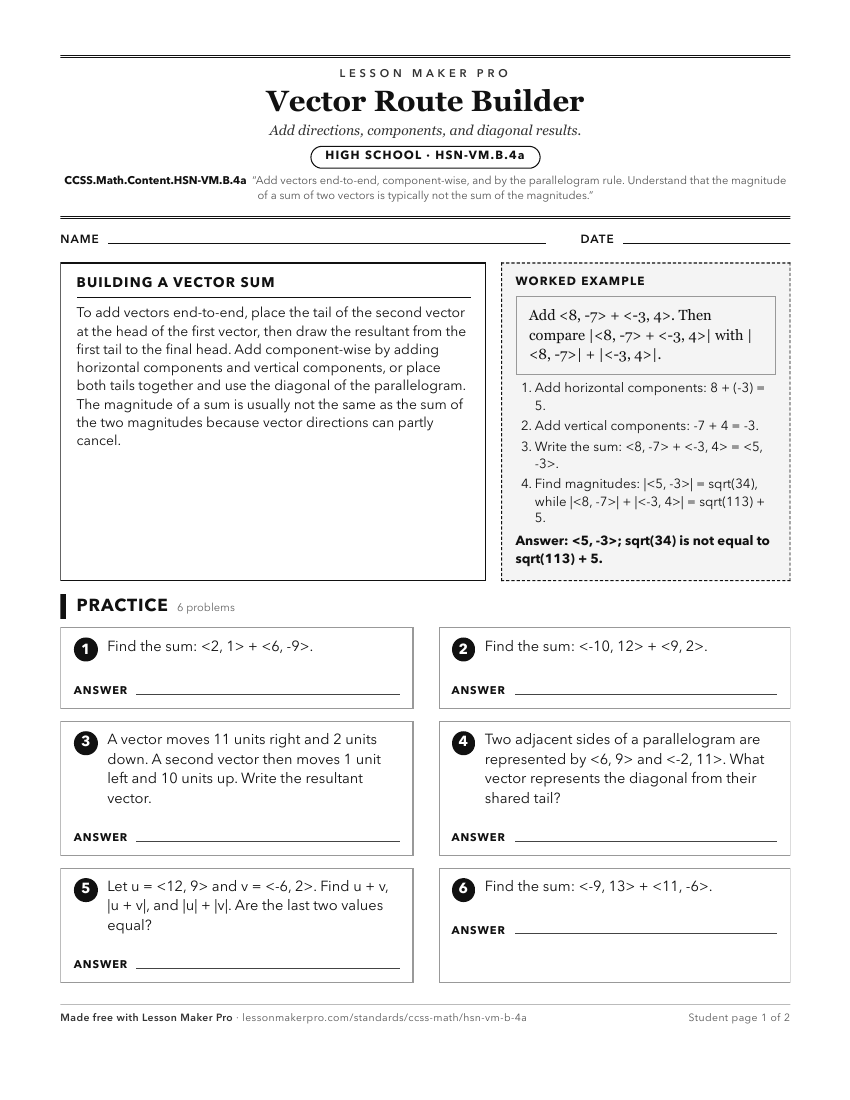
A ready-to-print activity worksheet aligned to CCSS.Math.Content.HSN-VM.B.4a, with an answer key for the teacher on its own page. No account needed.
PDF, US Letter, prints cleanly in black and white.
Download the worksheetLearning progression
Where This Standard Sits
Before This Standard
If students are struggling here, check these first.
- CCSS.Math.Content.HSN-VM.A.1
Vector addition depends on interpreting directed segments with magnitude and direction, especially comparing a resultant's magnitude to the addends' magnitudes.
- CCSS.Math.Content.HSN-VM.A.2
Finding vector components from endpoints supports component-wise addition and connects geometric arrows to coordinate calculations.
- CCSS.Math.Content.HSG-CO.C.11
Parallelogram properties help justify translating equal vectors to opposite sides and using the diagonal as their sum.
What This Unlocks
Mastery here sets students up for these next.
- CCSS.Math.Content.HSN-VM.B.4c
Vector subtraction is defined as adding the opposite vector, so graphical and component-wise addition methods directly carry over.
- CCSS.Math.Content.HSN-VM.B.4b
Finding a resultant from magnitudes and directions requires adding vectors by components or parallelogram and interpreting the resulting magnitude.
Keep exploring
Related Standards
Turn this exact standard into a lesson
Grade, subject, topic, and the complete standard are prefilled. Create one free, no account needed.
Also for this standard:Make a WorksheetMake a QuizMake a Sub Lesson