CCSS.
The Standard
Given two vectors in magnitude and direction form, determine the magnitude and direction of their sum.
Common Core State Standards for Mathematics
Teacher's field guide
What This Standard Means
What Students Need to Do
- Students resolve each vector into horizontal and vertical components. They add matching components, then convert the result back to a length and angle.
What Mastery Looks Like
- Students correctly find horizontal and vertical components using sine and cosine. They add corresponding components, calculate the resultant length, and give an angle in the correct quadrant.
Common Misconceptions
- Students may add the two lengths and the two angles separately. They may swap sine and cosine, mix degrees and radians, or report an inverse tangent angle in the wrong quadrant.
How to Assess It
- Exit ticket: A 10-unit vector points 30° above east, and a 6-unit vector points 120° from east. Find the resultant’s magnitude and direction, showing components.
Lesson moves
Ways to Teach It
Use rulers, protractors, and graph paper to draw two assigned vectors head to tail, then measure and calculate the resultant.
Explain why adding two vector lengths usually gives the wrong resultant, using a labeled sketch and one numerical example.
Play Resultant Match: students pair vector cards with component sums, resultant magnitudes, and directions, then justify each match.
Model a boat crossing a river by combining its velocity with the current, then find the boat’s actual speed and heading.
Free download
Printable HSN-VM.B.4b Worksheet
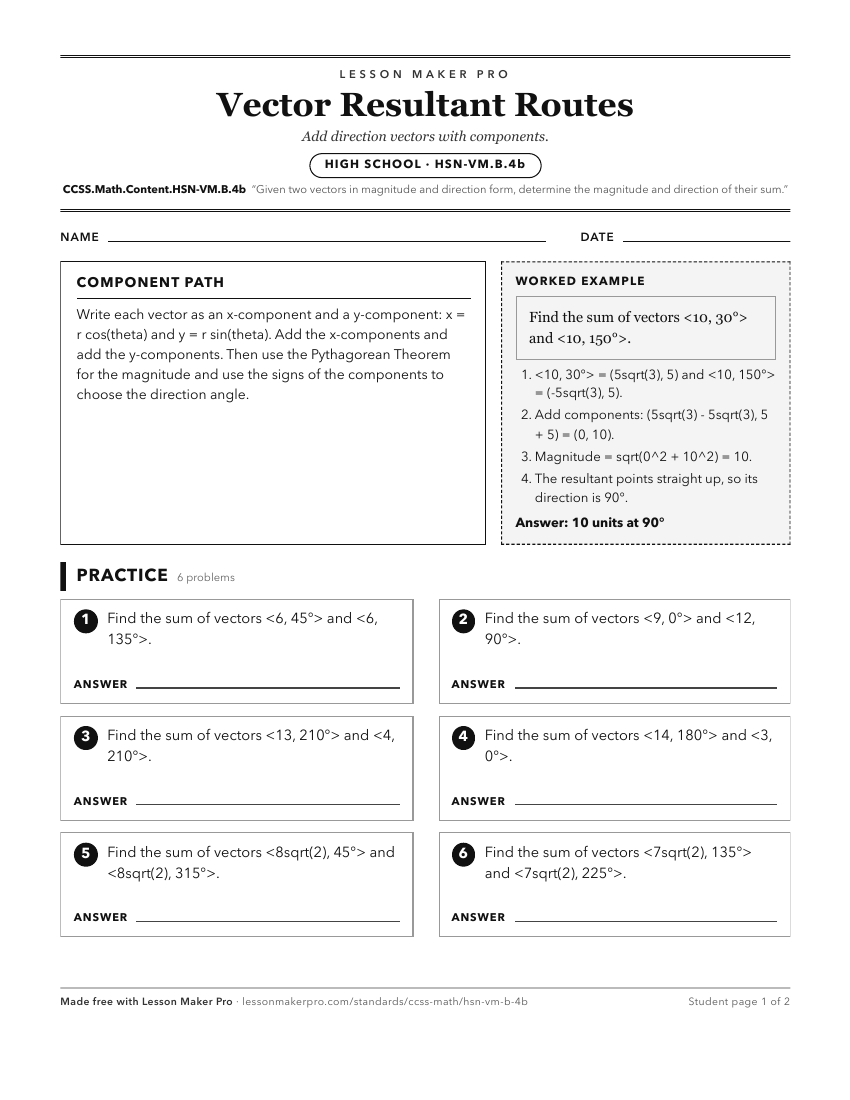
A ready-to-print activity worksheet aligned to CCSS.Math.Content.HSN-VM.B.4b, with an answer key for the teacher on its own page. No account needed.
PDF, US Letter, prints cleanly in black and white.
Download the worksheetLearning progression
Where This Standard Sits
Before This Standard
If students are struggling here, check these first.
- CCSS.Math.Content.HSG-SRT.C.8
Finding vector components and the resultant’s length and angle requires right triangle trigonometry and the Pythagorean Theorem.
- CCSS.Math.Content.HSN-VM.A.1
Finding a resultant requires understanding each vector as a directed length with magnitude, direction, and vector notation.
- CCSS.Math.Content.HSN-VM.B.4a
Finding a resultant from magnitudes and directions requires adding vectors by components or parallelogram and interpreting the resulting magnitude.
Keep exploring
Related Standards
Turn this exact standard into a lesson
Grade, subject, topic, and the complete standard are prefilled. Create one free, no account needed.
Also for this standard:Make a WorksheetMake a QuizMake a Sub Lesson