CCSS.
The Standard
Comparing the size of a product to the size of one factor on the basis of the size of the other factor, without performing the indicated multiplication.
Common Core State Standards for Mathematics
Teacher's field guide
What This Standard Means
What Students Need to Do
- Students examine whether a multiplier is less than, equal to, or greater than 1 to predict how a quantity changes. They justify the comparison without calculating the product.
What Mastery Looks Like
- Given 2/3 × 5/4, a student predicts the product is greater than 2/3 because 5/4 is greater than 1. The student can justify similar comparisons without finding exact products.
Common Misconceptions
- Students often think multiplication always makes numbers larger. They may compare the wrong factor to 1, or use only the numerator to judge a fraction's size.
How to Assess It
- Exit ticket: Without multiplying, compare 5/6 × 7/4 with 5/6 using >, <, or =. Explain how 7/4 supports your answer.
Lesson moves
Ways to Teach It
Build 3/4 with fraction strips, then model multiplying it by 1/2, 1, and 3/2; order the results.
Discuss: Why does multiplying 6 by 2/3 make a smaller number, while multiplying 6 by 4/3 makes a larger one?
Sort product cards into greater than, less than, or equal to the named factor, then justify each choice without solving.
Compare recipe amounts for half a batch, one batch, and one-and-a-half batches, predicting each change before measuring.
Free download
Printable 5.NF.B.5a Worksheet
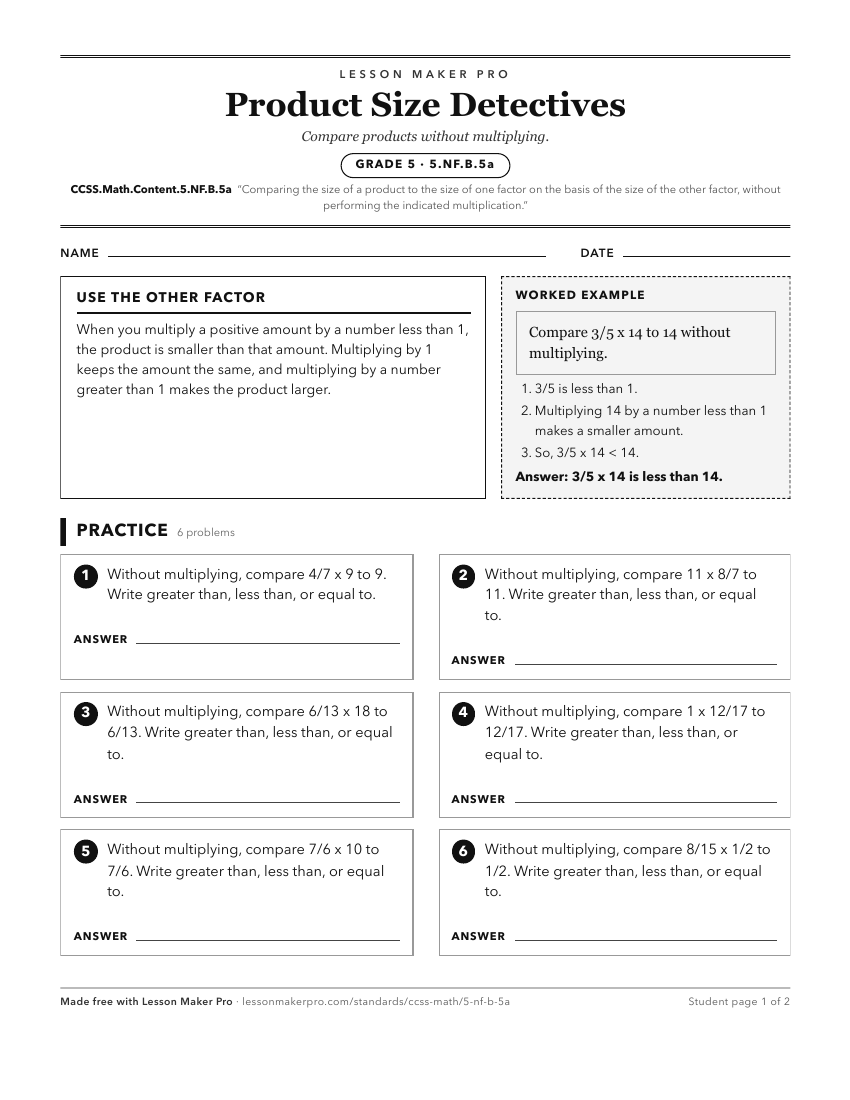
A ready-to-print activity worksheet aligned to CCSS.Math.Content.5.NF.B.5a, with an answer key for the teacher on its own page. No account needed.
PDF, US Letter, prints cleanly in black and white.
Download the worksheetLearning progression
Where This Standard Sits
Before This Standard
If students are struggling here, check these first.
- CCSS.Math.Content.4.NF.A.2
Comparing fractions to benchmarks, especially 1, supports judging whether a multiplier makes a product larger or smaller.
- CCSS.Math.Content.5.NF.B.4
Students must understand multiplying by fractions, especially factors less or greater than 1, to predict whether products grow or shrink.
- CCSS.Math.Content.4.OA.A.1
Multiplicative comparison carries over to seeing a multiplier as a scale factor that makes a product larger, smaller, or equal.
Keep exploring
Related Standards
- CCSS.Math.Content.5.NF.B.5b
Explaining why multiplying a given number by a fraction greater than 1 results in a product greater than the given number (recognizing multiplication by whole n...
- CCSS.Math.Content.5.NF.B.5
Interpret multiplication as scaling (resizing), by:
- CCSS.Math.Content.6.RP.A.3d
Use ratio reasoning to convert measurement units; manipulate and transform units appropriately when multiplying or dividing quantities.
- CCSS.Math.Content.4.OA.A.2
Multiply or divide to solve word problems involving multiplicative comparison, e.g., by using drawings and equations with a symbol for the unknown number to rep...
Turn this exact standard into a lesson
Grade, subject, topic, and the complete standard are prefilled. Create one free, no account needed.
Also for this standard:Make a WorksheetMake a QuizMake a Sub Lesson