CCSS.
The Standard
Multiply or divide to solve word problems involving multiplicative comparison, e.g., by using drawings and equations with a symbol for the unknown number to represent the problem, distinguishing multiplicative comparison from additive comparison.
Common Core State Standards for Mathematics · Operations and Algebraic Thinking
Teacher's field guide
What This Standard Means
What Students Need to Do
- Students solve comparison problems involving phrases such as “times as many” or “times as much.” They use multiplication or division, then show the relationship with a drawing and equation.
What Mastery Looks Like
- Students identify the larger quantity, smaller quantity, and comparison factor. They choose multiplication or division, use a symbol for the unknown, and explain their choice.
Common Misconceptions
- Students may read “three times as many” as “three more.” They may also divide in the wrong order or confuse the comparison factor with either quantity.
How to Assess It
- Give this exit ticket: “Lena has 24 stickers, four times as many as Noah. How many stickers does Noah have?” Require a drawing and equation.
Lesson moves
Ways to Teach It
Give pairs counters to build 6 counters, then build three times as many and label the quantities and comparison factor.
Compare “Maya has four more cards” with “Maya has four times as many cards,” then write how the models differ.
Sort word problem cards into additive or multiplicative comparisons, then solve each multiplicative problem with a drawing and equation.
Compare whole number prices from a store flyer and write problems using phrases such as “three times as much.”
Free download
Printable 4.OA.A.2 Worksheet
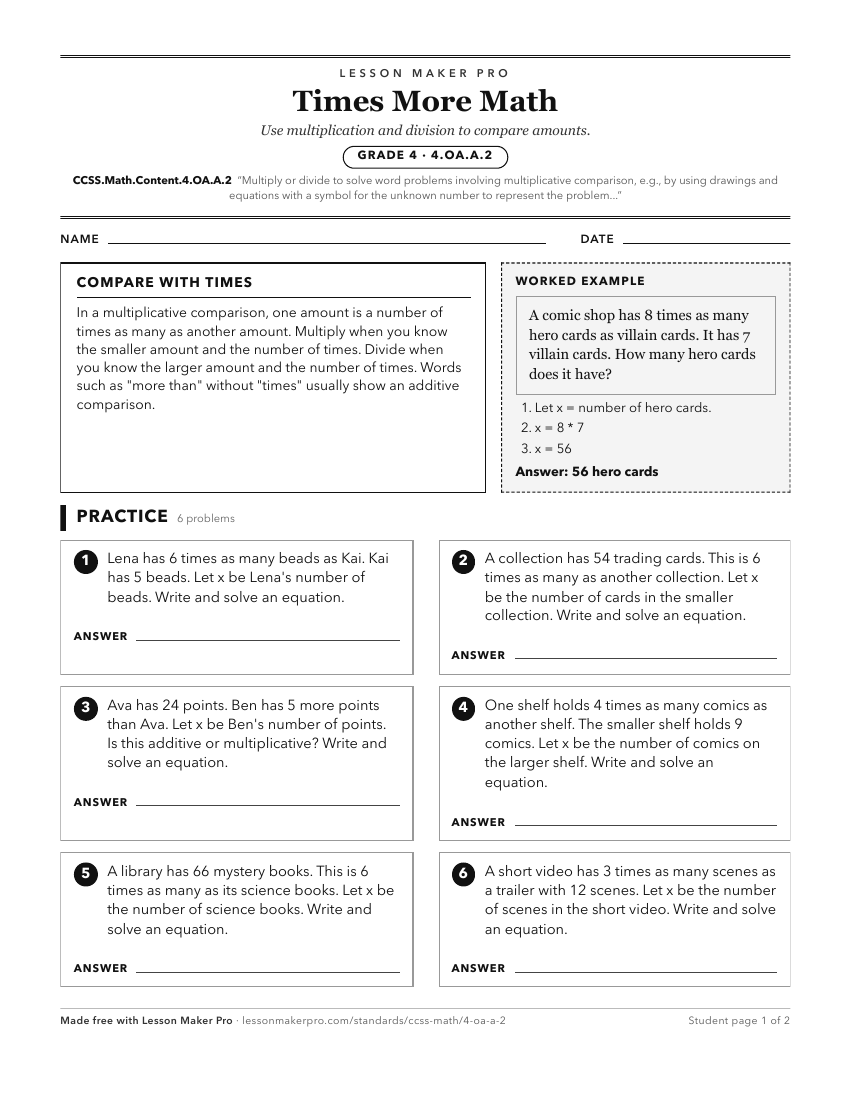
A ready-to-print activity worksheet aligned to CCSS.Math.Content.4.OA.A.2, with an answer key for the teacher on its own page. No account needed.
PDF, US Letter, prints cleanly in black and white.
Download the worksheetLearning progression
Where This Standard Sits
See the whole path on the Operations & Algebraic Thinking progression map.
Before This Standard
If students are struggling here, check these first.
- CCSS.Math.Content.4.OA.A.1
Students must understand “times as many” comparison equations before choosing multiplication or division to solve those comparison word problems.
- CCSS.Math.Content.3.OA.A.3
Solving equal-group multiplication and division problems supports representing comparison problems with equations and choosing multiplication or division.
- CCSS.Math.Content.3.OA.A.4
Solving multiplication and division equations with an unknown supports writing and solving comparison equations from word problems.
What This Unlocks
Mastery here sets students up for these next.
- CCSS.Math.Content.6.EE.A.2a
Using symbols for unknowns and equations in comparison problems supports translating operations into expressions with letters.
- CCSS.Math.Content.6.RP.A.1
Multiplicative comparison prepares students to see two quantities in times-as-many terms, which supports ratio language and relationships.
- CCSS.Math.Content.6.EE.B.6
Using a symbol for an unknown in comparison problems supports later use of variables to represent unknowns in expressions and situations.
Keep exploring
Related Standards
- CCSS.Math.Content.1.OA.A.1
Use addition and subtraction within 20 to solve word problems involving situations of adding to, taking from, putting together, taking apart, and comparing, wit...
- CCSS.Math.Content.4.NF.B.4c
Solve word problems involving multiplication of a fraction by a whole number, e.g., by using visual fraction models and equations to represent the problem.
- CCSS.Math.Content.2.OA.A.1
Use addition and subtraction within 100 to solve one- and two-step word problems involving situations of adding to, taking from, putting together, taking apart,...
Turn this exact standard into a lesson
Grade, subject, topic, and the complete standard are prefilled. Create one free, no account needed.
Also for this standard:Make a WorksheetMake a QuizMake a Sub Lesson