CCSS.
The Standard
Find a percent of a quantity as a rate per 100 (e.g., 30% of a quantity means 30/100 times the quantity); solve problems involving finding the whole, given a part and the percent.
Common Core State Standards for Mathematics
Teacher's field guide
What This Standard Means
What Students Need to Do
- Students write a percent as a fraction out of 100 or as a decimal, then multiply to find the part. They divide or use equivalent ratios to find the whole when the part and percent are known.
What Mastery Looks Like
- A student can solve problems such as 35% of 80 and 21 is 30% of what number. They label the part and whole and check answers with benchmark percents.
Common Misconceptions
- Students may treat 35% as 35 instead of 0.35 or 35/100. In reverse problems, they may use the given part as the whole or multiply when division is needed.
How to Assess It
- Exit ticket: Find 15% of 60, then find the whole when 18 is 30%. Require an equation and a labeled answer for each.
Lesson moves
Ways to Teach It
Give pairs 40 counters and a 100-grid. Use the grid to identify 25%, then show 25% of 40.
Discuss: “Twelve students are 30% of a club. How many members are there?” Compare equations and ratio tables.
Play Percent Match. Students pair cards such as 20% of 45 with answer cards, then justify one match using an equation.
Use store sale tags to calculate discounts, then find the original price when a tag says $18 off is a 30% discount.
Free download
Printable 6.RP.A.3c Worksheet
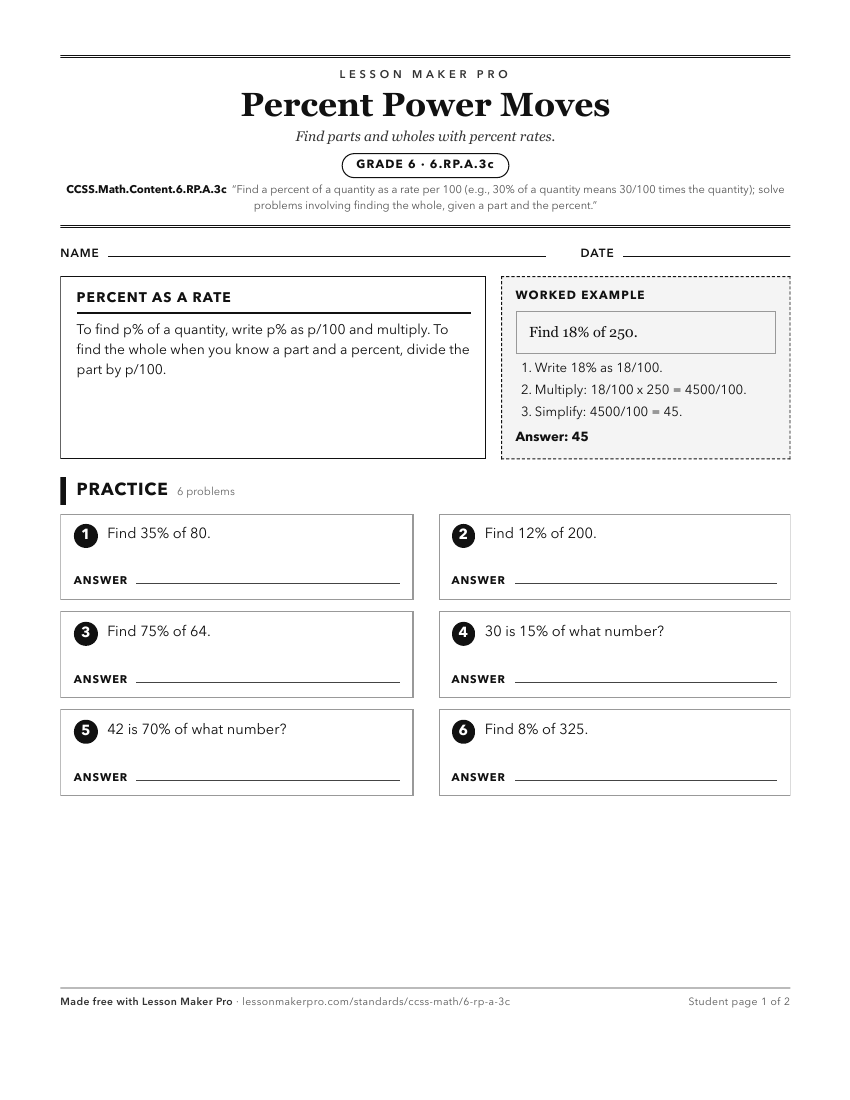
A ready-to-print activity worksheet aligned to CCSS.Math.Content.6.RP.A.3c, with an answer key for the teacher on its own page. No account needed.
PDF, US Letter, prints cleanly in black and white.
Download the worksheetLearning progression
Where This Standard Sits
Before This Standard
If students are struggling here, check these first.
- CCSS.Math.Content.6.RP.A.1
Percent problems use a part-to-whole ratio with 100 as the reference, extending ratio language to rates per 100.
- CCSS.Math.Content.6.RP.A.2
Understanding unit rates supports seeing percent as a rate per 100 and using that rate to relate part and whole.
- CCSS.Math.Content.5.NF.B.4
Percent problems use 30/100 times a quantity, so fraction multiplication directly carries into finding parts and interpreting percents.
What This Unlocks
Mastery here sets students up for these next.
Keep exploring
Related Standards
- CCSS.Math.Content.HSF-LE.A.1c
Recognize situations in which a quantity grows or decays by a constant percent rate per unit interval relative to another.
- CCSS.Math.Content.5.NF.B.3
Interpret a fraction as division of the numerator by the denominator (a/b = a ÷ b). Solve word problems involving division of whole numbers leading to answers i...
- CCSS.Math.Content.3.OA.A.3
Use multiplication and division within 100 to solve word problems in situations involving equal groups, arrays, and measurement quantities, e.g., by using drawi...
Turn this exact standard into a lesson
Grade, subject, topic, and the complete standard are prefilled. Create one free, no account needed.
Also for this standard:Make a WorksheetMake a QuizMake a Sub Lesson