CCSS.
The Standard
Understand the concept of a unit rate a/b associated with a ratio a:b with b ≠ 0, and use rate language in the context of a ratio relationship.
Common Core State Standards for Mathematics · Ratios and Proportional Relationships
Teacher's field guide
What This Standard Means
What Students Need to Do
- Students find how much of one quantity corresponds to one unit of another quantity. They express the result with labels, such as dollars per item or miles per hour.
What Mastery Looks Like
- Given a ratio, students divide in the correct order and state the unit rate with units. They can move between a ratio, a fraction, and a sentence using "per" or "for each."
Common Misconceptions
- Students may divide in the wrong order, treat a ratio as two unrelated numbers, or omit units. They may call 3 for every 4 a unit rate without rewriting it as 3/4 for one. Some confuse a unit rate with any equivalent ratio.
How to Assess It
- Exit ticket: Six bottles of juice cost $9. Find the cost for one bottle and write a sentence explaining the rate.
Lesson moves
Ways to Teach It
Give pairs counters and cups; have them model 12 counters in 3 cups, then find and label the number per cup.
Ask students to explain in writing what 50 means when a car travels 150 miles in 3 hours, then share responses.
Play Unit Rate Match with cards showing ratios, division expressions, unit rates, and context sentences; students race to build matching sets.
Use grocery ads to calculate cost per item for two packages, then have students explain each rate with units.
Free download
Printable 6.RP.A.2 Worksheet
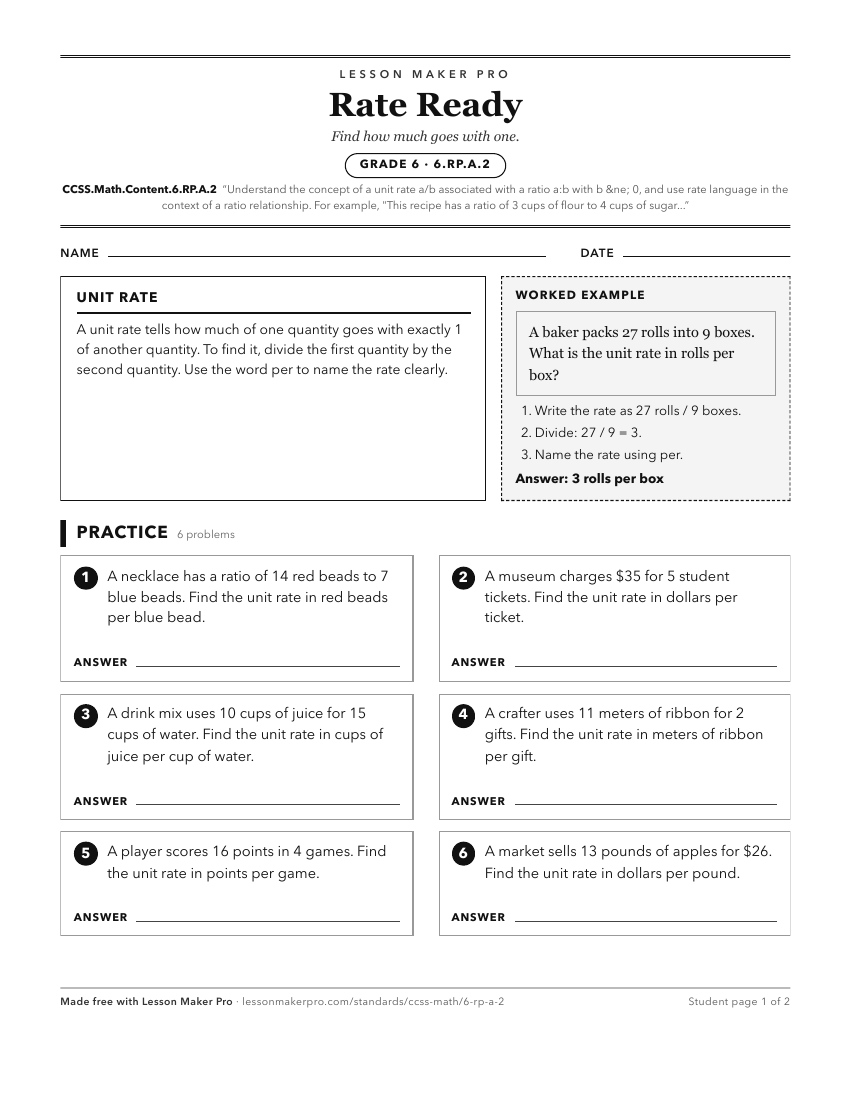
A ready-to-print activity worksheet aligned to CCSS.Math.Content.6.RP.A.2, with an answer key for the teacher on its own page. No account needed.
PDF, US Letter, prints cleanly in black and white.
Download the worksheetLearning progression
Where This Standard Sits
See the whole path on the Ratios & Proportional Relationships progression map.
Before This Standard
If students are struggling here, check these first.
- CCSS.Math.Content.6.RP.A.1
Unit rate requires interpreting a ratio relationship and its language before finding or describing the amount per one unit.
- CCSS.Math.Content.5.NF.B.3
Unit rates use a divided by b, so interpreting fractions as quotients supports finding and explaining per-one amounts.
- CCSS.Math.Content.5.NBT.B.6
Whole-number division strategies support seeing a unit rate as a quotient, though ratio meaning can begin with simpler examples.
What This Unlocks
Mastery here sets students up for these next.
- CCSS.Math.Content.6.RP.A.3b
Students need the meaning of a unit rate, like per one item or per hour, to solve unit pricing and speed problems.
- CCSS.Math.Content.7.RP.A.2d
Interpreting (1, r) on a proportional graph requires knowing that r is the unit rate for one unit of x.
- CCSS.Math.Content.7.RP.A.1
Students must understand unit rate as a per-one ratio before computing unit rates when the ratio quantities are fractions.
- CCSS.Math.Content.7.RP.A.2b
Students must understand unit rate as per-one value before recognizing it as the constant across tables, graphs, equations, and descriptions.
- CCSS.Math.Content.7.RP.A.2c
Writing y = kx depends on understanding k as the unit rate that links each pair of proportional quantities.
- CCSS.Math.Content.6.RP.A.3
Understanding unit rates helps students interpret ratio situations and solve rate problems using tables, diagrams, and equations.
Keep exploring
Related Standards
- CCSS.Math.Content.4.NF.B.4a
Understand a fraction a/b as a multiple of 1/b.
- CCSS.Math.Content.4.NF.B.4b
Understand a multiple of a/b as a multiple of 1/b, and use this understanding to multiply a fraction by a whole number.
- CCSS.Math.Content.4.NF.B.3
Understand a fraction a/b with a > 1 as a sum of fractions 1/b.
Turn this exact standard into a lesson
Grade, subject, topic, and the complete standard are prefilled. Create one free, no account needed.
Also for this standard:Make a WorksheetMake a QuizMake a Sub Lesson