CCSS.
The Standard
Understand p + q as the number located a distance |q| from p, in the positive or negative direction depending on whether q is positive or negative. Show that a number and its opposite have a sum of 0 (are additive inverses). Interpret sums of rational numbers by describing real-world contexts.
Common Core State Standards for Mathematics
Teacher's field guide
What This Standard Means
What Students Need to Do
- Students add positive and negative rational numbers by tracking distance and direction on a number line. They explain how opposite numbers cancel and describe what sums mean in real situations.
What Mastery Looks Like
- Students correctly model a rational-number sum on a number line and state the result. They explain why opposite numbers sum to zero and connect a sum to a matching situation.
Common Misconceptions
- Students may start each move at zero instead of at the first number. They may treat absolute value as the answer’s sign or move left whenever they see a negative anywhere. Some do not recognize that opposite numbers cancel to zero.
How to Assess It
- Give this exit ticket: “Model and solve -3.5 + 1.75 on a number line, then explain why -2.25 + 2.25 equals zero.”
Lesson moves
Ways to Teach It
Tape a number line on the floor, then have students walk sums drawn from fraction and decimal cards.
Ask students to write a short situation represented by -6.5 + 4, then explain what the result means.
Play Target Zero, where pairs choose rational-number cards that combine to reach zero or a teacher-named target.
Track hourly temperature changes and write each new temperature as the previous temperature plus a positive or negative change.
Free download
Printable 7.NS.A.1b Worksheet
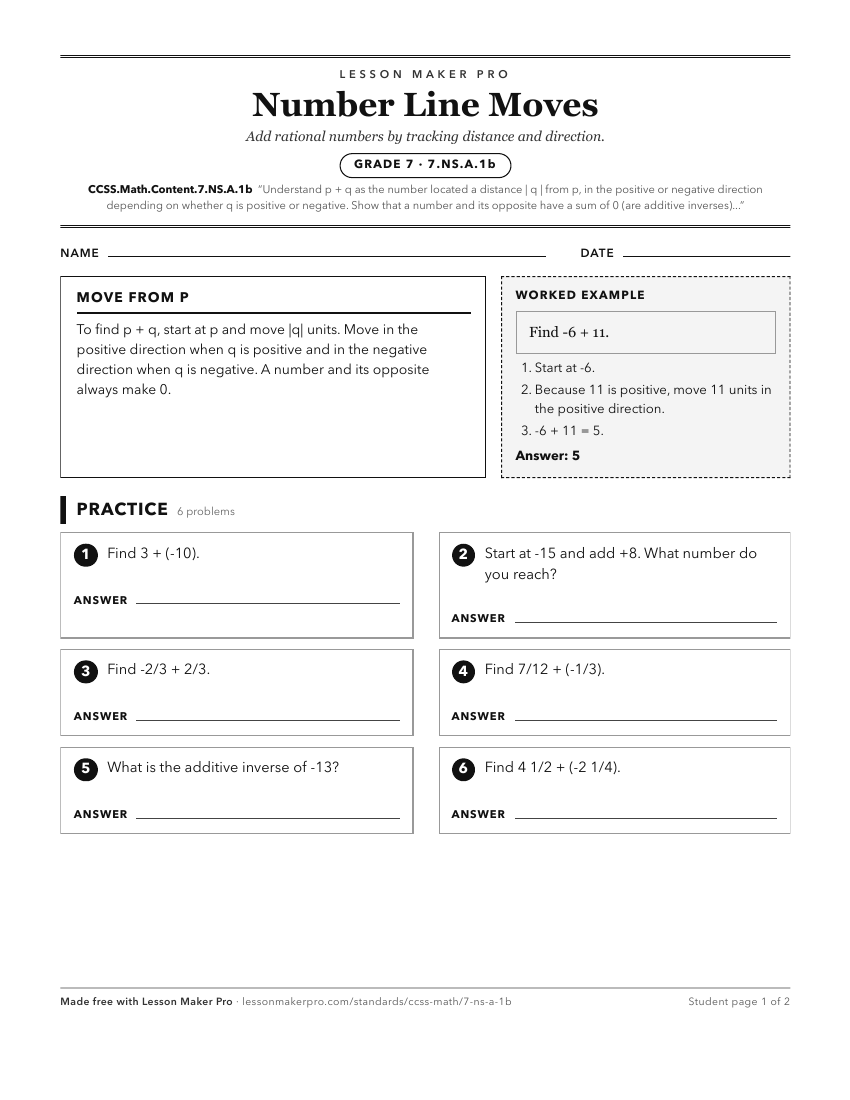
A ready-to-print activity worksheet aligned to CCSS.Math.Content.7.NS.A.1b, with an answer key for the teacher on its own page. No account needed.
PDF, US Letter, prints cleanly in black and white.
Download the worksheetLearning progression
Where This Standard Sits
Before This Standard
If students are struggling here, check these first.
- CCSS.Math.Content.6.NS.C.6
Adding rational numbers as movement from p requires placing positive and negative rational numbers accurately on the number line.
- CCSS.Math.Content.6.NS.C.7c
Understanding absolute value as distance helps students see adding q as moving |q| units in q’s direction on the number line.
- CCSS.Math.Content.6.NS.C.5
Representing positives, negatives, and zero in contexts supports interpreting signed-number sums as directional changes and additive inverses.
What This Unlocks
Mastery here sets students up for these next.
- CCSS.Math.Content.7.NS.A.1d
Understanding rational sums and additive inverses supports using operation properties to add rational numbers and reason about subtraction strategies.
- CCSS.Math.Content.7.NS.A.1c
Subtraction as adding the opposite depends on rational addition, additive inverses, and number-line direction from the earlier standard.
Keep exploring
Related Standards
- CCSS.Math.Content.7.EE.B.4a
Solve word problems leading to equations of the form px + q = r and p(x + q) = r, where p, q, and r are specific rational numbers. Solve equations of these form...
- CCSS.Math.Content.6.EE.B.7
Solve real-world and mathematical problems by writing and solving equations of the form x + p = q and px = q for cases in which p, q and x are all nonnegative r...
- CCSS.Math.Content.7.NS.A.2b
Understand that integers can be divided, provided that the divisor is not zero, and every quotient of integers (with non-zero divisor) is a rational number. If ...
Turn this exact standard into a lesson
Grade, subject, topic, and the complete standard are prefilled. Create one free, no account needed.
Also for this standard:Make a WorksheetMake a QuizMake a Sub Lesson