CCSS.
The Standard
Use geometric shapes, their measures, and their properties to describe objects (e.g., modeling a tree trunk or a human torso as a cylinder).
Common Core State Standards for Mathematics
Teacher's field guide
What This Standard Means
What Students Need to Do
- Students represent everyday objects with familiar two-dimensional figures or three-dimensional solids. They choose useful measurements, use geometric properties, and explain the assumptions behind their model.
What Mastery Looks Like
- Students can model an object with one shape or a combination of shapes, then label the measurements needed for calculations. They can explain why the model is reasonable and where it is limited.
Common Misconceptions
- Students may assume a model must match every detail of an object. They may choose shapes by appearance alone, confuse radius with diameter, or ignore missing measurements and units.
How to Assess It
- Show a picture of a silo. Ask students to sketch a geometric model, label needed measurements, and name one feature their model ignores.
Lesson moves
Ways to Teach It
Give groups cans, cones, boxes, and balls to measure, sketch as geometric solids, and compare each model with the actual object.
Ask students to write which shapes best model a tree trunk, lampshade, and torso, then explain what each model leaves out.
Play a matching game with object cards, solid cards, and measurement cards, requiring students to justify each completed set.
Have students model a storage tank, estimate its capacity from given dimensions, and explain how wall thickness or rounded ends affect the estimate.
Free download
Printable HSG-MG.A.1 Worksheet
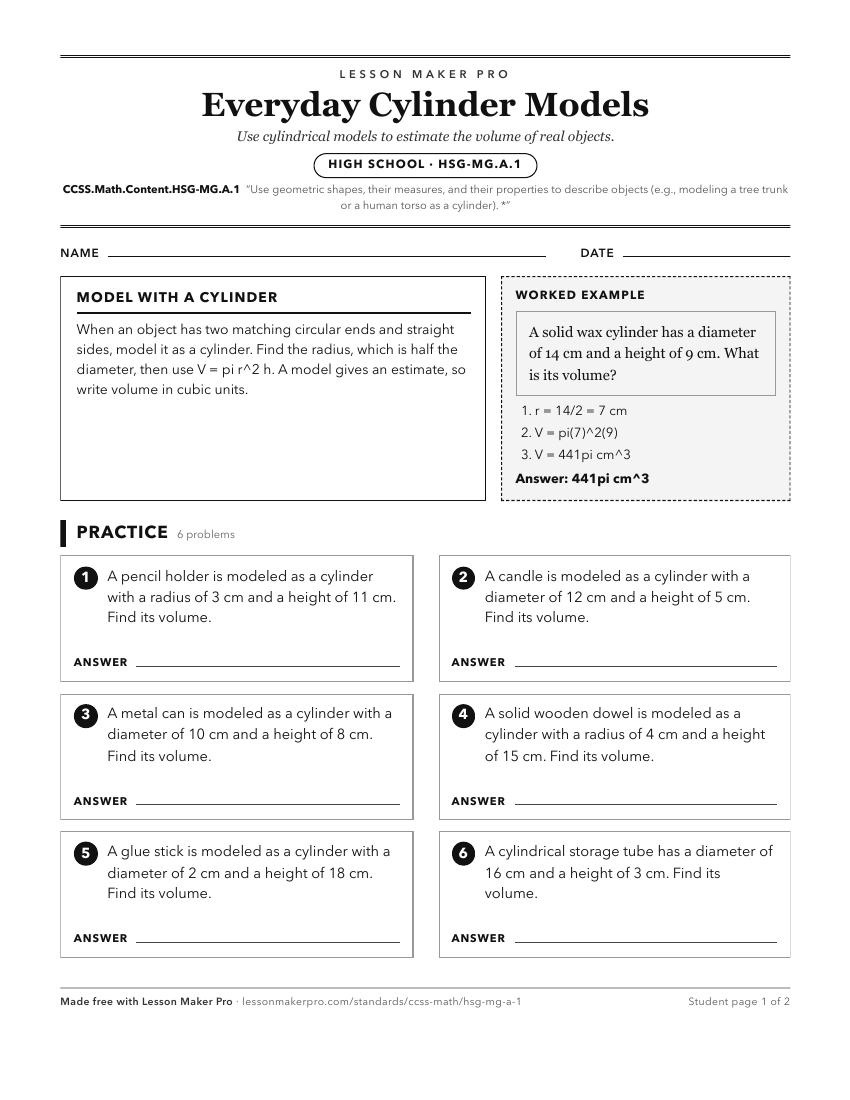
A ready-to-print activity worksheet aligned to CCSS.Math.Content.HSG-MG.A.1, with an answer key for the teacher on its own page. No account needed.
PDF, US Letter, prints cleanly in black and white.
Download the worksheetLearning progression
Where This Standard Sits
Before This Standard
If students are struggling here, check these first.
- CCSS.Math.Content.HSN-Q.A.2
Choosing relevant quantities such as height, radius, or volume supports representing real objects with geometric models and measurements.
- CCSS.Math.Content.HSN-Q.A.1
Choosing consistent units and interpreting measurements supports using geometric dimensions to model real objects with shapes.
- CCSS.Math.Content.7.G.B.6
Area, volume, surface area, and simple composite solids support modeling real objects with measured geometric shapes, though modeling can begin qualitatively.
What This Unlocks
Mastery here sets students up for these next.
- CCSS.Math.Content.HSG-MG.A.3
Describing real objects with geometric models supports using measures and properties to meet design constraints and optimize choices.
- CCSS.Math.Content.HSG-GMD.B.4
Recognizing real objects as cylinders, cones, and other solids supports visualizing their slices and rotations.
Keep exploring
Related Standards
- CCSS.Math.Content.K.G.B.5
Model shapes in the world by building shapes from components (e.g., sticks and clay balls) and drawing shapes.
- CCSS.Math.Content.K.G.B.4
Analyze and compare two- and three-dimensional shapes, in different sizes and orientations, using informal language to describe their similarities, differences,...
- CCSS.Math.Content.HSG-MG.A
Apply geometric concepts in modeling situations
- CCSS.Math.Content.K.G.A
Identify and describe shapes (squares, circles, triangles, rectangles, hexagons, cubes, cones, cylinders, and spheres).
Turn this exact standard into a lesson
Grade, subject, topic, and the complete standard are prefilled. Create one free, no account needed.
Also for this standard:Make a WorksheetMake a QuizMake a Sub Lesson