CCSS.
The Standard
Apply geometric methods to solve design problems (e.g., designing an object or structure to satisfy physical constraints or minimize cost; working with typographic grid systems based on ratios).
Common Core State Standards for Mathematics
Teacher's field guide
What This Standard Means
What Students Need to Do
- Students turn design requirements into labeled diagrams, measurements, and geometric calculations. They test possible designs, check constraints, and explain which option best meets the goal.
What Mastery Looks Like
- Students create a labeled scale drawing or model and use area, volume, similarity, or ratios to test it. They justify why their design meets constraints and improves cost, space, or material use.
Common Misconceptions
- Students may ignore material thickness, scale, units, or required clearances. They may choose the smallest dimensions without checking whether the design still meets every constraint.
How to Assess It
- Give students a 20-by-30-centimeter sheet and ask them to design the largest open-top box, showing dimensions, volume, and constraint checks.
Lesson moves
Ways to Teach It
Build open-top paper boxes from equal sheets, then measure dimensions and compare volumes to find the most efficient design.
Write a recommendation for a wheelchair ramp design, using slope, length, and space limits as evidence.
Run a design challenge where teams revise floor plans to fit required rooms within a fixed area and budget.
Compare two beverage packages by calculating volume and surface area, then decide which uses less material per serving.
Free download
Printable HSG-MG.A.3 Worksheet
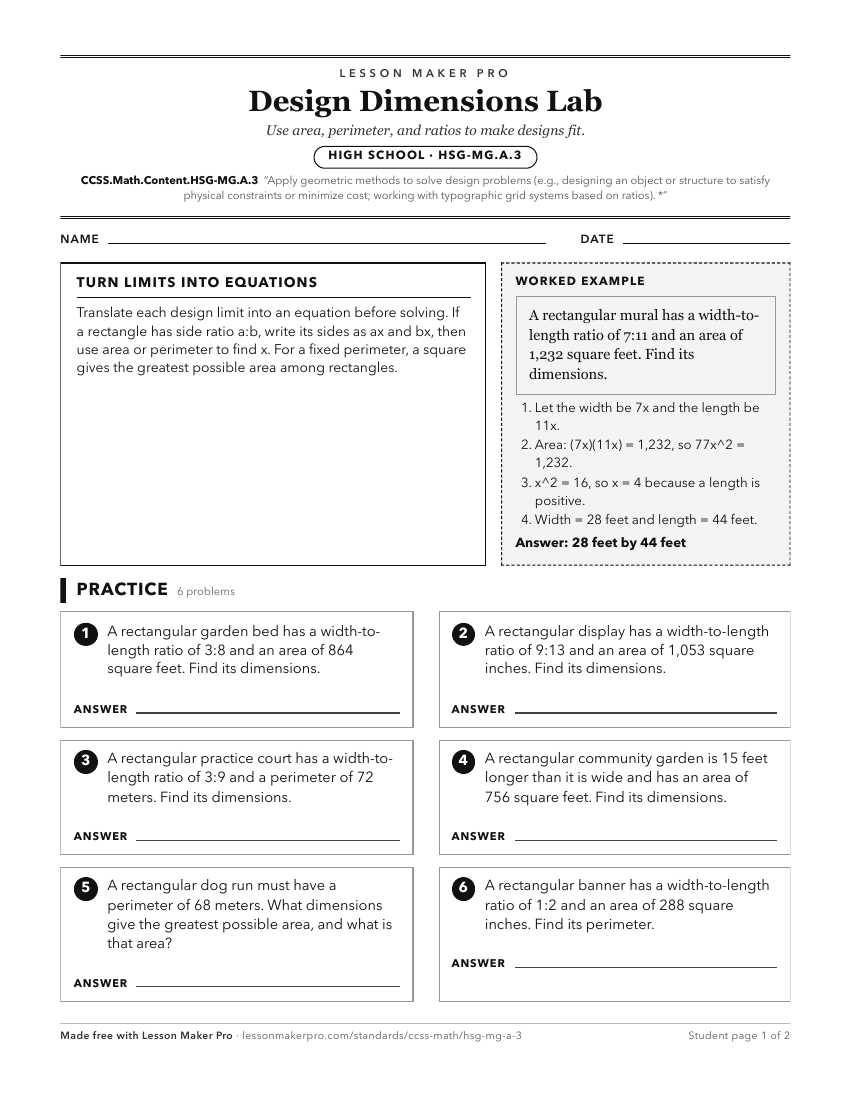
A ready-to-print activity worksheet aligned to CCSS.Math.Content.HSG-MG.A.3, with an answer key for the teacher on its own page. No account needed.
PDF, US Letter, prints cleanly in black and white.
Download the worksheetLearning progression
Where This Standard Sits
Before This Standard
If students are struggling here, check these first.
- CCSS.Math.Content.HSG-MG.A.1
Describing real objects with geometric models supports using measures and properties to meet design constraints and optimize choices.
- CCSS.Math.Content.HSN-Q.A.2
Choosing relevant quantities, units, and constraints supports setting up geometric design models to meet limits or minimize cost.
- CCSS.Math.Content.HSA-CED.A.3
Representing constraints and judging viable solutions supports geometric design tasks with physical limits, costs, and ratio requirements.
Keep exploring
Related Standards
- CCSS.Math.Content.HSG-CO.D
Make geometric constructions
- CCSS.Math.Content.HSG-CO.D.12
Make formal geometric constructions with a variety of tools and methods (compass and straightedge, string, reflective devices, paper folding, dynamic geometric ...
- CCSS.Math.Content.HSG-MG.A
Apply geometric concepts in modeling situations
Turn this exact standard into a lesson
Grade, subject, topic, and the complete standard are prefilled. Create one free, no account needed.
Also for this standard:Make a WorksheetMake a QuizMake a Sub Lesson